After enough of these engagements, you start to see the same shape in every one. An enterprise wants to adopt AI, or sell it, and everyone agrees it has to be “trustworthy” — but nobody can say exactly what that means or how you’d prove it. So trust gets handled ad hoc: a scan here, a policy doc there, a nervous email to legal. It works right up until a regulator or a big customer asks, “show me,” and there’s nothing solid to show.
I’m Anand, one of the co-founders of AramGRC. Over dozens of assurance projects across the US and India, we’ve distilled what actually works into a single framework — a repeatable way to build, and prove, trust in AI. This is that framework, laid out end to end, with links to the deeper guides on each piece.
Why trust in AI needs a framework
Trust doesn’t scale on good intentions. If every AI system is governed differently and every customer question is answered from scratch, you’ll always be one tough procurement review away from a stalled deal. A framework turns trust into something repeatable: the same layers, the same evidence, every time — so you can answer “is this AI safe and compliant?” the same confident way for the tenth system as for the first.
Key takeaway
Trustworthy AI isn’t a feeling or a slogan — it’s a stack of evidence. A framework is how you produce that evidence on demand.
The AramGRC third-party AI assurance framework
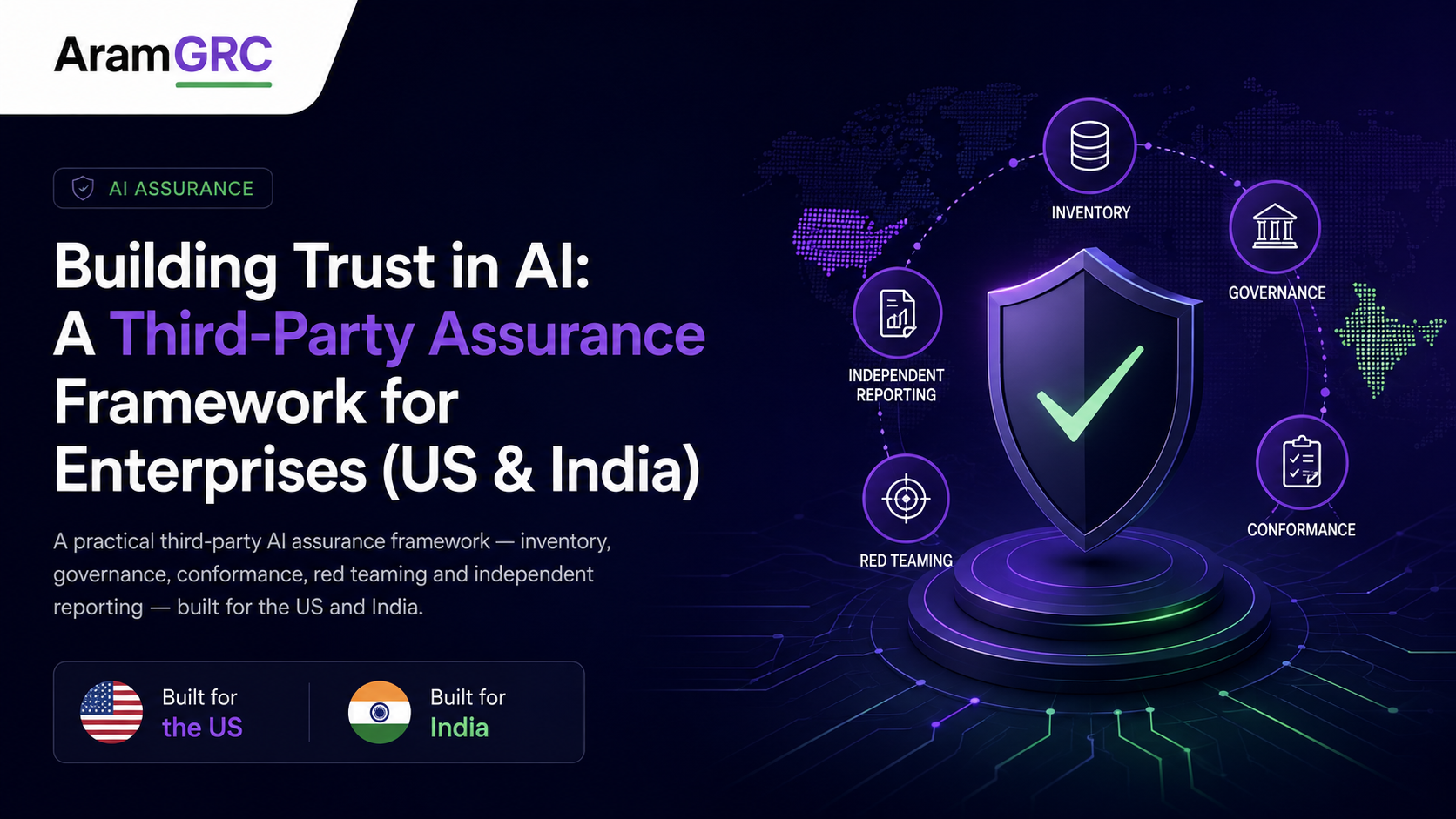
We think of assurance in five layers. Each answers a different question a buyer, board or regulator will ask, and each builds on the one before.
| Layer | The question it answers | What it produces |
|---|
| 1. Inventory & classification | What AI do we have, and how risky is each system? | An AI inventory with risk tiers |
| 2. Governance | Do we manage AI responsibly and repeatably? | An ISO/IEC 42001 management system |
| 3. Regulatory conformance | Do we meet the laws that apply to us? | EU AI Act, DPDP and NIST alignment |
| 4. Technical assurance | Does the AI actually hold up under attack? | Red-team, security and bias testing |
| 5. Independent reporting | Can we prove all of the above to outsiders? | A report buyers and regulators trust |
Layer 1 — Inventory and classification
You can’t govern what you can’t see. Start with an inventory of every AI system, model and dataset, and classify each by risk. This is what makes everything else tractable — and it’s the first thing a serious AI audit checks.
Layer 2 — Governance
On top of the inventory sits a management system: policies, roles, risk and impact assessments, human oversight, and lifecycle controls. The global standard for this is ISO/IEC 42001, and independent certification is what turns “we govern AI well” into something a buyer will believe — as I explain in ISO/IEC 42001 assurance.
Layer 3 — Regulatory conformance
Next, map your AI to the laws that apply. For European exposure that means the EU AI Act conformity assessment; in India it means the DPDP Act and MeitY guidance, which I cover in AI assurance for Indian AI companies; and the NIST AI RMF is the common reference in the US. The point is to know which rules bind each system, and to hold the evidence.
Layer 4 — Technical assurance
Governance proves you manage AI well; it doesn’t prove a model won’t be jailbroken. That’s what testing is for. Independent AI red teaming — and for language models specifically, LLM red teaming — stresses the system the way a real adversary would. It’s worth understanding how this differs from a pen test or an audit, which I break down in AI penetration testing vs red teaming vs audit.
Layer 5 — Independent reporting
Finally, the evidence has to travel. Every layer produces documentation, but it only becomes assurance when an independent party attests to it in a report a customer’s risk committee or a regulator can rely on. Why independence is non-negotiable is the subject of third-party AI assurance — and if you’re choosing who does the testing, how to choose an AI red teaming partner is the checklist to use.
Key takeaway
Governance without testing is paperwork; testing without governance is a stunt; neither is assurance until an independent report ties them together.
How the framework works across the US and India
The five layers are universal, but the regulatory layer flexes by geography. A company selling in both markets runs one governance system and one testing programme, then maps the evidence to each regime:
- United States — the NIST AI RMF as the common language, plus sector and state rules.
- European Union — EU AI Act obligations for your risk tier (relevant to anyone with EU users).
- India — the DPDP Act and MeitY guidelines, with ISO/IEC 42001 increasingly expected.
Build the stack once; present the slice each customer or regulator asks for. That’s the efficiency the framework buys you.
Applying the framework: where to start
- Start with Layer 1 — get the inventory and risk classification done. It’s fast and it unlocks everything else.
- Fix the highest-risk systems first — don’t boil the ocean.
- Stand up governance (Layer 2) toward ISO/IEC 42001 in parallel.
- Bring in independent testing (Layer 4) before your first big enterprise deal or high-stakes launch.
- Produce the report (Layer 5) proactively, so the security questionnaire is a formality, not a fire drill.
Common mistakes I see
- Buying a tool and calling it assurance. Tools are Layer 4 inputs, not the whole stack.
- Governance with no testing. A beautiful policy binder that’s never been stress-tested.
- Testing with no independence. Your own team, your own tools, a green dashboard nobody external will trust.
- Waiting for a deadline or a deal to start. The evidence takes longer to build than the paperwork suggests.
How we help at AramGRC
AramGRC is built to run this framework end to end for AI companies in India and the US: AI inventory and classification, ISO/IEC 42001 governance, EU AI Act and DPDP conformance, independent AI red teaming, and the assurance report your customers and regulators actually trust. You get one partner across all five layers, and one coherent body of evidence instead of a drawer full of disconnected PDFs.
Ready to make your AI provably trustworthy?
We’ll run the full assurance framework — inventory, governance, conformance, red teaming and independent reporting — and give you evidence your customers and regulators trust. For enterprises in the US and India.
Talk to the AramGRC team
Frequently asked questions
What is an AI assurance framework?
An AI assurance framework is a repeatable structure for building and proving trust in AI. A practical one has five layers: inventory and risk classification, governance (ISO/IEC 42001), regulatory conformance (EU AI Act, DPDP, NIST), technical assurance (red teaming and security testing), and independent reporting — each producing evidence a buyer or regulator can rely on.
How do you build trust in AI at enterprise scale?
By turning trust into evidence: inventory and classify your AI, govern it with a management system, map it to the regulations that apply, test it independently with red teaming, and capture it all in an independent report. A framework makes this repeatable across every system rather than ad hoc.
What’s the difference between AI governance and AI assurance?
AI governance is how you manage AI responsibly inside your organisation; AI assurance is the independent evidence that proves it to outsiders. Governance is a layer of the assurance framework; assurance is the trust the whole stack produces.
Does the same framework work for both the US and India?
Yes. The layers are universal; only the regulatory layer changes — NIST AI RMF in the US, the EU AI Act for European exposure, and the DPDP Act and MeitY guidance in India. You build the governance and testing once and map the evidence to each regime.
Where should an enterprise start?
Start with an AI inventory and risk classification — it’s quick and unlocks everything else — then fix the highest-risk systems, stand up ISO/IEC 42001 governance in parallel, and bring in independent testing before your first major deal or high-stakes launch.
About the author
Anand — Co-founder, AramGRC. AramGRC is an independent, India-first AI assurance partner. We help AI companies in India and the US build trust in AI end to end — inventory and governance, EU AI Act, ISO/IEC 42001 and DPDP conformance, and independent AI red teaming and assurance reporting.