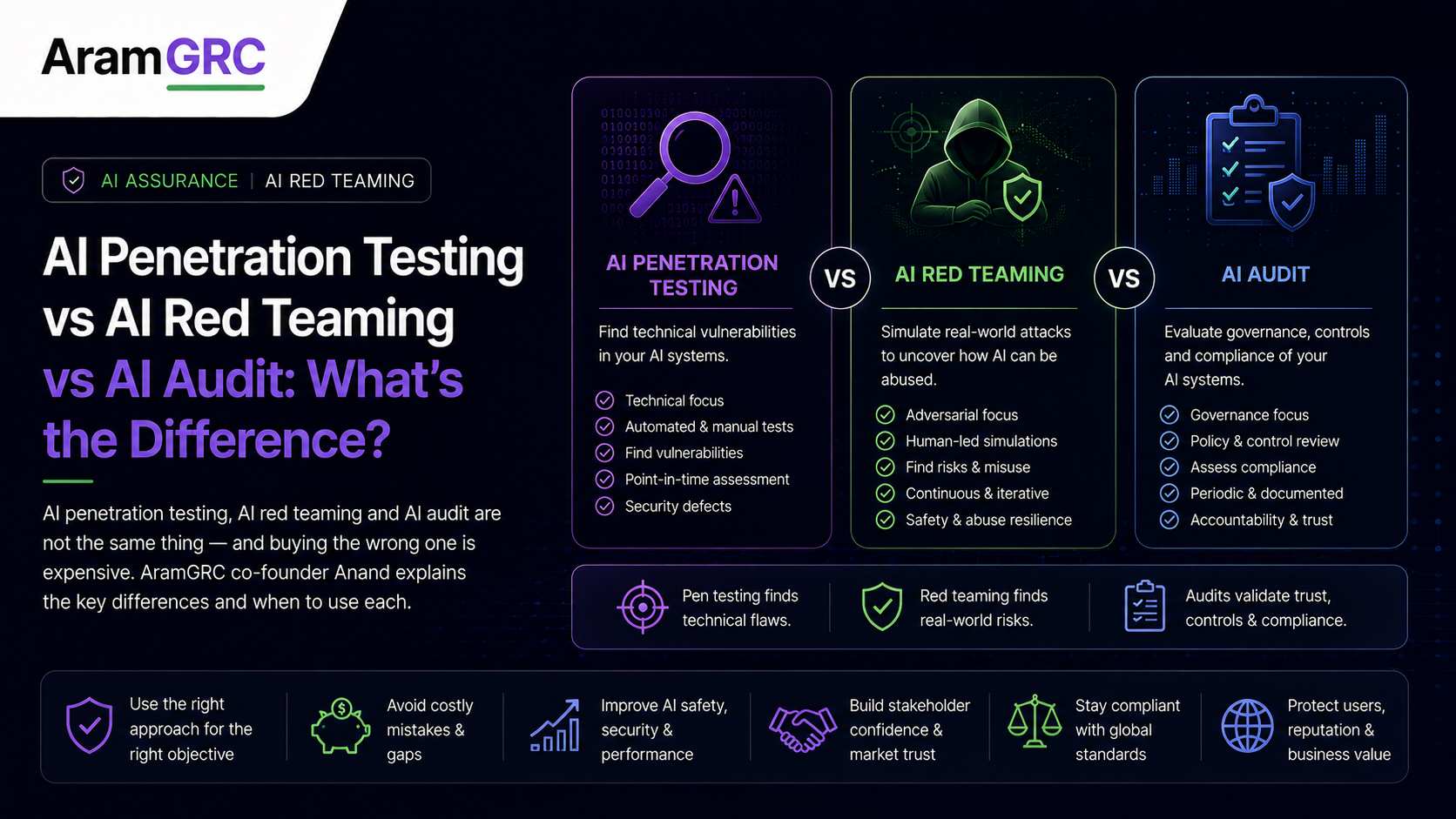
“We already did a penetration test — isn’t that the same thing?” I get some version of this question almost every week. A founder wants their AI checked, a buyer is asking for “an assessment,” a board member says “get it audited,” and everyone assumes these words mean the same thing. They don’t. And the confusion is expensive: I’ve watched teams pay for a penetration test when they needed a red team, or commission a red team when what the customer actually wanted was an audit against a standard.
I’m Anand, one of the co-founders of AramGRC. Let me clear this up once, in plain language: what AI penetration testing, AI red teaming and AI audit each actually are, how they overlap, and how to know which one you need.
The short answer
Penetration testing asks “can I break into the system?” Red teaming asks “can I make the AI misbehave, however I can?” An audit asks “does this AI meet a defined standard, and can you prove it?” One is about technical security, one is about adversarial behaviour, one is about governance and conformance. They overlap, they complement each other, and serious AI programmes end up needing all three — but for different reasons and at different moments.
Key takeaway
Pen testing = break in. Red teaming = make it misbehave. Audit = prove it meets the standard. Different questions, different evidence.
The three, side by side
| AI penetration testing | AI red teaming | AI audit |
|---|
| Core question | Can an attacker exploit the system? | Can the AI be made to behave unsafely, unfairly or insecurely? | Does the AI meet a defined standard, with evidence? |
| Focus | Technical vulnerabilities in the app, APIs and infrastructure | Adversarial behaviour of the whole AI system (model + data + tools + agents) | Governance, controls, documentation and compliance |
| Approach | Find and exploit known vulnerability classes | Creative, worst-case, goal-driven adversarial testing | Structured examination against a framework |
| Measured against | Security best practice (e.g. OWASP) | Threat model + real-world misuse | A standard: ISO/IEC 42001, EU AI Act, NIST AI RMF |
| Typical output | A list of vulnerabilities with severities | Findings, exploit narratives, evidence and remediation | A conformance report: what’s met, what’s a gap, evidence |
| Best when | Securing the application and infrastructure layer | Shipping high-stakes or customer-facing AI | Certifying, or proving compliance to buyers/regulators |
What is AI penetration testing?
AI penetration testing is a security exercise: a tester tries to find and exploit technical vulnerabilities in your AI application and the infrastructure around it — the APIs, authentication, access controls, dependencies and the stack the model runs on. It borrows directly from traditional pen testing, extended to AI-specific surfaces like model endpoints and inference APIs. The goal is concrete: get in, escalate, exfiltrate. The output is a list of vulnerabilities, each with a severity and a fix. It answers “is this system secure?” — but it doesn’t tell you much about how the AI behaves once someone is simply talking to it as intended.
What is AI red teaming?
AI red teaming is broader and more behavioural. Instead of hunting only for technical exploits, a red team acts like a motivated adversary — or an unlucky, creative user — and tries to make the AI itself do the wrong thing: jailbreaks, prompt injection (including instructions hidden in documents it reads), leaking sensitive data, generating harmful content, biased decisions, or an agent being talked into an action it shouldn’t take. It tests the whole system — model, prompts, retrieved data, tools and human process — and the most serious findings come from chaining small issues into a real exploit. The output is a report with findings, reproduction steps, evidence and remediation. Red teaming answers “what is the worst this AI can be made to do?”
What is an AI audit?
An AI audit is an assessment against a defined standard or framework — ISO/IEC 42001, the EU AI Act, or the NIST AI Risk Management Framework. Rather than attacking the system, an audit examines whether you have the right governance, controls, documentation and processes in place, and whether there’s evidence to prove it. It looks at your AI inventory, risk assessments, human oversight, logging, and how you manage the AI lifecycle. The output is a conformance report: what you meet, where the gaps are, and the evidence behind each conclusion. An audit answers “does this AI, and the way you run it, meet the bar — and can you prove it to a regulator or customer?”
How they overlap (and work together)
These aren’t competitors; they’re layers. A thorough programme uses all three, and they feed each other:
- Penetration testing secures the technical foundation the AI runs on.
- Red teaming stresses the AI’s behaviour on top of that foundation.
- An audit checks that the governance around it all holds up — and often uses red-team and pen-test results as evidence that controls actually work.
An audit that ticks “we test for adversarial robustness” is far more credible when there’s a real red-team report behind that tick. And a red team is more valuable when its findings are mapped back to the standards an audit cares about. This is exactly why the umbrella term matters: AI assurance is the outcome of combining these — independent, documented confidence that your AI is safe, fair and compliant.
Which one do you actually need?
- Securing the app, APIs and infrastructure → start with AI penetration testing.
- Shipping a customer-facing or high-stakes AI feature (an LLM app, an agent, a decision model) → you need AI red teaming.
- Pursuing ISO/IEC 42001, preparing for the EU AI Act, or answering a customer’s “prove you’re compliant” → you need an AI audit.
- Selling AI into enterprises or regulated industries → you’ll likely need all three over time, with red teaming and an audit as the headline evidence buyers ask for.
If you only do one thing before shipping AI that real people or money depend on, make it red teaming — it’s the test most closely tied to how your AI will actually fail in the wild.
How we think about it at AramGRC
We’re an independent AI assurance partner, which means we sit across all three: AI red teaming for how your AI behaves, security testing for the layer it runs on, and audit/assessment against ISO/IEC 42001, the EU AI Act and NIST AI RMF — for AI product companies in India and the US. The point isn’t to sell you three things; it’s to give you the right evidence for the question you’re actually being asked.
Not sure which one you need?
Tell us what you’re shipping and who’s asking — we’ll help you scope the right mix of red teaming, security testing and audit. For AI companies in India and the US.
Talk to the AramGRC team
Frequently asked questions
What is the difference between AI red teaming and AI penetration testing?
AI penetration testing looks for technical vulnerabilities in the application and infrastructure — can an attacker break in? AI red teaming is broader and behavioural — can the AI itself be made to misbehave through jailbreaks, prompt injection, data leakage, bias or tool abuse, across the whole system, not just the code.
Is an AI audit the same as AI red teaming?
No. An AI audit assesses whether your AI and its governance meet a defined standard (ISO/IEC 42001, EU AI Act, NIST AI RMF), with evidence. Red teaming actively attacks the AI to find how it fails. An audit checks conformance; red teaming often provides the evidence an audit relies on.
Do I need all three?
Not always at once, but mature AI programmes use all three: penetration testing for the technical layer, red teaming for the AI’s behaviour, and an audit for governance and compliance. Which you need first depends on whether your priority is security, safety, or proving compliance.
Which comes first — red teaming or an audit?
It depends on the driver. If you’re about to ship a high-stakes AI feature, red teaming comes first. If a customer or regulator is asking you to prove compliance with a standard, the audit is the priority — though a good audit will expect red-team evidence.
What is AI assurance, and how does it relate to these?
AI assurance is the umbrella outcome: independent, documented confidence that an AI system is safe, fair and compliant. Penetration testing, red teaming and audit are methods that feed into assurance; assurance is the trust and evidence they produce together.
About the author
Anand — Co-founder, AramGRC. AramGRC is an independent AI assurance partner. We help AI product companies in India and the US prove their systems are safe and trustworthy through AI red teaming, security testing and assurance reporting aligned to ISO/IEC 42001, the EU AI Act and NIST AI RMF.