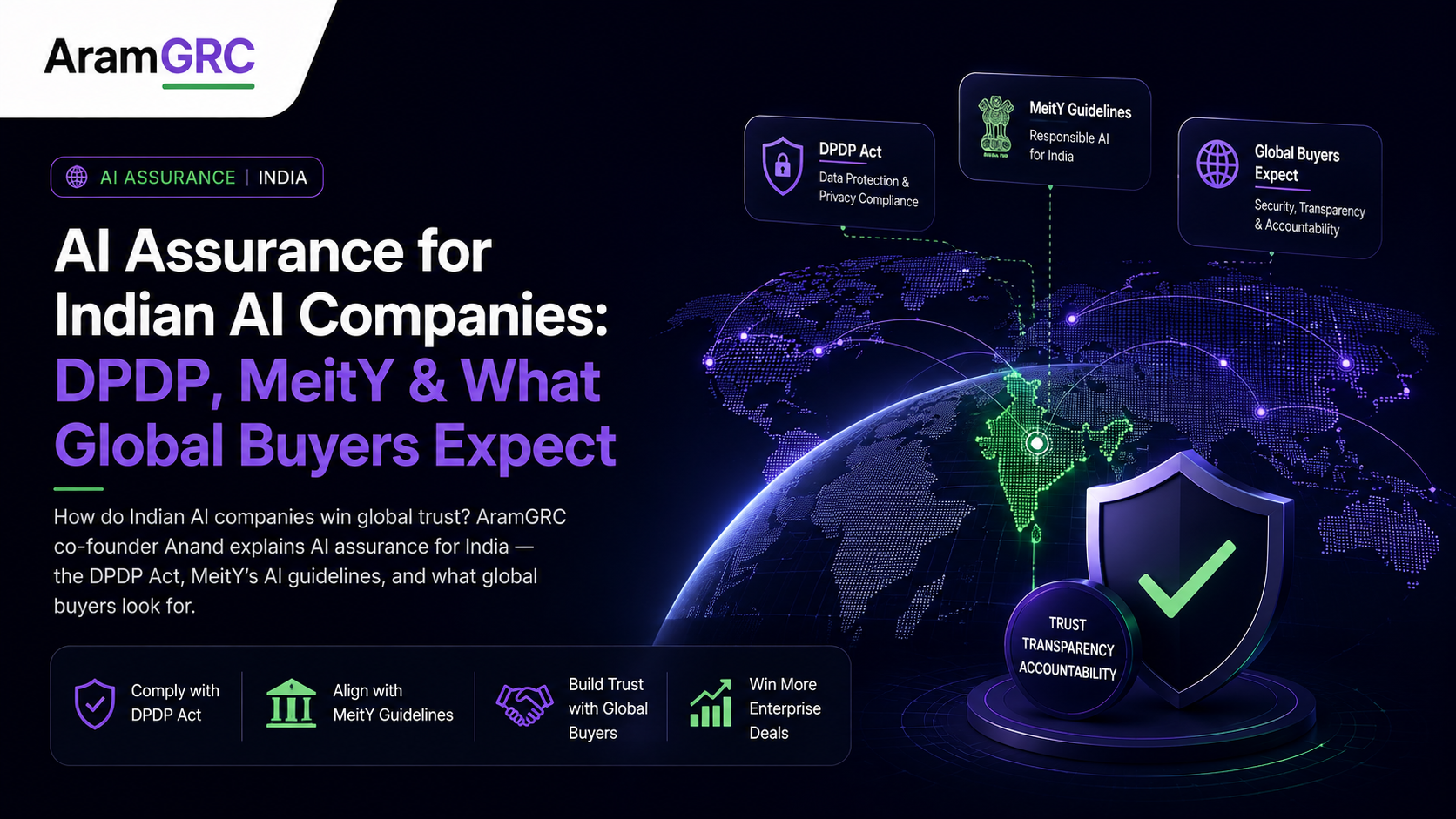
A Bengaluru founder I know almost lost a US enterprise deal at the finish line. The product was excellent, the price was right, and then the customer’s security team sent the questionnaire: “How is your AI governed? Has it been independently tested? Are you compliant with data-protection law?” He had good answers in his head and nothing on paper. The deal slipped two quarters while he scrambled to produce evidence he could have prepared in advance.
I’m Anand, one of the co-founders of AramGRC, and this is the story of Indian AI right now: the engineering is world-class, but the assurance — the proof that an AI system is safe, well-governed and compliant — is often the missing piece that decides global deals. This is a practical guide to AI assurance for Indian AI companies: the Indian rules you must meet, and the very different bar that US and EU buyers hold you to.
Two clocks are running for Indian AI companies
If you build AI in India and sell it anywhere serious, you’re being judged on two fronts at once. Domestically, India’s own AI and data-protection regime is taking shape. Internationally, your customers in the US and EU expect independent proof of safety and governance before they buy. Meeting one does not satisfy the other — and the companies pulling ahead prepare for both together.
Key takeaway
For an India-first AI company selling globally, “we follow Indian law” and “we’ve been independently assured” are two different promises. Global buyers want both.
The Indian layer: DPDP, MeitY and sectoral rules
Start at home. The pieces every Indian AI company should understand:
- The DPDP Act (Digital Personal Data Protection Act) and the draft DPDP Rules 2025 — India’s data-protection law. If your AI processes personal data, this governs consent, purpose limitation, security safeguards and breach response. Larger or higher-risk players can be classified as a Significant Data Fiduciary, which brings extra duties like data protection impact assessments and audits.
- MeitY’s AI governance guidelines — India’s emerging, principles-based direction for responsible AI, emphasising safety, accountability and transparency rather than a single prescriptive rulebook.
- Sectoral expectations — the RBI on model risk in finance, SEBI on AI in the markets, and IRDAI on AI in insurance. If you sell into those sectors, their guidance applies on top of the general rules.
- ISO/IEC 42001 — the global AI management system standard, being adopted in India too, and increasingly the way to demonstrate mature AI governance.
(This is general information, not legal advice — confirm your specific obligations, and the current status of the DPDP Rules, with qualified counsel.)
The global layer: what US and EU buyers actually expect
Here’s what I see land in the questionnaires from overseas customers, regardless of Indian law:
- Independent testing. “Has a third party red-teamed or tested this AI, and can we see the report?” A self-assessment doesn’t count.
- Recognised governance. ISO/IEC 42001 certification, or clear evidence of an AI management system.
- EU AI Act readiness. If they or their users are in Europe, they’ll ask whether you’ve classified your system and can meet the relevant obligations.
- Security and data assurance. SOC 2-style evidence, data-handling commitments, and clarity on where data goes.
For a US or EU buyer, “we comply with India’s DPDP Act” is reassuring but not sufficient — they map you to the standards and regulations they answer to.
Key takeaway
Indian AI companies win global deals on evidence, not intentions. The vendors who prepare independent assurance up front skip months of procurement friction.
The assurance stack for an India-first company selling globally
Put together, a strong, deal-ready posture looks like this:
| Layer | What it proves | Who asks for it |
|---|
| DPDP / Indian compliance | You handle personal data lawfully in India | Indian regulators, Indian enterprise buyers |
| ISO/IEC 42001 | You govern AI with a mature, audited management system | Global enterprise buyers |
| EU AI Act readiness | You can meet European obligations for your risk tier | EU-facing customers and users |
| Independent AI red teaming | Your AI actually withstands adversarial testing | Security teams everywhere |
You don’t need all of it on day one — but you should know which layer each customer is really asking about, and build the evidence in the order your market demands.
A practical roadmap
- Map your data and AI: what personal data you process (for DPDP) and which AI systems you run (for governance).
- Close the DPDP basics: consent, security safeguards, breach response, and DPIAs if you’re a Significant Data Fiduciary.
- Stand up AI governance toward ISO/IEC 42001 — inventory, risk and impact assessments, human oversight, documentation.
- Get independent testing: an AI red team and assurance report you can hand to overseas buyers.
- Prepare an EU AI Act classification if you have any European exposure.
Do this proactively and the security questionnaire becomes a formality instead of a fire drill.
How we help at AramGRC
AramGRC is built India-first for exactly this. We help Indian AI companies get DPDP-ready, stand up ISO/IEC 42001 governance, prepare for the EU AI Act, and — crucially — produce the independent AI red-teaming and assurance reports that US and EU buyers ask for. The goal is simple: make sure the next time a global customer sends the questionnaire, you already have the answers on paper.
Selling Indian-built AI to global customers?
We’ll get you DPDP-ready, ISO 42001-aligned and independently assured — so the security questionnaire becomes a formality. Built India-first, for buyers everywhere.
Talk to the AramGRC team
Frequently asked questions
What is the DPDP Act?
The Digital Personal Data Protection (DPDP) Act is India’s data-protection law. If your AI processes personal data, it governs consent, purpose limitation, security safeguards and breach response, with additional duties (like impact assessments and audits) for organisations classified as Significant Data Fiduciaries. The DPDP Rules 2025 add operational detail.
What do global buyers expect from Indian AI vendors?
Independent testing (a third-party red team or assurance report they can see), recognised governance such as ISO/IEC 42001, EU AI Act readiness if they have European exposure, and security/data-handling evidence. Compliance with Indian law alone is reassuring but usually not sufficient for US and EU buyers.
Does India have AI regulation?
India has taken a principles-based direction through MeitY’s AI governance guidelines, alongside the DPDP Act for personal data and sectoral guidance from regulators like the RBI, SEBI and IRDAI, rather than a single omnibus AI law. ISO/IEC 42001 is increasingly used to demonstrate responsible AI governance.
Is ISO/IEC 42001 relevant for Indian AI companies?
Yes. ISO/IEC 42001 is the global AI management system standard and is being adopted in India too. For Indian companies selling to global enterprises, certification is one of the clearest ways to prove mature AI governance.
Do Indian AI companies need to comply with the EU AI Act?
If your AI system’s output is used in the EU, the EU AI Act can apply regardless of where your company is based — the same extraterritorial logic as the GDPR. Indian AI companies with any European users or customers should classify their systems and prepare accordingly.
What is a Significant Data Fiduciary?
Under the DPDP Act, a Significant Data Fiduciary is an organisation designated as higher-risk based on factors like the volume and sensitivity of personal data it processes. Such organisations carry extra obligations, including data protection impact assessments and independent audits.
About the author
Anand — Co-founder, AramGRC. AramGRC is an India-first AI assurance partner. We help AI product companies in India and the US get DPDP-ready, stand up ISO/IEC 42001 governance, prepare for the EU AI Act, and prove their AI is trustworthy through independent AI red teaming and assurance reporting.