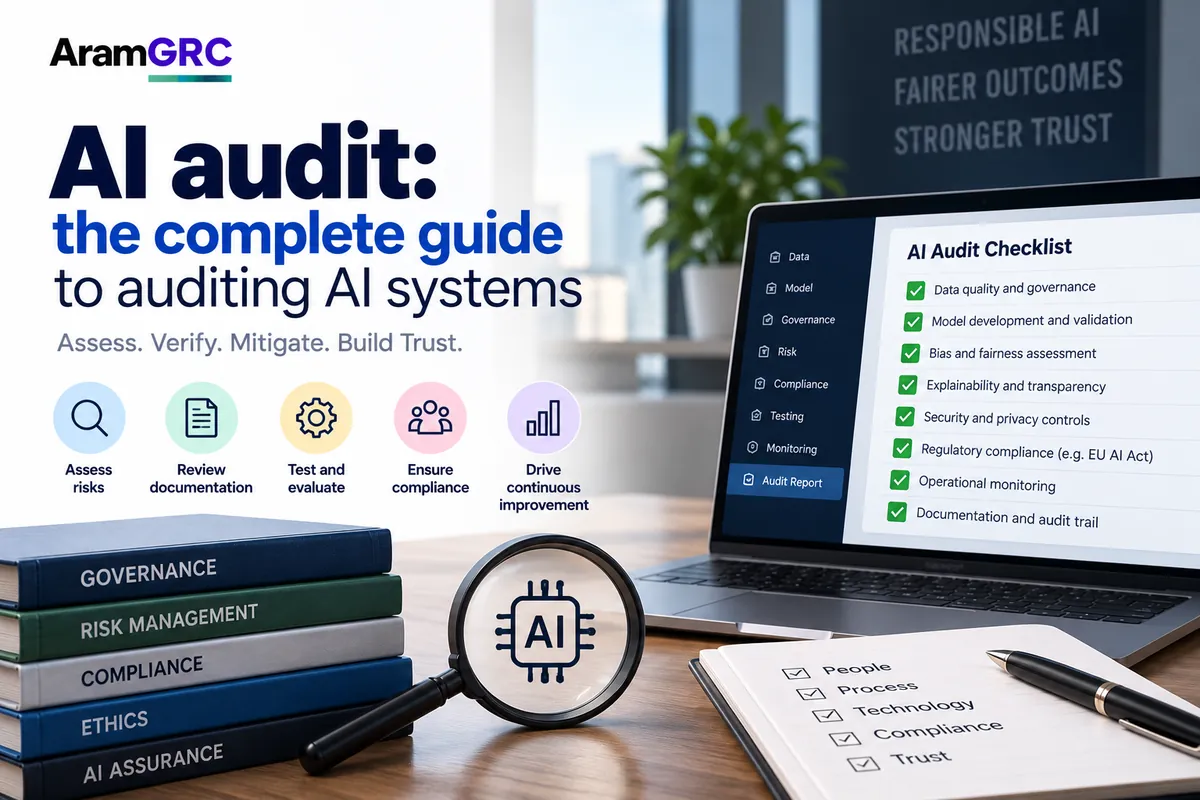
AI audit: the complete guide to auditing AI systems
An AI audit is how you prove — independently and with evidence — that an AI system is safe, fair, compliant and governed. As AI moves into decisions that affect people, and as regulators and enterprise buyers start asking for proof, the AI audit is becoming a core business requirement. This guide explains what an AI audit is, the types, the process, what a good report contains, and when you need one, with deep-dive links to each topic. It pairs with our guides to AI governance and ISO 42001 certification.
AramGRC Team·AI Audit & Assurance·September 11, 2026·13 min read
What is an AI audit?
An AI audit is an independent, evidence-based examination of an AI system — or an organisation's AI practices — against a defined standard, such as ISO/IEC 42001, the EU AI Act, or an internal AI policy. Its purpose is to verify, objectively, that the system does what it claims: that it is safe, fair, lawful and under proper control — and to document any gaps. Where a data scientist builds and improves a model, an AI auditor independently checks it, which is why independence is the defining feature of a credible audit.
An AI audit at a glance
What it is: — an independent examination of an AI system against a standard or control set.
What it checks: — performance, bias and fairness, robustness, data quality, explainability, human oversight, security and governance.
What it produces: — a report with findings, severity ratings, evidence and a remediation roadmap — and, where appropriate, an independent attestation.
Who needs one: — organisations deploying AI in decisions that affect people, and AI vendors whose buyers demand proof.
Why now: — the EU AI Act, ISO/IEC 42001 and India's DPDP and RBI expectations increasingly require independent evidence.
Why AI audits matter now
Three forces have turned AI audits from optional to expected:
Regulation. — The EU AI Act requires conformity assessments for high-risk systems; ISO/IEC 42001 requires internal audits; India's DPDP Act and RBI's FREE-AI framework expect assurance over automated systems.
Procurement. — Enterprise buyers increasingly ask vendors to prove their AI is governed before signing — often with an independent audit report.
Risk. — A biased or unsafe model discovered by a regulator or a journalist is far more expensive than one caught by an auditor before launch.
Types of AI audit
Not all AI audits are the same. The main types:
Governance audit — reviews your AI management system, policies, roles and controls (the ISO/IEC 42001 lens).
Model / technical audit — examines a specific system for performance, bias, robustness and explainability.
Compliance audit — checks a system against a regulation such as the EU AI Act or a sector rule.
Third-party / vendor audit — independently assesses AI you buy, before a deal or renewal. See third-party AI audit.
What an AI audit covers
A thorough AI audit examines a system across several dimensions: its performance against intended use; bias and fairness across affected groups; data quality, representativeness and lawful basis; robustness and security against adversarial inputs and drift; explainability appropriate to the use; human oversight and escalation; and the governance around it — ownership, monitoring and incident handling.
The AI audit process
An audit runs from scoping and evidence-gathering through testing and gap analysis to a report and remediation roadmap. We walk the full sequence in how to audit an AI system, and give you a practical AI audit checklist.
AI audit frameworks and standards
An audit is only as good as the benchmark it's measured against. The main references are ISO/IEC 42001 (the AI management system standard), the EU AI Act's requirements for high-risk systems, and the NIST AI Risk Management Framework. We cover how to structure one in AI audit framework.
What a good AI audit report contains
A credible report is more than a pass/fail. It states the scope and standard, sets out findings with severity ratings and the evidence behind them, gives a prioritised remediation roadmap, and — where warranted — an independent attestation you can share with customers, partners and regulators. For a deeper look at report contents, see our companion post, what is an AI audit.
Internal vs third-party AI audit
An internal audit is essential for continuous improvement, but external stakeholders — buyers, boards and regulators — rarely accept self-assessment. That's where an independent, third-party AI audit comes in: an objective examination and a report someone else will trust.
AI audit vs AI assurance vs AI red teaming
These overlap but differ. An AI audit examines a system against a standard and issues findings. AI assurance is the broader activity of providing independent evidence and confidence over an AI system. AI red teaming is adversarial testing that tries to break the system. A strong assurance programme uses all three — see our guide to AI red teaming.
The AI auditor
Behind every audit is an AI auditor — a professional who combines an understanding of AI and ML with knowledge of the standards and the ability to test for bias, robustness and control. See AI auditor: role, skills and certification.
Key takeaways
An AI audit is an independent, evidence-based check that an AI system is safe, fair, compliant and governed.
The main types are governance, model/technical, compliance and third-party audits.
A good report gives findings, severity, evidence, a remediation roadmap and, where warranted, an attestation.
Audits are increasingly required by the EU AI Act, ISO/IEC 42001 and India's DPDP and RBI expectations.
Independence is what makes an audit credible to buyers, boards and regulators.
How AramGRC helps
AramGRC provides independent AI audit services — ISO/IEC 42001 internal audits, EU AI Act conformity audits, third-party vendor AI audits, and independent assurance attestation. You get an auditor's report you can act on and, where warranted, shareable proof of trustworthy AI. See third-party AI assurance.
Frequently asked questions
What is an AI audit?+
An independent, evidence-based examination of an AI system against a defined standard — like ISO 42001 or the EU AI Act — that verifies it is safe, fair, compliant and governed, and documents any gaps.
Why do you need an AI audit?+
To prove to buyers, boards and regulators that an AI system is trustworthy, to catch bias, safety and compliance issues before they cause harm, and to meet requirements under the EU AI Act, ISO 42001 and India's DPDP and RBI rules.
What does an AI audit cover?+
Performance, bias and fairness, data quality and lawful basis, robustness and security, explainability, human oversight, and the governance around the system.
Who performs an AI audit?+
An independent AI auditor or assurance firm — separate from the team that built the system, so the findings are objective.
How often should AI systems be audited?+
High-risk systems should be audited before deployment and re-audited on a schedule or whenever the system or its context changes materially.
What is the difference between an AI audit and AI assurance?+
An AI audit examines a system against a standard and issues findings; AI assurance is the broader activity of providing independent evidence and confidence over an AI system, of which audit is one part.
What is in an AI audit report?+
The scope and standard, findings with severity ratings and evidence, a prioritised remediation roadmap, and — where warranted — an independent attestation.
How much does an AI audit cost?+
It depends on the number and complexity of systems in scope and the standard used; a focused scope and a prior gap assessment keep it efficient.
AI AuditAssuranceAI Governance
The AI Audit series
AI Audit
What an AI audit is, the types, the process, and what a good report contains.