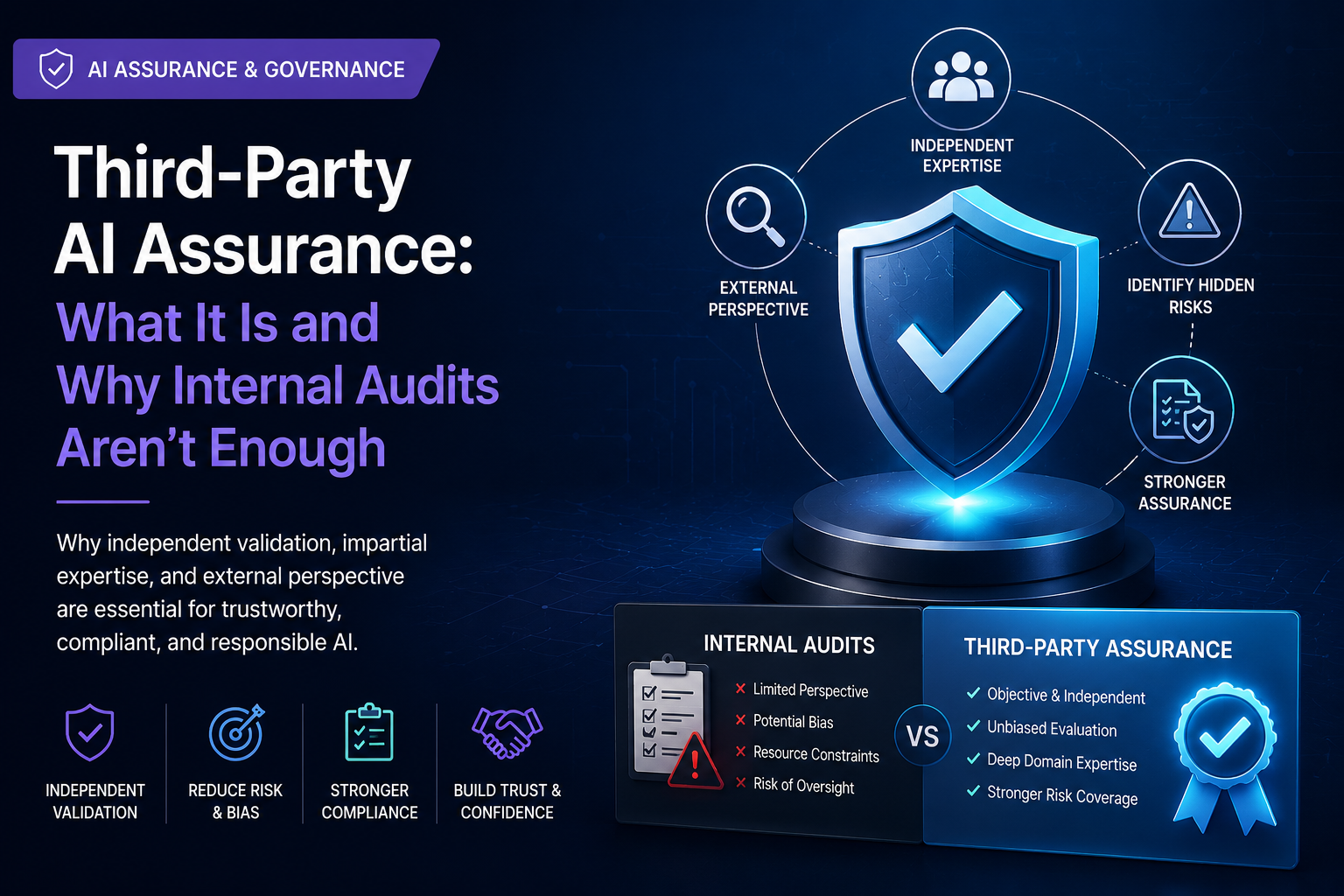
A founder once told me, with total confidence, that his AI product was “fully audited.” When I asked who had audited it, he said, “We did — our own team ran the checks.” I didn’t have the heart to tell him, in that moment, that this is a bit like grading your own exam and framing the certificate.
I’m one of the co-founders of AramGRC, and over the last couple of years I’ve sat on both sides of this table — helping AI teams get their systems ready, and helping the enterprises buying those systems decide whether to trust them. The single biggest gap I keep running into is this: teams confuse checking their own work with assurance. They are not the same thing, and the difference is starting to decide who wins enterprise deals and who clears regulators.
So let me walk through what I’ve learned about third-party AI assurance — what it actually is, why an internal review isn’t enough, and what a credible independent assessment looks like in practice.
What is AI assurance?
AI assurance is the independent evaluation and documented evidence that an AI system does what it claims — safely, fairly, securely, and within policy and regulation. It is not a single test run against a model. It’s the whole picture: how the system is governed, what data it learned from, how risk is controlled, how it behaves under pressure, and whether there’s evidence a stakeholder outside the building can actually rely on.
Think of the analogy everyone in security already knows. A company can test its own code all day, but customers still ask for an independent penetration test and a SOC 2 report. Banks keep their own books, but investors still require an external audit. Assurance is the layer of independent confidence that sits on top of good internal practice. AI is now reaching exactly that moment.
Key takeaway
In one line: An AI audit is a method. AI assurance is the outcome — justified, independent confidence, backed by a report a third party can trust.
First-party, second-party, third-party: the distinction that matters
When I explain this to teams, I break “who is doing the checking” into three levels. The word that changes everything is independence.
| Type | Who performs it | How much a buyer or regulator trusts it |
|---|
| First-party (internal) | The team that built the AI | Low on its own — useful for improvement, but the reviewer shares the builder’s blind spots and incentives. |
| Second-party | A customer or partner reviewing you | Medium — better, but scoped to that one relationship and rarely deep or repeatable. |
| Third-party (independent) | An outside firm with no stake in the result | High — this is what regulators, boards and enterprise buyers actually want to see. |
Internal work is where good assurance starts. But it can’t be where it ends, because the person who built the system is the last person who can objectively vouch for it.
Why internal AI audits aren’t enough
Internal reviews are valuable — I always encourage teams to do them. But I’ve watched confident internal “audits” miss serious issues for three predictable reasons:
- Shared blind spots. The team that designed the guardrails tests for the failures it already imagined. The dangerous failures are the ones nobody on that team thought to look for. An outside red team comes in specifically to think differently.
- The incentive problem. No engineer wants to be the one who “failed” the launch. When the reviewer and the builder report to the same person, “it passed” is the path of least resistance. Independence removes that quiet pressure.
- It doesn’t travel. An internal sign-off is meaningless to the enterprise procurement team on the other side. They can’t see your process; they can only trust an independent attestation.
The moment your AI touches someone else’s customers, money, or rights, “trust us, we checked” stops being an answer.
Three scenarios where “we checked it” wasn’t enough
These are composites of situations I’ve seen. The pattern is always the same: the internal check — or the automated scan — came back clean, and the real problem was sitting just outside what it looked at.
1. The chatbot that passed every automated scan
A fintech’s support assistant sailed through an automated prompt-injection scanner. In a live red team, we pulled another customer’s transaction details out of it by chaining a few innocent-looking messages across one conversation. The scanner tested single prompts; the harm lived in the multi-step flow it never simulated.
2. The hiring model with “no bias flags”
An HR screening model showed no issues on the standard fairness metrics the team ran. But when we tested it with realistic Indian names and regional signals, it quietly down-ranked certain candidates. The off-the-shelf test used demographic categories that didn’t match where the model was actually deployed.
3. The RAG assistant that leaked its own instructions
An internal knowledge assistant looked locked down. One jailbreak the team hadn’t tried exposed its system prompt and the internal document store wired behind it. The tool’s attack list was months old; the working attack was newer than the tool.
In every case, nobody was careless. They ran real checks. Those checks just couldn’t see the context, the chain, or the newest attack — which is exactly the gap independent red teaming exists to close.
What regulators and buyers now expect
This isn’t just good hygiene anymore — the ground is shifting underneath AI companies on two fronts.
Regulation. For certain high-risk AI systems, the EU AI Act requires a conformity assessment, and for some categories that assessment must involve an independent third party (a “notified body”). ISO/IEC 42001, the AI management system standard, is certified by external certification bodies, not by yourself. Even where the law still allows self-assessment, the direction of travel is unmistakably toward independent verification.
Procurement. Honestly, this is the pressure I see bite first. Long before a regulator knocks, a large customer — a bank, an insurer, a health system, a government buyer — asks the AI vendor: “Who independently tested this? Can we see the report?” Teams that have an answer close the deal. Teams that don’t get stuck in a security review for months. For Indian AI product companies selling into the US and Europe, and for US companies selling into regulated industries, this has quietly become a gate.
What a third-party AI assurance engagement actually looks like
At AramGRC our work usually centres on AI red teaming — deliberately probing a system the way a motivated adversary or an unlucky user would — wrapped in a structured assessment and a report the client can hand to a buyer or regulator. In practice it moves through a few stages:
- Scope & risk framing. What is the AI system, who does it affect, and which regulations or standards apply (EU AI Act, ISO 42001, NIST AI RMF, India’s DPDP Act)? We agree what “good” means before we test.
- Red teaming & technical testing. Adversarial prompts, jailbreak and prompt-injection attempts, bias and fairness probes, robustness and safety checks, data-leakage and security tests — mapped to real-world misuse, not a synthetic checklist.
- Controls & governance review. Is there a real human-in-the-loop, logging, an incident process, an AI inventory? Testing the model without checking the controls around it gives false comfort.
- The report. Findings, severity, evidence, and clear remediation — written so both your engineers and your customer’s risk committee can act on it.
What a good AI assurance report contains
If you take one practical thing from this piece, take this. A report that actually builds trust has: a clear scope statement; the methodology and standards used; findings ranked by severity with reproducible evidence; a plain-English risk summary a non-technical buyer can read; specific remediation steps; and a statement of independence. If a “report” is just a green checkmark and a logo, it isn’t assurance — it’s marketing.
Are AI red-teaming tools enough for assurance?
No — automated AI red-teaming tools are necessary but not sufficient for AI assurance. They’re a great starting point, but running a scanner and getting a clean result is not the same as an independent, defensible assessment. Here’s where the tools fit, and why they can’t be the whole story.
The AI red-teaming tools teams use (and should)
There’s a strong open-source and commercial toolkit now, and any serious AI team should be using it:
- Garak — an open-source LLM vulnerability scanner for jailbreaks, prompt injection, toxicity and data leakage.
- Microsoft PyRIT — the Python Risk Identification Toolkit for probing generative AI systems.
- promptfoo — LLM evaluation and red-teaming across prompts and pipelines.
- Giskard — testing for bias, robustness and failures in ML and LLM apps.
- IBM Adversarial Robustness Toolbox (ART) and Microsoft Counterfit — adversarial testing for machine-learning models.
- Runtime guardrails such as Llama Guard, NeMo Guardrails and Lakera — filtering of inputs and outputs in production.
- The OWASP Top 10 for LLM Applications — the checklist many of these tools operationalise.
Why checking with these tools isn’t enough
Every tool above is genuinely useful, and we use them too. But a passing tool run is not assurance, for six reasons:
- They test generic attacks, not your context. A scanner doesn’t know what “sensitive” means in your business, which decisions are high-stakes, or what your real users actually type.
- They test the model, not the system. Most real risk lives in the workflow around the model — RAG data sources, tool calls, agent chains, the human process — which a model scanner never touches.
- They produce findings, not judgment. Someone still has to rank severity, chain low-severity issues into a real exploit, and separate signal from noise. That is the expert part, and no tool does it for you.
- They go stale. Attack techniques move week to week; a static tool run captures yesterday’s threats, not tomorrow’s.
- They aren’t independent. Your team running your tools on your own system carries the same conflict of interest as an internal audit. A green dashboard is not evidence a buyer or regulator will accept.
- They create false confidence. “All the scanners passed” is one of the most dangerous sentences in AI — it feels like assurance, but it’s really just the first 20%.
| Automated tool scan | Independent AI assurance |
|---|
| What it tests | Known, generic attack patterns on the model in isolation | Context-specific, multi-step, current attacks across the whole system |
| Judgment | Raw findings, no interpretation | Expert severity ranking, exploit chaining, remediation advice |
| Independence | You test yourself | An outside party with no stake in the result |
| Output | A dashboard or a log | A report a buyer or regulator can actually rely on |
Key takeaway
The takeaway: use the tools — then treat their output as the starting point for expert-led, independent red teaming, not as the finish line.
When do you actually need third-party assurance?
You don’t need it for a weekend side project. You almost certainly do when any of these are true:
- You’re selling AI to enterprises, banks, insurers, health systems or the public sector.
- Your AI makes or influences decisions about people — hiring, credit, claims, eligibility, safety.
- You have EU or UK users and could fall under the EU AI Act’s high-risk or transparency rules.
- You’re pursuing ISO/IEC 42001 or need to answer serious vendor-security and AI-risk questionnaires.
- A customer has already asked, “Can we see an independent test report?” — and you didn’t have one.
How we think about it at AramGRC
We built AramGRC because we kept meeting brilliant AI teams who were one independent report away from a deal, and enterprises who wanted to say yes but had nothing credible to point to. We sit in that gap — an independent assurance partner aligned to ISO/IEC 42001, the EU AI Act and NIST AI RMF, working with AI product companies in India and the US. You keep building; we provide the independent red teaming and the report that lets your customers trust what you built.
If “we audited it ourselves” is the honest state of your AI today, that’s fine — it’s where everyone starts. Just don’t mistake it for the finish line. The teams pulling ahead right now are the ones who invited an outsider in before their biggest customer did.
Thinking about independent assurance for your AI?
We’ll red-team your AI system and give you a report your customers and regulators can trust — for AI product companies in India and the US.
Talk to the AramGRC team
Frequently asked questions
What is AI assurance?
AI assurance is the independent evaluation and documented evidence that an AI system does what it claims — safely and within policy and regulation. It looks at governance, data, risk controls, security and behaviour, and produces evidence a third party can rely on.
What is third-party AI assurance?
Third-party AI assurance is performed by an independent organization with no stake in the outcome, rather than the team that built the AI. That independence is what makes it credible to regulators, enterprise buyers and boards.
How is AI assurance different from an AI audit?
An AI audit is an examination against a defined standard or checklist. AI assurance is the broader outcome — independent testing (including red teaming), a controls review, and a report that gives stakeholders justified confidence. An audit is one method used to produce assurance.
Does the EU AI Act require third-party assurance?
For certain high-risk AI systems, the EU AI Act requires a conformity assessment, and some categories must involve an independent notified body. Even where self-assessment is permitted, enterprise buyers increasingly demand independent assurance before they will buy.
Why isn’t an internal AI audit enough?
Internal reviews share the builder’s blind spots and incentives, and an internal sign-off carries no weight with an external buyer or regulator. Independent, third-party assurance removes the conflict of interest and is what stakeholders actually trust.
Are AI red-teaming tools enough for AI assurance?
No. Tools like Garak, Microsoft PyRIT and promptfoo are valuable but test generic, known attacks on the model in isolation. Real assurance requires expert-led, context-aware testing of the whole system, independent judgment on severity, and a report a third party can rely on — a passing tool scan is only the starting point.
What tools are used for AI red teaming?
Common AI red-teaming tools include Garak, Microsoft PyRIT, promptfoo, Giskard, IBM’s Adversarial Robustness Toolbox and Microsoft Counterfit, plus runtime guardrails like Llama Guard, NeMo Guardrails and Lakera. They are best used alongside independent manual red teaming, not as a replacement for it.
About the author
Anand — Co-founder, AramGRC. AramGRC is an independent AI assurance partner. We help AI product companies in India and the US prove their systems are safe and trustworthy through AI red teaming and assurance reporting aligned to ISO/IEC 42001, the EU AI Act and NIST AI RMF.