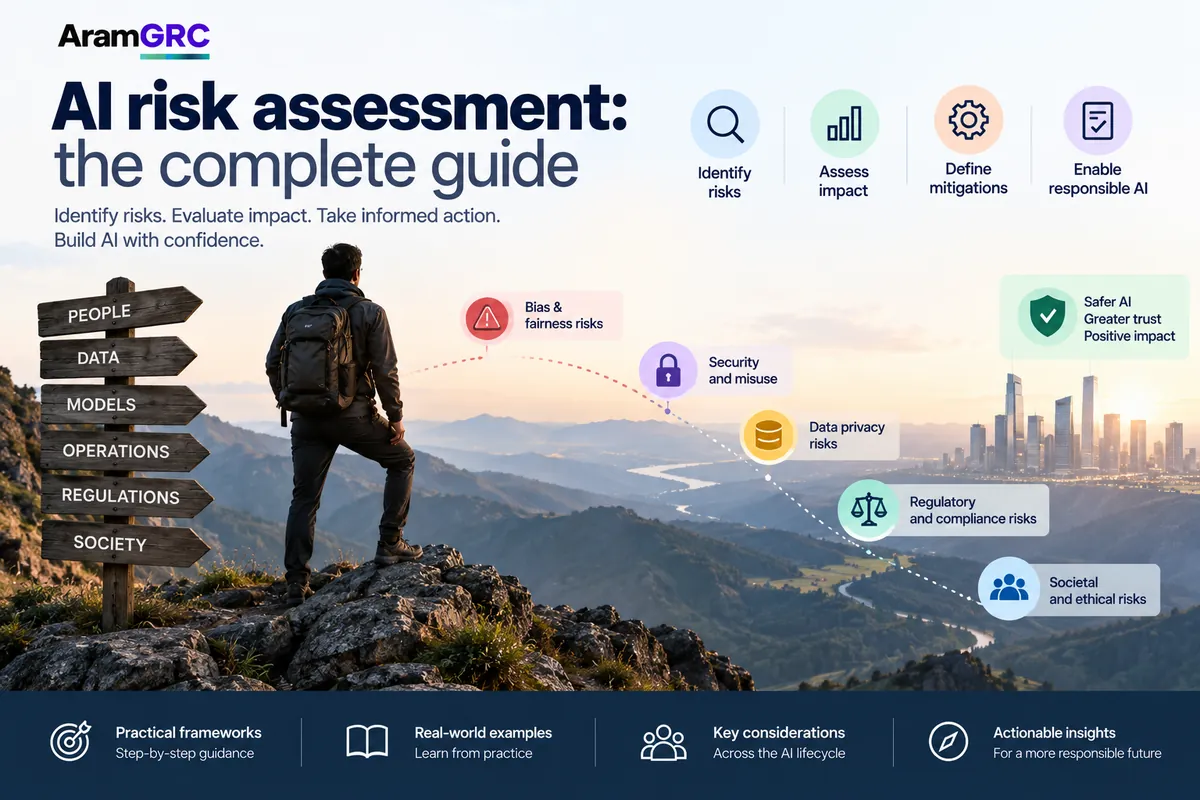
An AI risk assessment is the single most important control in responsible AI — the gate that catches a biased, unsafe or non-compliant system before it reaches your customers, not after. This guide explains what an AI risk assessment is, the risks to evaluate, the process, and how it maps to ISO/IEC 42001, the EU AI Act and the NIST AI RMF, with deep-dive links to a template and framework. It pairs with our guides to AI governance and AI audit.
AramGRC Team·AI Risk & Assurance·September 11, 2026·13 min read
What is an AI risk assessment?
An AI risk assessment is a structured evaluation of the harms an AI system could cause — to individuals, to your organisation and to society — and the controls you will put in place to reduce those harms to an acceptable level. It is the AI-specific version of a risk assessment your security or compliance team already runs, but it evaluates risks unique to AI: bias, opacity, drift, and automated decisions that affect people's lives. Done well, it produces three things: a clear picture of what could go wrong, a prioritised list of what to fix, and documented evidence that you assessed the system responsibly.
An AI risk assessment at a glance
What it is: — a structured evaluation of an AI system's potential harms and the controls to reduce them.
When you do it: — before deployment, and whenever the system or its context changes materially.
What it produces: — a risk register with each risk scored, an owner and a mitigation, plus a go / no-go decision.
What it covers: — purpose and impact, data, bias and fairness, robustness and security, explainability, human oversight and regulatory exposure.
Why it matters: — it's the highest-leverage control in AI governance, and it's required by the EU AI Act, ISO/IEC 42001 and India's DPDP and RBI expectations.
Why AI needs its own risk assessment
Standard IT risk assessments miss what makes AI risky. AI systems make decisions about people, can be biased in ways invisible in the code, degrade silently as the world changes, are often opaque, and depend on data whose quality and lawful basis directly affect safety and compliance. A generic risk assessment won't surface any of that — which is why AI needs its own.
The risks an AI risk assessment evaluates
A robust assessment scores a system across these dimensions:
Purpose and impact — what the system decides, and who is affected if it's wrong.
Data risk — is the training and input data accurate, representative and lawfully sourced (DPDP / GDPR compliant)?
Bias and fairness — does the system produce equitable outcomes across groups?
Transparency and explainability — can you explain how it works and why it produced a result?
Robustness and security — does it resist adversarial inputs, misuse and failure, and is it monitored for drift?
Human oversight — can a person review, override or halt its decisions?
Regulatory exposure — where does it sit against the EU AI Act's risk tiers, ISO 42001 and sector rules?
The process runs from scoping the system, through identifying and scoring risks, to defining controls, assigning owners and making a documented decision — then monitoring and re-assessing. We walk the full sequence in how to conduct an AI risk assessment.
AI risk assessment vs AI impact assessment
They're related but distinct. A risk assessment evaluates the risks an AI system poses to the organisation and its objectives; an AI impact assessment (as described in ISO/IEC 42005, and required as a fundamental-rights impact assessment for some high-risk systems under the EU AI Act) evaluates the system's consequences for individuals and groups. Mature programmes do both — often together — because a system can be low-risk to the business and high-impact on the people it affects.
The AI risk assessment framework
You don't have to invent criteria — derive them from a recognised framework. The NIST AI Risk Management Framework (Govern, Map, Measure, Manage) and ISO/IEC 42001 both give you a structure, and the EU AI Act specifies a risk-management system for high-risk AI. We cover how to build one in AI risk assessment framework.
Using an AI risk assessment template
A good template turns the process into a repeatable worksheet — one row per risk, with the dimension, description, likelihood, impact, score, control, owner and status — so every team assesses AI the same way and results roll up into a portfolio view. See AI risk assessment template.
AI vendor risk assessment
Buying AI shifts where the risk sits, not whether it exists. When you assess a third-party or embedded AI system, you add questions about the vendor's training data and lawful basis, bias testing, contractual commitments, data handling and certifications. See AI vendor risk assessment.
AI risk assessment and regulation
A risk assessment isn't just good practice — it's increasingly required. The EU AI Act mandates a risk-management system for high-risk AI; ISO/IEC 42001 requires AI risk and impact assessments; and India's DPDP Act and RBI's FREE-AI framework expect risk management over automated systems. Doing it well is how you satisfy several regimes at once. See the EU AI Act and AI governance in India.
From assessment to AI risk management
A risk assessment is a point-in-time snapshot; AI risk management is the ongoing discipline of monitoring, reviewing and treating AI risk across the lifecycle. See AI risk management.
Key takeaways
An AI risk assessment evaluates an AI system's potential harms and the controls to reduce them — the highest-leverage control in AI governance.
It scores risks across purpose, data, bias, robustness, explainability, oversight and regulatory exposure.
It differs from an AI impact assessment (which focuses on effects on people) — do both.
It's required by the EU AI Act, ISO/IEC 42001 and India's DPDP and RBI expectations.
Use a template and a recognised framework (NIST AI RMF, ISO 42001) to make it repeatable.
How AramGRC helps
AramGRC's AI risk assessment service delivers a safety, security and privacy risk register with a prioritised mitigation plan — mapped to ISO/IEC 42001 and the EU AI Act — so you have a defensible, pre-deployment analysis for every AI system, not a spreadsheet nobody trusts.
Frequently asked questions
What is an AI risk assessment?+
A structured evaluation of the harms an AI system could cause and the controls to reduce them — covering bias, safety, privacy, transparency and regulatory exposure — producing a scored risk register and a deployment decision.
Why do you need an AI risk assessment?+
To catch biased, unsafe or non-compliant AI before deployment, to satisfy the EU AI Act, ISO 42001 and India's DPDP and RBI expectations, and to have documented evidence you assessed the system responsibly.
What risks does an AI risk assessment cover?+
Purpose and impact, data quality and lawful basis, bias and fairness, transparency and explainability, robustness and security, human oversight, and regulatory exposure.
How do you conduct an AI risk assessment?+
Scope the system, identify risks across the dimensions, score each for likelihood and impact, define controls with owners, make a documented go/no-go decision, and monitor and re-assess.
What is the difference between an AI risk assessment and an AI impact assessment?+
A risk assessment evaluates risks to the organisation; an AI impact assessment evaluates the system's effects on individuals and groups (ISO 42005, and a fundamental-rights impact assessment under the EU AI Act). Do both.
Is there an AI risk assessment template?+
Yes — a good template captures each risk with its dimension, likelihood, impact, score, control and owner, so assessments are consistent and auditable.
When should you do an AI risk assessment?+
Before an AI system is deployed, and again whenever the system or its context changes materially — it's a gate, not a one-off.
Does the EU AI Act require a risk assessment?+
Yes — the EU AI Act requires a risk-management system for high-risk AI systems, and a fundamental-rights impact assessment in certain cases.
AI Risk AssessmentAI GovernanceAssurance
The AI Risk Assessment series
AI Risk Assessment
What an AI risk assessment is, the risks to evaluate, the process, template and framework.