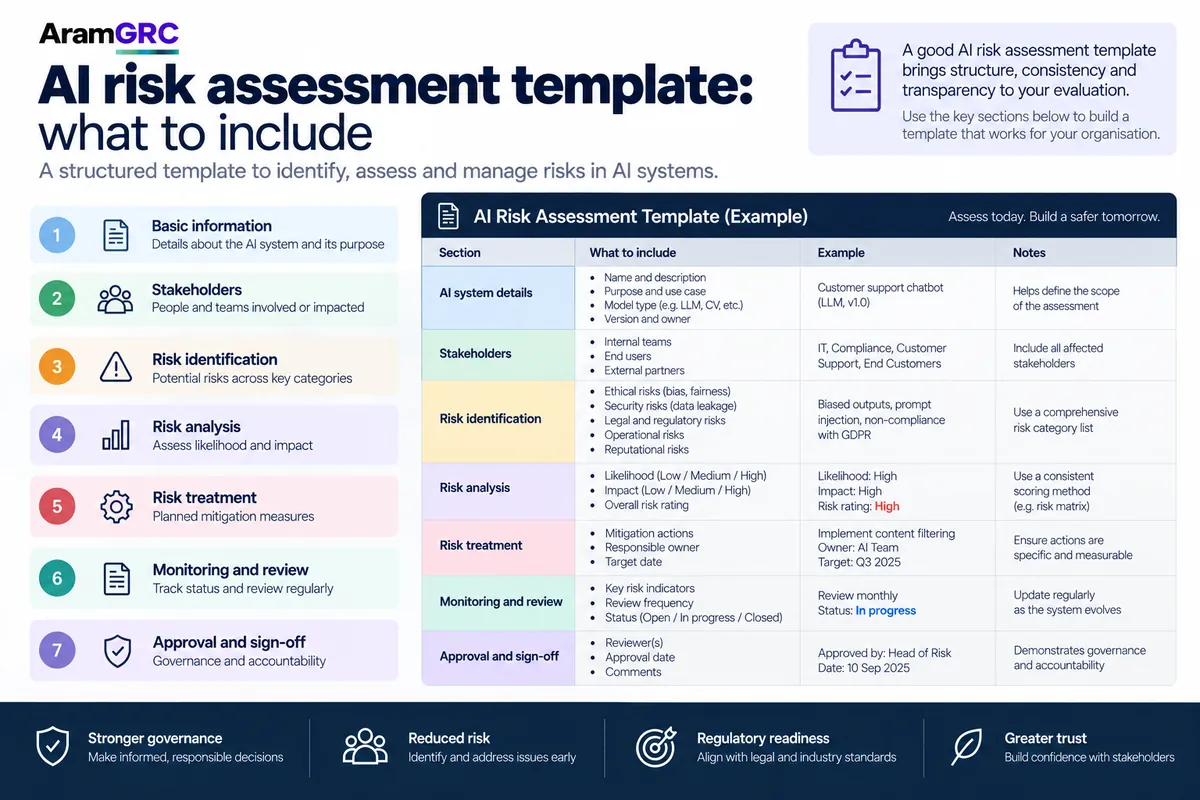
A good AI risk assessment template turns a one-off exercise into a repeatable control. This guide sets out exactly what a template should contain and how to use it consistently across your AI systems. Part of our guide to the AI risk assessment.
AramGRC Team·AI Risk & Assurance·September 11, 2026·8 min read
Why use a template
A template standardises how every team assesses AI, so results are consistent and comparable, roll up into a portfolio view of AI risk, and give you the audit evidence ISO/IEC 42001 and the EU AI Act expect. Without one, each assessment reflects whoever ran it.
What an AI risk assessment template should include
A strong template has two parts. A header capturing the system context:
System name, owner and business unit.
Purpose and intended use.
Risk tier (and EU AI Act classification, if relevant).
Assessment date, reviewer, and next review date.
And a risk table — one row per risk — with these columns:
Risk dimension (data, bias, robustness, etc.).
Risk description — the specific way harm could occur.
Likelihood (e.g. 1–5).
Impact (e.g. 1–5).
Risk score (likelihood × impact).
Control / mitigation.
Owner.
Status (open, mitigated, accepted).
The risk dimensions to cover
Each system should have rows across: purpose and impact, data quality and lawful basis, bias and fairness, transparency and explainability, robustness and security, human oversight, and regulatory exposure. See types of AI risk for what to list under each.
How to score
Use a simple, consistent scale — 1–5 for likelihood and 1–5 for impact — and multiply for a score. Consistency matters more than precision: the goal is to rank risks reliably, not to compute a false-precision number.
Using the template consistently
Apply the same template to every AI system, and the individual assessments roll up into a portfolio view — which systems carry the most unmitigated risk, and where to focus. It also feeds the Statement of Applicability and evidence trail for ISO 42001.
AramGRC provides an AI risk assessment template mapped to ISO/IEC 42001 and the EU AI Act — and runs the assessment with you so the template is filled with evidence, not guesswork.
Frequently asked questions
What is an AI risk assessment template?+
A standard worksheet for assessing an AI system — a header capturing system context and a table with one row per risk (dimension, description, likelihood, impact, score, control, owner, status).
What should an AI risk assessment template include?+
System name, owner, purpose and risk tier in the header; and per-risk rows covering dimension, description, likelihood, impact, score, control and owner.
Is there a free AI risk assessment template?+
Templates are widely available, but the value is in one mapped to a recognised standard (ISO 42001, the EU AI Act) and filled with tested evidence rather than guesses.
How do you fill out an AI risk assessment template?+
For each risk dimension, describe how harm could occur, score likelihood and impact, record the control and owner, and set a status — then review on a schedule.