Types of AI risk: the main categories, with examples
You can't assess a risk you haven't named. This guide sets out the main types of AI risk with concrete examples, so your risk assessment covers the full picture. Part of our guide to the AI risk assessment.
AramGRC Team·AI Risk & Assurance·September 11, 2026·8 min read
Why categorise AI risk
A clear taxonomy makes risk assessment complete — it stops you fixating on the risk you already know about (usually accuracy) while missing the ones that cause real harm (usually bias, privacy or security). These categories become the rows of your risk assessment template.
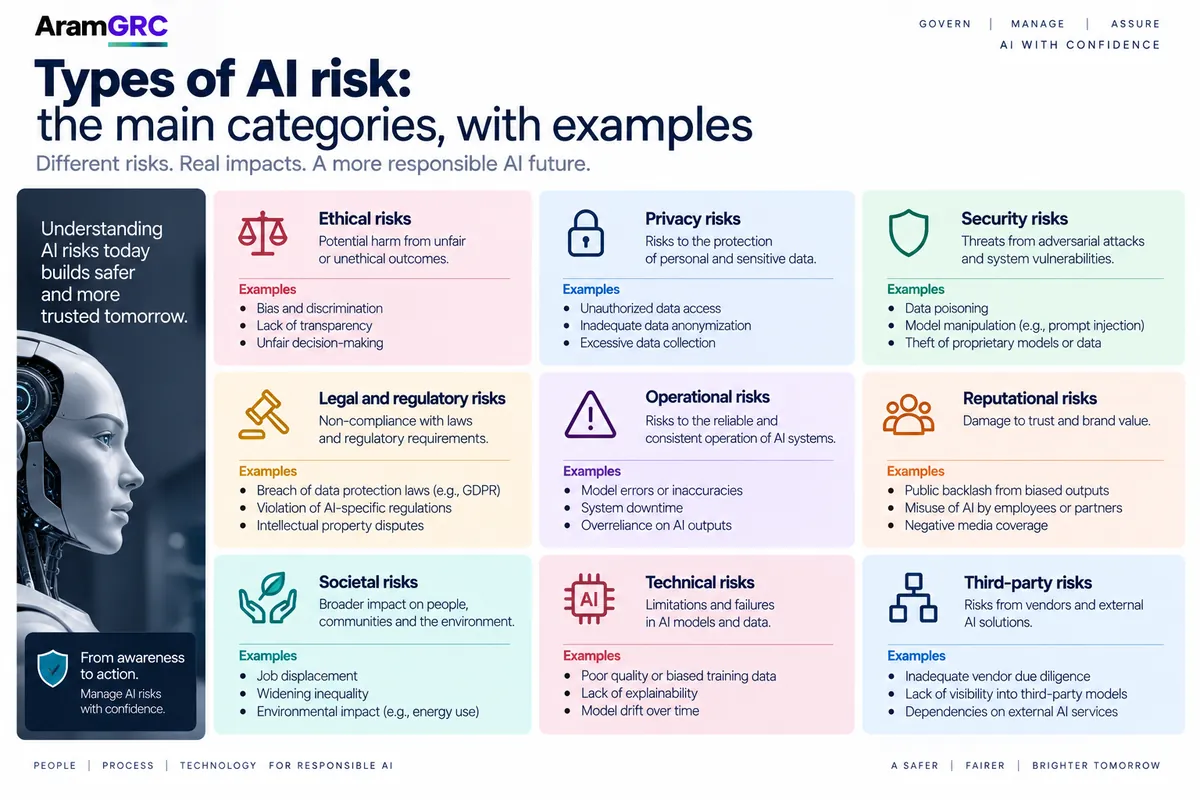
The main types of AI risk
Bias and fairness risk — the system discriminates across groups; e.g. a hiring model that downgrades certain candidates.
Safety and reliability risk — the system produces wrong or harmful outputs; e.g. a medical triage tool that misclassifies.
Security risk — adversarial attacks, prompt injection and data leakage; e.g. a chatbot tricked into revealing another user's data.
Privacy and data-protection risk — misuse of personal data; e.g. training on customer data without a lawful basis under the DPDP Act.
Transparency and explainability risk — black-box decisions no one can explain; e.g. a declined loan with no reason given.
Robustness and drift risk — performance degrades as the world changes; e.g. a fraud model that stops catching new patterns.
Hallucination and accuracy risk — confident, wrong answers; e.g. a support assistant inventing a policy.
Human-oversight and accountability risk — no one can intervene or is responsible; e.g. an agent that acts without review.
Third-party and supply-chain risk — risk inherited from vendor or embedded AI; see AI vendor risk assessment.
Regulatory and compliance risk — breaching the EU AI Act, DPDP or sector rules.
Reputational and societal risk — public harm and loss of trust.
IP and confidentiality risk — sensitive data or IP leaked into external models.
How risk types map to controls
Each risk type points to a control: bias risk to fairness testing, security risk to red teaming, privacy risk to data governance, drift risk to monitoring, oversight risk to a human-in-the-loop. Naming the risk is the first step to treating it.
Which risks matter most
It depends on the use. A high-stakes system deciding about people carries heavy bias, explainability and oversight risk; an internal productivity tool carries more security and IP risk. Your risk tier determines how deeply to assess each.
AramGRC assesses your AI systems across all these risk types and delivers a scored register with a prioritised mitigation plan.
Frequently asked questions
What are the main types of AI risk?+
Bias and fairness, safety and reliability, security, privacy and data protection, transparency and explainability, robustness and drift, hallucination and accuracy, human oversight, third-party/supply-chain, regulatory, reputational, and IP/confidentiality risk.
What is the biggest AI risk?+
It depends on the use, but for systems that affect people, bias, privacy and lack of human oversight tend to cause the most harm and regulatory exposure.
How do you mitigate AI risk?+
Map each risk type to a control — bias testing for fairness, red teaming for security, data governance for privacy, monitoring for drift, and human-in-the-loop for oversight — then track them in a risk register.
What are examples of AI risk?+
A biased hiring model, a chatbot leaking data via prompt injection, a fraud model that drifts, a support assistant hallucinating a policy, or training on personal data without a lawful basis.