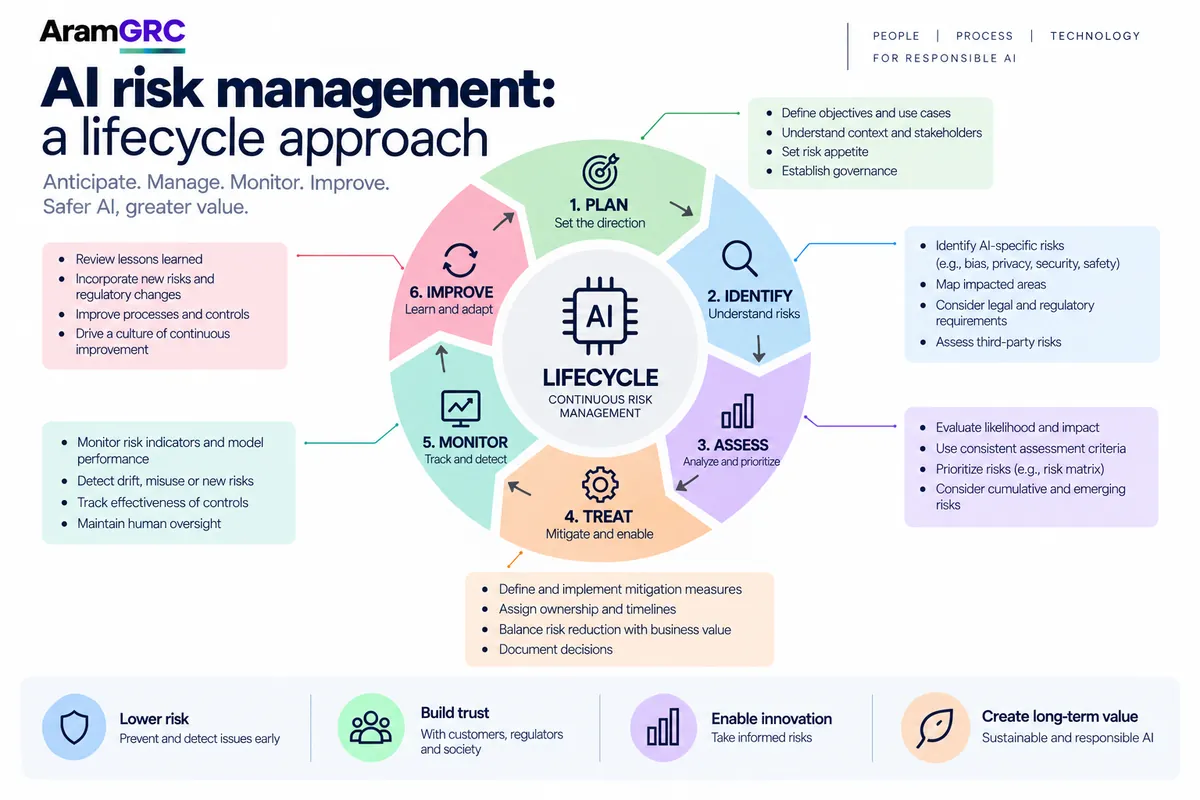
A risk assessment is a snapshot; AI risk management is the ongoing discipline that keeps AI safe long after launch. This guide explains what AI risk management is, the lifecycle, and how it fits into governance. Part of our guide to the AI risk assessment.
AramGRC Team·AI Risk & Assurance·September 11, 2026·9 min read
What is AI risk management?
AI risk management is the continuous practice of identifying, assessing, treating and monitoring the risks AI systems pose across their whole lifecycle — from design and data through deployment and into production, where models drift and contexts change. It's the ongoing engine; a risk assessment is one moment within it.
AI risk management vs AI risk assessment
A risk assessment evaluates a system at a point in time and produces a scored register. AI risk management is the wider, continuous discipline — re-assessing as things change, treating risks, monitoring in production, and handling incidents. You can't manage risk with assessments alone, and you can't manage it without them.
The AI risk management lifecycle
Effective programmes run a loop: identify (inventory and tier AI systems), assess (risk and impact assessments), treat (controls and mitigations), monitor (drift, performance and bias in production), and review (re-assess on a cadence and on change). The NIST AI RMF captures this as four functions — Govern, Map, Measure, Manage.
Key components
An AI inventory with risk tiering — you can't manage what you can't see.
A risk and impact assessment gate before deployment.
Controls and mitigations mapped to identified risks.
Production monitoring for drift, performance and emerging bias.
Incident response for when an AI system fails.
Governance and accountability — a named owner for AI risk.
AI risk management and governance
AI risk management is a core part of AI governance — governance sets the policy and accountability; risk management does the identifying, treating and monitoring. Together they let you scale AI safely.
AI risk management in regulated sectors
Regulators increasingly mandate it: the EU AI Act requires a risk-management system for high-risk AI, and in India the RBI's model-risk expectations and FREE-AI framework pull AI/ML models into formal lifecycle governance. See AI regulation in India.
Common pitfalls
The usual failures: treating risk as a launch-day checkbox, no monitoring for drift, no owner, and no link between the risk register and real controls. Risk management is a loop, not a document.
How AramGRC helps
AramGRC helps you stand up AI risk management as an operating discipline — inventory, assessment, controls, monitoring and incident response — mapped to the NIST AI RMF, ISO/IEC 42001 and the EU AI Act.
Frequently asked questions
What is AI risk management?+
The continuous practice of identifying, assessing, treating and monitoring AI risk across the whole lifecycle — the ongoing discipline within which risk assessments sit.
What is the difference between AI risk management and AI risk assessment?+
A risk assessment evaluates a system at a point in time; AI risk management is the continuous discipline of re-assessing, treating, monitoring and responding to AI risk over the lifecycle.
What does the NIST AI RMF cover?+
It structures AI risk management into four functions — Govern, Map, Measure and Manage — a widely used backbone for managing AI risk.
Who owns AI risk management?+
A named governance or risk owner is accountable, with system owners responsible for their systems and a cross-functional committee for high-risk decisions.