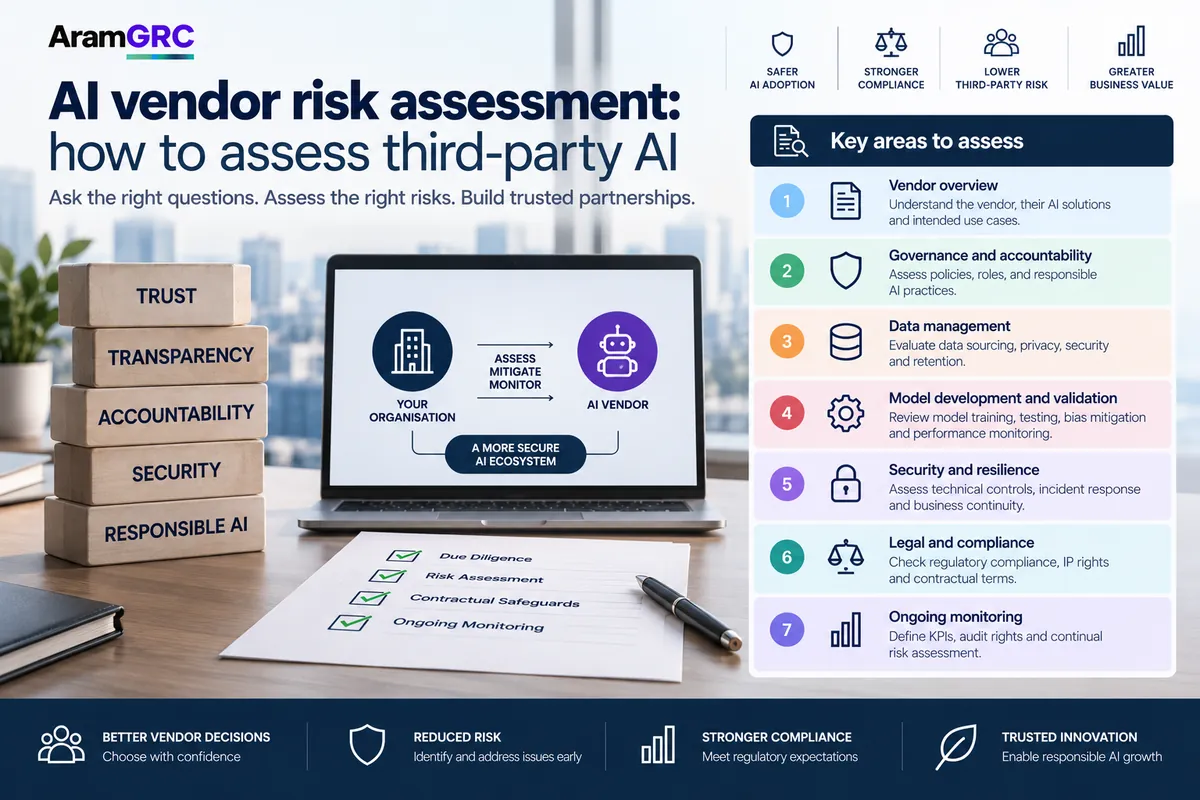
AI vendor risk assessment: how to assess third-party AI
Most organisations get more AI risk from the AI they buy than the AI they build. This guide explains how to assess third-party and embedded AI — the questions to ask, and why you remain accountable. Part of our guide to the AI risk assessment.
AramGRC Team·AI Risk & Assurance·September 11, 2026·8 min read
Why AI vendor risk matters
Buying AI shifts where the risk sits, not whether it exists — and under regulations like the EU AI Act and India's DPDP Act, you often remain accountable for AI you deploy, even when you didn't build it. A biased vendor model or one trained on unlawfully sourced data becomes your problem the moment you put it in front of customers.
What's different about AI vendor risk
AI vendors bring risks traditional software vendors don't: opaque models you can't fully inspect, training data you didn't control, models that drift, and AI embedded inside broader SaaS products you may not even have flagged as AI. Standard vendor due-diligence misses all of it.
The AI vendor risk assessment: what to ask
A strong assessment puts these questions to the vendor:
Training data — what was the model trained on, and on what lawful basis?
Bias and fairness — how is the model tested for bias, and can they share results?
Security and robustness — how do they defend against adversarial attacks and data leakage?
Data handling — how is your data processed and protected (DPDP / GDPR), and who are the sub-processors?
Human oversight — can you review, override or turn off its decisions?
Incidents and support — how are failures detected, reported and fixed?
Certifications — do they hold ISO/IEC 42001 or provide independent assurance?
Contractual commitments — what do they warrant in writing?
EU AI Act role — are they the provider, and what does that leave you responsible for as deployer?
How to run it
Tier your AI vendors by risk (a chatbot vendor is not a credit-model vendor), assess the high-risk ones before you sign and again at renewal, and record the results in your AI risk register alongside your own systems.
Embedded and shadow AI
The hardest vendor risk is the AI you didn't notice — features quietly added to existing SaaS, or tools staff adopt without approval. Discovery is the first step; you can't assess a vendor AI you don't know you're using.
A third-party audit of vendor AI
For high-stakes vendor AI, a questionnaire isn't enough — an independent third-party AI audit of the vendor's system gives you real assurance before you rely on it.
How AramGRC helps
AramGRC independently assesses and audits third-party AI systems before you deploy them — surfacing the data, bias, security and compliance risks you'd otherwise inherit.
Frequently asked questions
What is an AI vendor risk assessment?+
An assessment of the risk in AI you buy or embed from a third party — evaluating the vendor's training data, bias testing, security, data handling, oversight and certifications before you deploy it.
What questions should you ask an AI vendor?+
What the model was trained on and its lawful basis, how it's tested for bias, its security and robustness, how it handles your data, human oversight, incident handling, certifications, and contractual commitments.
Are you responsible for a vendor's AI?+
Often yes — under the EU AI Act and India's DPDP Act, the organisation deploying AI usually remains accountable for it, even when a third party built it.
How do you assess third-party AI?+
Tier vendors by risk, put a structured questionnaire to the high-risk ones before signing and at renewal, and for high-stakes systems commission an independent third-party audit.