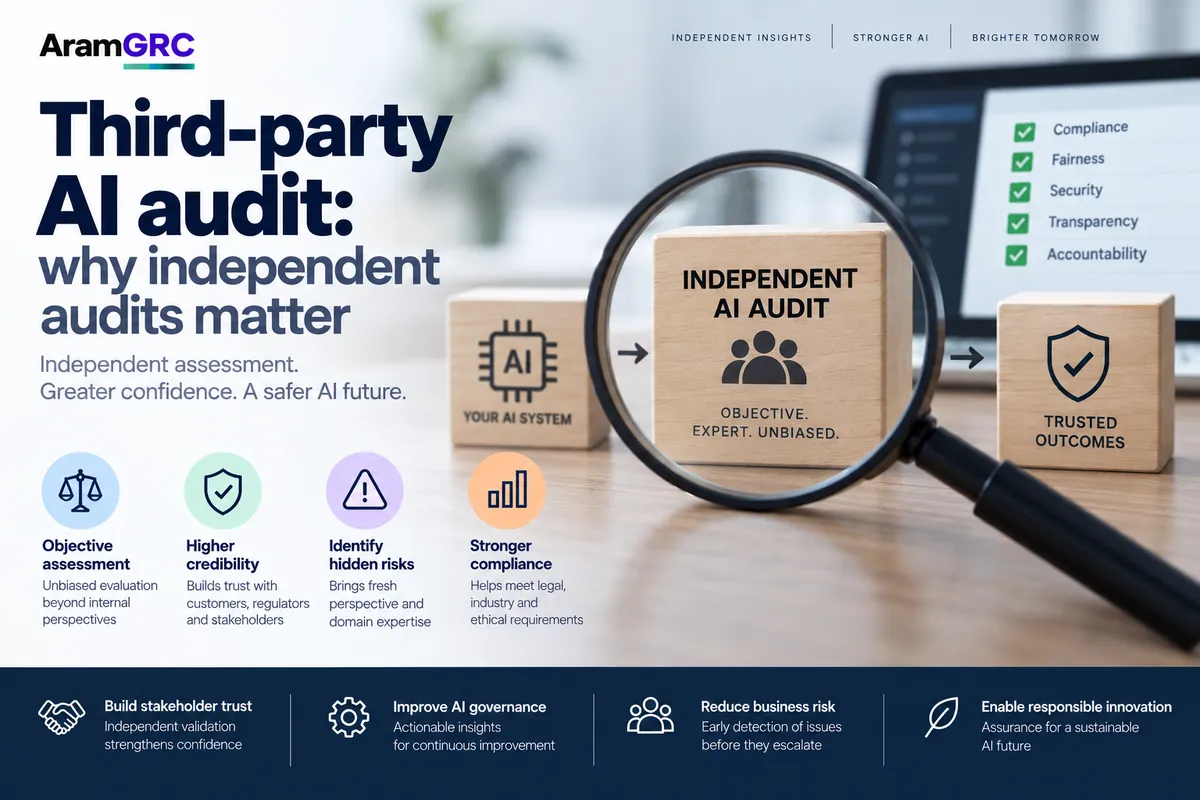
Third-party AI audit: why independent audits matter
When a buyer, board or regulator asks whether your AI is trustworthy, your own word rarely settles it — theirs is a question independence answers. This guide explains what a third-party AI audit is, why internal audits aren't enough, and when you need one. Part of our guide to the AI audit.
AramGRC Team·AI Audit & Assurance·September 11, 2026·8 min read
What is a third-party AI audit?
A third-party AI audit is an independent examination of an AI system by an external assurance provider — separate from the team that built or operates it. Because the auditor has no stake in the outcome, the findings and the report carry weight with people outside your organisation.
Why internal audits aren't enough
Internal audits are essential for continuous improvement, but external stakeholders discount self-assessment — a company grading its own AI is not the evidence a regulator or enterprise buyer is looking for. Independence is what turns an audit into proof. We explore this in depth in third-party AI assurance.
When you need a third-party AI audit
Procurement — an enterprise buyer requires independent evidence before signing.
EU AI Act conformity — certain high-risk systems require assessment by a third-party notified body (see the EU AI Act).
Vendor risk — you're buying AI and need to assess it before a deal or renewal.
High-stakes deployment — the system makes consequential decisions about people and you want defensible, external assurance.
What a third-party AI audit gives you
Objective findings you can trust, and a report or attestation you can share — with customers, partners, boards and regulators. It converts an internal belief that your AI is sound into external proof that it is.
Third-party vs internal AI audit
Internal audits are frequent, cheaper, and great for finding and fixing issues early. Third-party audits are periodic, independent, and built to be shared. Mature programmes use both: internal audits to stay ready, third-party audits to prove it.
Auditing the AI you buy
A third-party audit also works in reverse — when you're the buyer. Independently auditing a vendor's AI before you deploy it surfaces the risks you'd otherwise inherit, from biased models to unlawful training data.
How to choose a third-party AI auditor
Look for genuine independence, recognised credentials and method, sector experience, and a report format your stakeholders will accept. The value is in the trust the audit carries, not just the checklist behind it.
How AramGRC helps
AramGRC is built for exactly this — independent, third-party AI audits and assurance, with a shareable report and, where warranted, the AramGRC Mark as public proof of trustworthy AI. See third-party AI assurance.
Frequently asked questions
What is a third-party AI audit?+
An independent examination of an AI system by an external assurance provider, separate from the team that built it — so the findings and report carry weight with buyers, boards and regulators.
Why isn't an internal AI audit enough?+
External stakeholders discount self-assessment. Independence is what makes an audit credible as proof to regulators and enterprise buyers.
When do I need an independent AI audit?+
When a buyer requires evidence, when the EU AI Act mandates a notified body for a high-risk system, when you're assessing a vendor's AI, or when a system makes high-stakes decisions.
Who can perform a third-party AI audit?+
An independent assurance firm or auditor with recognised credentials, a defined method, and no stake in the system being audited.