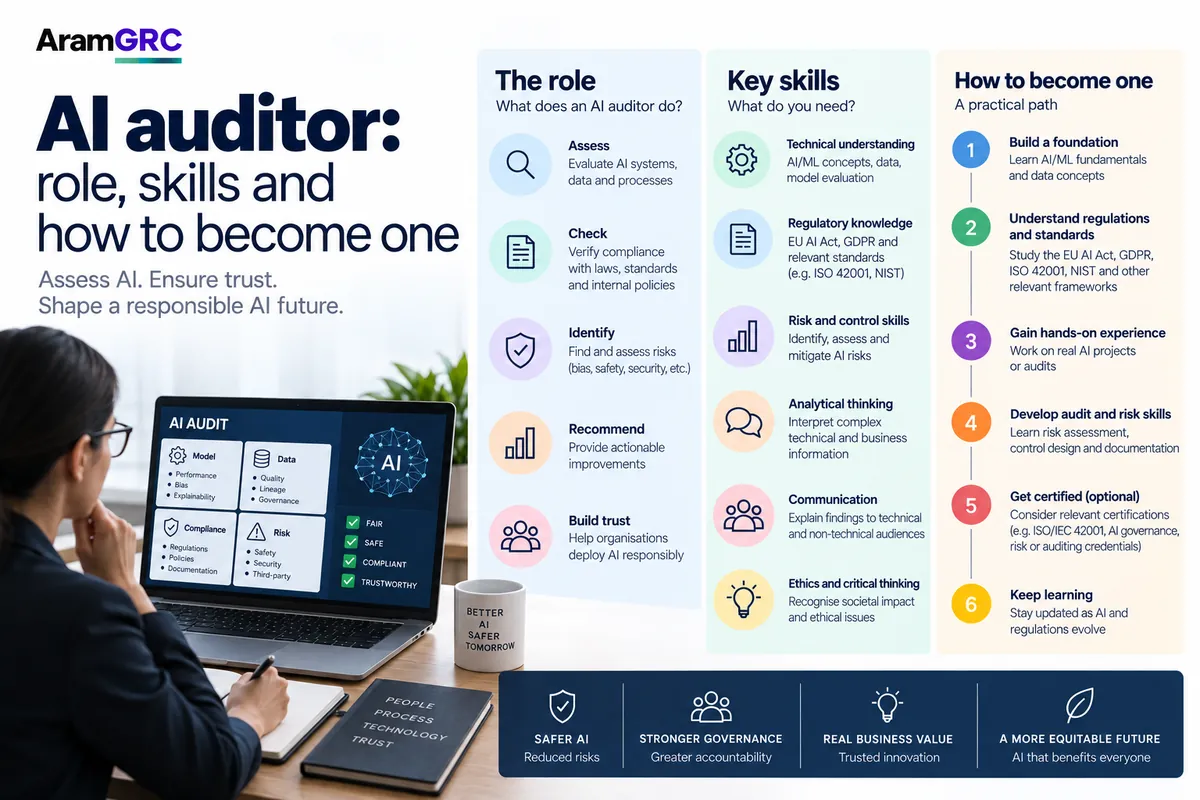
As AI audits become a business requirement, the AI auditor is one of the fastest-growing roles in assurance. This guide explains what an AI auditor does, the skills and certifications required, and how to become one. Part of our guide to the AI audit.
AramGRC Team·AI Audit & Assurance·September 11, 2026·8 min read
What is an AI auditor?
An AI auditor is a professional who independently examines AI systems and the governance around them against a standard — checking for bias, safety, explainability, compliance and control, and reporting findings objectively. The defining trait is independence: an auditor verifies, rather than builds, the system.
What an AI auditor does
Day to day, an AI auditor scopes audits, gathers evidence (model cards, data lineage, test results, governance records), runs or reviews bias and robustness testing, maps a system against a standard like ISO/IEC 42001 or the EU AI Act, rates and documents gaps, and writes the audit report and, where warranted, an attestation.
Skills an AI auditor needs
AI auditing is a hybrid discipline. The strongest auditors combine: an understanding of how AI and ML systems work; knowledge of the standards and regulations (ISO/IEC 42001, the EU AI Act, the NIST AI RMF, and in India the DPDP Act and RBI FREE-AI); the ability to test for bias, robustness and explainability; and classic audit and risk skills — evidence, objectivity and reporting.
AI auditor certifications
Recognised credentials help you enter and progress in the field: an ISO/IEC 42001 Lead Auditor course qualifies you to audit AI management systems (see ISO 42001 lead auditor); AI governance credentials build the regulatory foundation (see AI governance certification); and information-systems audit certifications transfer well. Look for accredited, assessed credentials over unassessed courses.
How to become an AI auditor
Build a foundation in AI/ML concepts and in AI governance and regulation.
Earn a recognised credential — an ISO 42001 Lead Auditor course is a strong start.
Learn the testing methods — bias, robustness and explainability testing.
Get audit experience — internal audits, or working alongside an assurance firm.
Is AI auditing a good career?
Yes — it's among the fastest-growing roles in risk and assurance, and the skills are scarce because AI audit is new. Regulation (the EU AI Act, ISO 42001) and enterprise demand are creating sustained need for people who can independently assess AI.
Hiring an AI auditor: what to look for
If you're engaging one: independence from the team that built the system, recognised credentials, a defined method and framework, and relevant sector experience. The cheapest reviewer isn't worth much if buyers and regulators won't trust the independence behind the report.
How AramGRC helps
AramGRC's auditors independently assess AI systems against ISO/IEC 42001, the EU AI Act and your own policy — and our training helps organisations build internal AI audit capability.
Frequently asked questions
What is an AI auditor?+
A professional who independently examines AI systems and their governance against a standard — checking bias, safety, explainability, compliance and control — and reports findings objectively.
What does an AI auditor do?+
Scopes audits, gathers evidence, runs or reviews bias and robustness testing, maps systems to a standard, rates gaps, and writes the audit report and attestation.
How do I become an AI auditor?+
Build a foundation in AI/ML and AI governance, earn a recognised credential like an ISO 42001 Lead Auditor course, learn bias and robustness testing, and get audit experience.
What certification does an AI auditor need?+
An ISO/IEC 42001 Lead Auditor credential is the most directly relevant; AI governance credentials and information-systems audit certifications also help.
Is AI auditing a good career?+
Yes — it's a fast-growing assurance role with scarce skills, driven by AI regulation and enterprise demand.