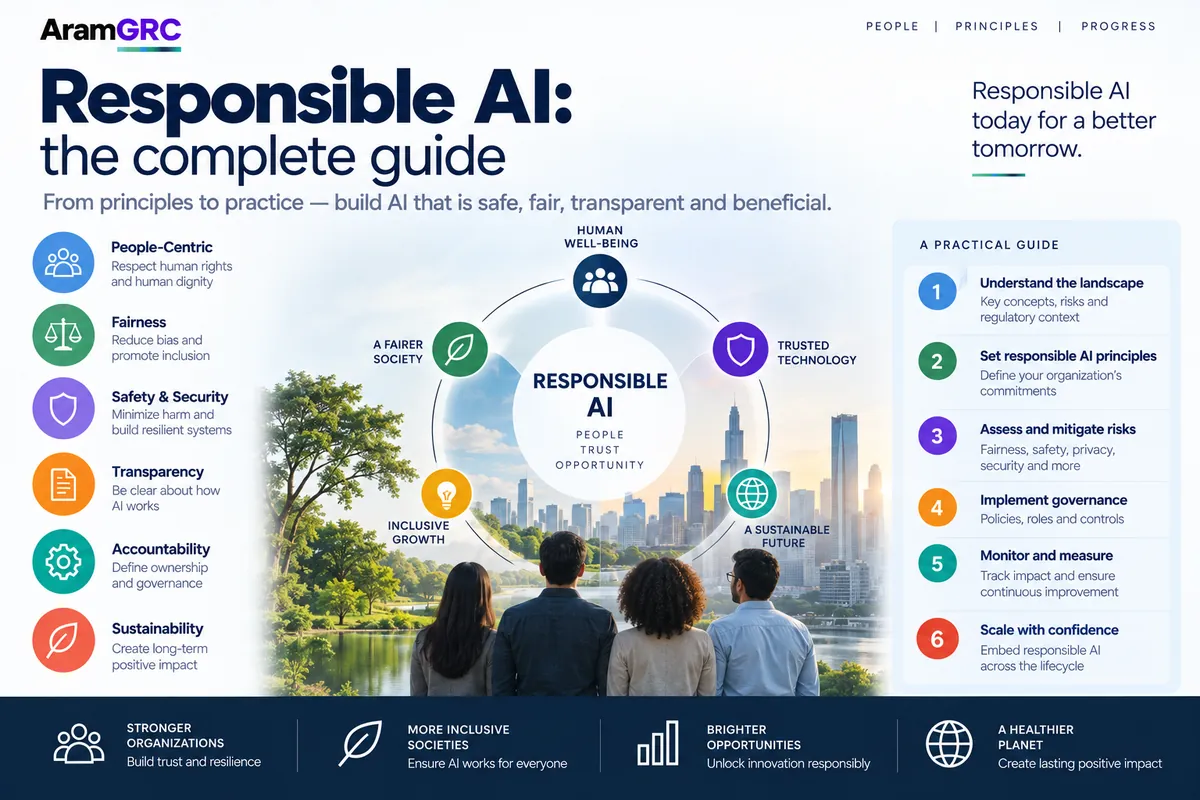
Responsible AI is the commitment to build and use AI ethically, fairly, transparently and accountably — and the practices that make that commitment real. Every organisation now says it uses AI responsibly; far fewer can show what that means in practice. This guide sets out the core principles, how responsible AI relates to governance and ethics, and how to move from statement to action, with deep-dive links. It pairs with our guides to AI governance and AI risk assessment.
AramGRC Team·Responsible AI·September 11, 2026·13 min read
What is responsible AI?
Responsible AI is the practice of designing, developing and deploying AI systems that respect people's rights, avoid harm, and earn trust. It spans the full lifecycle — from the data a system is trained on, to how it makes decisions, to how it's monitored in production and who is accountable when something goes wrong. In short: responsible AI is what “using AI well” actually looks like when you turn it into concrete practices rather than a statement of intent.
Responsible AI at a glance
What it is: building and using AI ethically, fairly, transparently and accountably, across the lifecycle.
Core principles: fairness, transparency, accountability, privacy and security, safety and reliability, human oversight, and inclusiveness.
How it's done: through governance — policies, roles, risk and impact assessments, testing and monitoring.
Why it matters: trust, regulation (EU AI Act, ISO 42001, India's DPDP and MeitY guidelines), enterprise demand and risk reduction.
Why responsible AI matters
Responsible AI has moved from a values statement to a business requirement. Customers and regulators now expect it; the EU AI Act, ISO/IEC 42001 and India's AI governance guidelines encode it; enterprise buyers ask for proof of it before signing; and the cost of getting it wrong — a biased model, a privacy breach, a harmful output — is measured in fines, lost deals and reputation. Done well, responsible AI is what lets you adopt AI faster, not slower, because you're not stopping every few months to clean up avoidable harm.
The core principles of responsible AI
Leading frameworks — from the OECD, the EU, NIST and major technology companies — converge on a consistent set:
Fairness — AI treats individuals and groups equitably and doesn't discriminate.
Transparency — how a system works and why it decided something can be explained appropriately.
Accountability — a named human or function is responsible for each system's outcomes.
Privacy and security — personal data is protected and used lawfully; systems resist misuse.
Safety and reliability — systems perform as intended and fail safely.
Human oversight — people can review, contest and override AI decisions.
Inclusiveness — AI is designed to work for the diversity of people it serves.
These three are used interchangeably but describe different layers. AI ethics is the set of values (fairness, dignity, non-harm). Responsible AI is the practice of building to those values. AI governance is the operating system — policies, roles, assessments and controls — that makes responsible AI happen reliably and provably. Ethics tells you what's right; responsible AI is doing it; AI governance is how you guarantee it.
A framework for responsible AI
Principles only matter if they change what teams do. A responsible AI framework turns the principles into requirements, assessments, controls and evidence — mapped to standards like ISO/IEC 42001 and the NIST AI RMF. See responsible AI framework.
How to implement responsible AI
Implementation is where most responsible-AI efforts stall. The move from policy to practice runs through inventory, risk and impact assessments, testing for bias and safety, monitoring, and real accountability. See how to implement responsible AI.
Responsible AI examples
Responsible AI is easiest to understand through what it looks like in practice — a bias-tested credit model, a transparent chatbot, a human-reviewed hiring tool. See responsible AI examples.
Responsible AI tools
A growing set of tools supports responsible AI — for bias testing, explainability, monitoring and governance. See responsible AI tools & toolkits.
Measuring responsible AI maturity
You can't improve what you don't measure. A responsible AI maturity assessment benchmarks your organisation against the principles and gives you a roadmap. See responsible AI maturity.
Responsible AI and regulation
Responsible AI is increasingly the law, not just good practice. The EU AI Act encodes fairness, transparency and human oversight; ISO/IEC 42001 provides a certifiable management system for it; and India's DPDP Act, MeitY guidelines and RBI's FREE-AI framework all centre responsible-AI principles. See the EU AI Act and AI regulation in India.
Responsible AI as a business advantage
Responsible AI is often framed as a constraint. In practice it's an enabler: it lets you deploy AI into high-stakes uses with confidence, satisfy enterprise buyers who now demand it, stay ahead of regulation, and protect trust that takes years to build and moments to lose.
Key takeaways
Responsible AI is building and using AI ethically, fairly, transparently and accountably — across the lifecycle.
Its core principles are fairness, transparency, accountability, privacy and security, safety, human oversight and inclusiveness.
It's made real through AI governance — and measured through a maturity assessment.
It's increasingly required by the EU AI Act, ISO/IEC 42001 and India's AI rules.
Done well, it accelerates AI adoption rather than slowing it.
How AramGRC helps
AramGRC's Responsible AI Maturity Assessment benchmarks your organisation against responsible-AI principles and gives you a scorecard and improvement roadmap — and our Responsible AI team capacity setup builds the roles, RACI and skills to operate it, so responsible AI becomes something you do, not just something you say.
Frequently asked questions
What is responsible AI?+
The practice of designing, developing and deploying AI ethically, fairly, transparently and accountably across its lifecycle, so it respects people's rights and earns trust.
What does responsible AI mean?+
It means building and using AI in line with values like fairness, transparency, accountability, privacy, safety, human oversight and inclusiveness — and having the practices to make those real.
What are the principles of responsible AI?+
Fairness, transparency, accountability, privacy and security, safety and reliability, human oversight, and inclusiveness.
What is the difference between responsible AI and AI governance?+
Responsible AI is the set of values and the practice of building to them; AI governance is the operating system of policies, roles and controls that makes responsible AI consistent and provable.
What is the difference between responsible AI and ethical AI?+
AI ethics is the underlying values; responsible AI is the practice of applying those values when building and using AI systems.
Why is responsible AI important?+
Because unmanaged AI creates legal, reputational and financial risk. Responsible AI earns trust, satisfies regulators and buyers, and lets you scale AI adoption safely.
How do you implement responsible AI?+
Translate principles into requirements, inventory and assess your AI systems, test for bias and safety, monitor in production, assign accountability, and align to a standard like ISO 42001.
Is there a responsible AI certification?+
Organisations can certify to ISO/IEC 42001 (the AI management system standard), and individuals can take responsible-AI and AI-governance credentials — see our AI governance certification guide.
Responsible AIAI GovernanceAI Ethics
The Responsible AI series
Responsible AI
What responsible AI means, the core principles, and how to put it into practice.