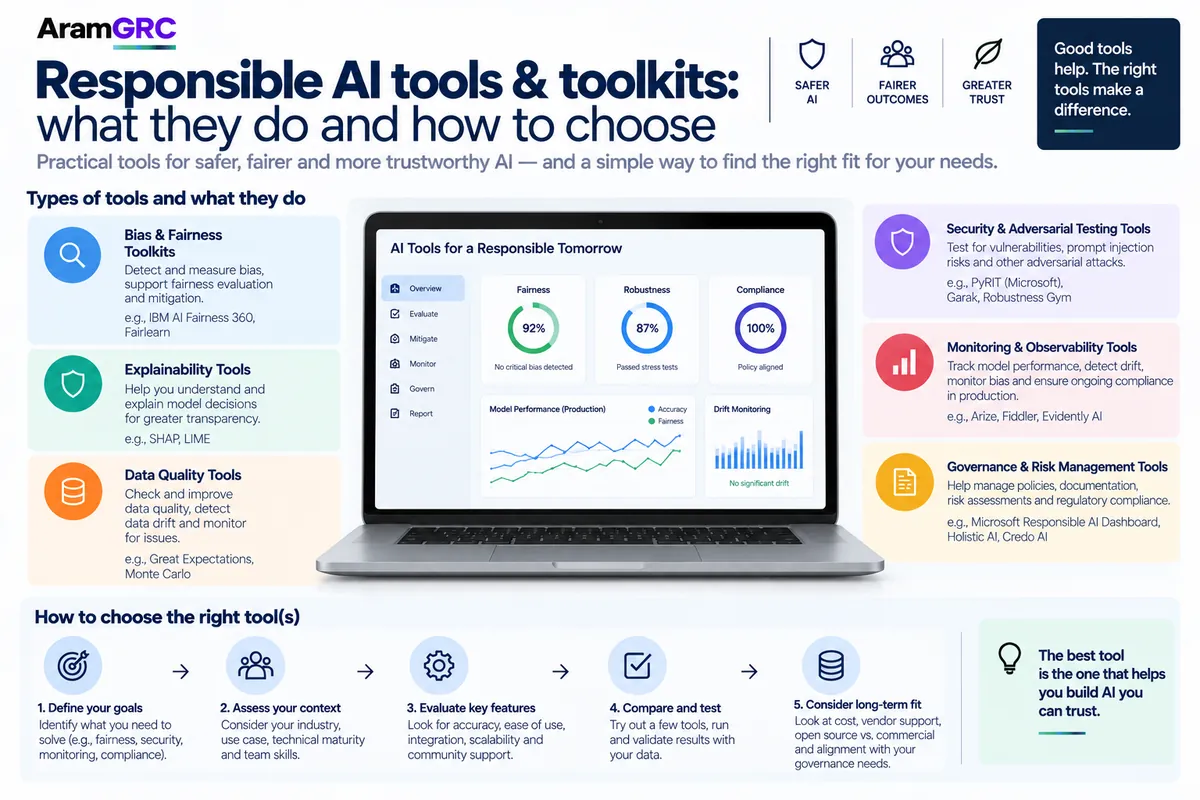
Responsible AI tools & toolkits: what they do and how to choose
A growing set of tools and toolkits supports responsible AI — for bias testing, explainability, monitoring and governance. This guide covers the categories, examples, and how to choose. Part of our guide to Responsible AI.
AramGRC Team·Responsible AI·September 11, 2026·8 min read
What responsible AI tools do
Responsible AI tools help operationalise the principles — measuring fairness, explaining model decisions, monitoring for drift, and holding the inventory, assessments and evidence. They turn responsible AI from manual effort into something repeatable and scalable.
The categories of responsible AI tools
Bias and fairness — libraries that measure fairness metrics across groups (e.g. Fairlearn, AIF360).
Explainability — tools that surface why a model produced a result (e.g. SHAP, LIME).
Robustness and red-teaming — adversarial testing tools (e.g. Garak, PyRIT); see AI red teaming tools.
Monitoring — drift, performance and bias monitoring for production.
Governance and evidence platforms — AI GRC platforms that hold the inventory, assessments and audit-ready evidence.
Vendor and big-tech toolkits
Several large providers publish responsible-AI toolkits — for example Microsoft's Responsible AI Toolbox, and offerings from Google and IBM — bundling fairness, explainability and error-analysis tools. They're a useful starting point, especially if you're already on that cloud.
How to choose responsible AI tools
Evaluate on: which principles they actually cover (fairness, explainability, robustness), how they map to the standards you're judged against, whether they produce exportable evidence, and how they integrate with your stack. Favour tools that strengthen an evidence trail, not just a dashboard.
Tools support responsible AI; they don't deliver it
A tool can measure a fairness gap; it can't decide whether it's acceptable, design the control, or take accountability. Responsible AI needs governance and human judgement — tools make it faster, not automatic.
How AramGRC helps
AramGRC helps you choose and apply the right responsible-AI tooling within a governance programme — so the outputs feed real decisions and evidence.
Frequently asked questions
What are responsible AI tools?+
Tools that operationalise responsible-AI principles — bias and fairness testing, explainability, robustness/red-teaming, monitoring, and governance/evidence platforms.
What is the Microsoft Responsible AI Toolbox?+
A Microsoft-published open-source toolkit bundling fairness assessment, interpretability/explainability and error-analysis tools to support responsible AI development.
What tools test AI for bias?+
Open-source libraries like Fairlearn and AIF360 measure fairness metrics across groups; they integrate into an evaluation pipeline.
Do tools make AI responsible?+
No — tools measure and support responsible AI, but governance, controls and human judgement are what actually make an AI system responsible.