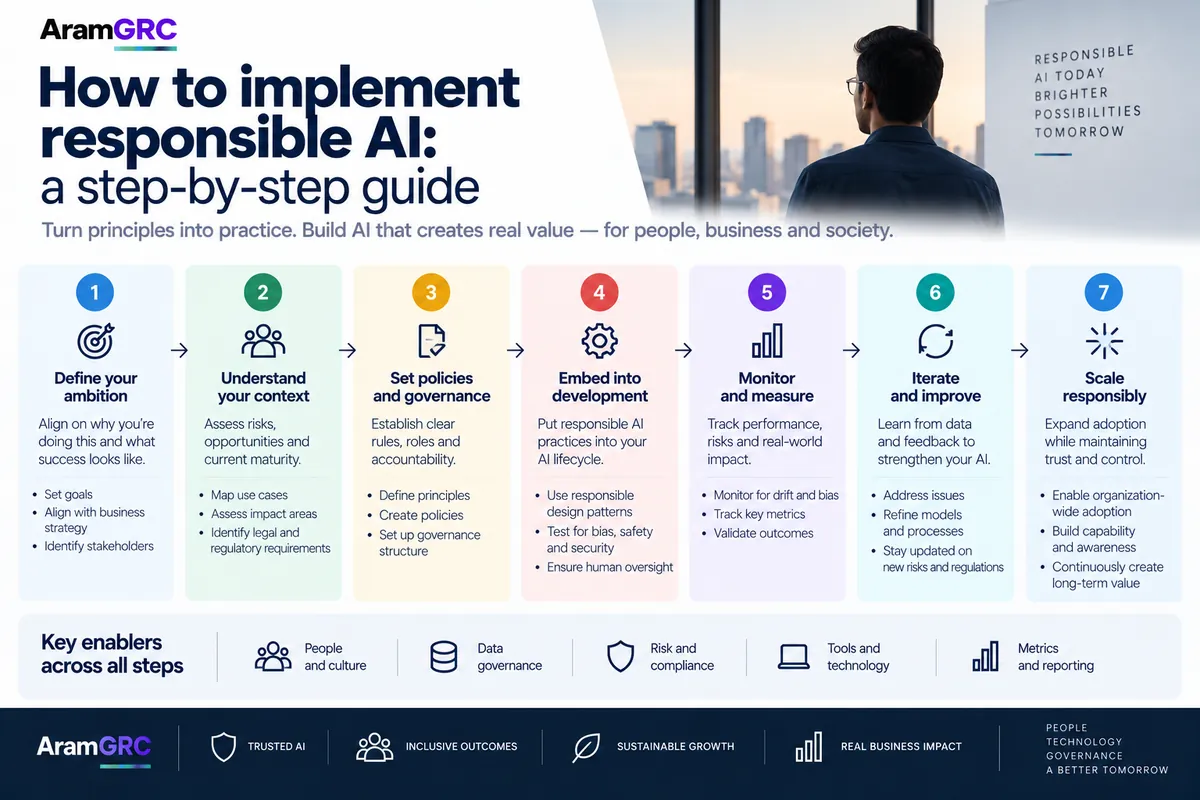
How to implement responsible AI: a step-by-step guide
Most organisations have a responsible-AI statement; far fewer have responsible AI in practice. This guide walks the steps to close that gap — turning principles into requirements, assessments, tests and evidence. Part of our guide to Responsible AI.
AramGRC Team·Responsible AI·September 11, 2026·9 min read
Why implementation is where responsible AI fails
The gap between a responsible-AI policy and responsible AI in practice is where most programmes stall. A statement of principles doesn't test a model for bias, doesn't gate a deployment, and doesn't monitor for drift. Implementation is the unglamorous work that makes the principles real — and it's what regulators and buyers actually look for.
The steps to implement responsible AI
Set your principles and AI policy — short, clear, and owned by leadership.
Inventory and risk-tier your AI systems — including third-party and embedded AI.
Translate principles into requirements — e.g. ‘fairness’ becomes ‘every customer-facing model is bias-tested before launch’.
Assess before deployment — a risk and impact assessment gate (see AI risk assessment).
Test for bias and safety — build it into the release process (see AI testing).
Monitor in production — watch for drift and emerging harm.
Assign accountability and build capability — a RACI, and the roles and training to operate it.
Align to a standard and prove it — map to ISO/IEC 42001 so responsible AI becomes a credential (see ISO 42001 certification).
Making responsible AI stick
Implementation isn't just process — it's culture and capability. Responsible AI sticks when teams are trained, accountability is real, and doing the right thing is the path of least resistance rather than an extra hurdle.
Common mistakes
The usual failures: a policy with no controls behind it, no owner, no evidence, and treating responsible AI as a one-time project rather than an operating discipline.
Responsible AI by design
The cheapest place to build responsible AI is at the start. ‘Responsible AI by design’ means baking the principles into how systems are scoped and built, rather than retrofitting them after a problem surfaces.
How AramGRC helps
AramGRC helps you implement responsible AI end to end — a maturity assessment to find the gaps, a governance operating model, and the team capacity to run it. See responsible AI maturity.
Frequently asked questions
How do you implement responsible AI?+
Set principles and policy, inventory and risk-tier your AI, translate principles into requirements, assess before deployment, test for bias and safety, monitor in production, assign accountability, and align to a standard like ISO 42001.
What is responsible AI by design?+
Baking responsible-AI principles into how AI systems are scoped and built from the start, rather than retrofitting them after a problem appears.
Who is responsible for implementing responsible AI?+
Leadership owns the commitment; a governance lead owns the programme; system owners are accountable for their systems; and risk, legal and security partners support it.
How do you make responsible AI stick?+
Through culture and capability — training teams, making accountability real, and designing the responsible path to be the easy one, not an extra hurdle.