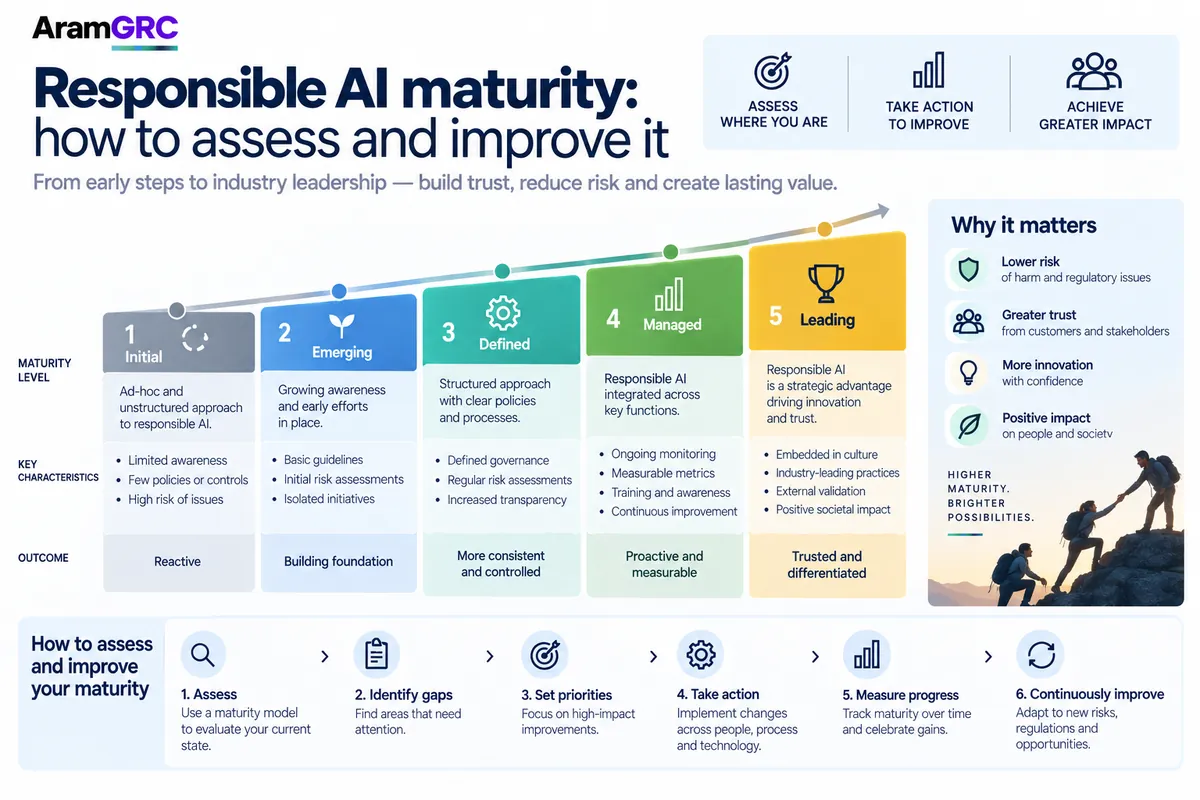
Responsible AI maturity: how to assess and improve it
You can't improve what you don't measure. Responsible AI maturity tells you how developed your practice really is, and where to focus next. This guide explains the maturity levels, how an assessment works, and how to move up the curve. Part of our guide to Responsible AI.
AramGRC Team·Responsible AI·September 11, 2026·8 min read
What is responsible AI maturity?
Responsible AI maturity is a measure of how developed and embedded an organisation's responsible-AI practice is — from ad-hoc good intentions to a managed, evidenced, continuously improving discipline. It turns a vague sense of ‘are we doing this well?’ into a score you can act on.
Why measure responsible AI maturity
A maturity assessment gives you a baseline, shows where the biggest gaps are, lets you benchmark against peers and expectations, and demonstrates progress to leadership, buyers and regulators. It's the difference between ‘we care about responsible AI’ and ‘here's exactly where we are and what's next’.
The responsible AI maturity levels
Most maturity models use five levels:
Level 1 — Ad-hoc: no formal practice; responsible AI depends on individuals.
Level 2 — Developing: principles and some policies exist, but they're inconsistently applied.
Level 3 — Defined: a documented framework, assessments and controls are in place.
Level 4 — Managed: controls are monitored and measured, with evidence and accountability.
Level 5 — Optimised: responsible AI is embedded, continuously improved, and independently assured.
What a maturity assessment evaluates
A good assessment scores you across both the responsible-AI principles and the governance dimensions that deliver them: policy and leadership, AI inventory, risk and impact assessment, testing (bias, safety), monitoring, accountability and capability.
How a responsible AI maturity assessment works
It combines interviews, document review and evidence checks into a scorecard by dimension, a benchmarked overall level, and a prioritised roadmap of the highest-impact gaps to close first.
How to improve your responsible AI maturity
Move up the curve by closing the highest-impact gaps in order — usually starting with an AI inventory and a pre-deployment assessment gate, then testing and monitoring, then evidence and independent assurance. Small, sequenced steps beat a boil-the-ocean programme.
How AramGRC helps
AramGRC's Responsible AI Maturity Assessment benchmarks your organisation against responsible-AI principles across all these dimensions, and gives you a scorecard and an improvement roadmap — and our team capacity setup builds the roles to act on it.
Frequently asked questions
What is responsible AI maturity?+
A measure of how developed and embedded an organisation's responsible-AI practice is — from ad-hoc to managed and continuously improving — expressed as a score you can act on.
How do you measure responsible AI maturity?+
With a maturity assessment that scores you across the responsible-AI principles and governance dimensions (policy, inventory, assessment, testing, monitoring, accountability) and benchmarks an overall level.
What are the responsible AI maturity levels?+
Typically five: ad-hoc, developing, defined, managed and optimised — from no formal practice to an embedded, independently assured discipline.
How do you improve responsible AI maturity?+
Close the highest-impact gaps in sequence — usually inventory and a pre-deployment assessment gate first, then testing and monitoring, then evidence and independent assurance.