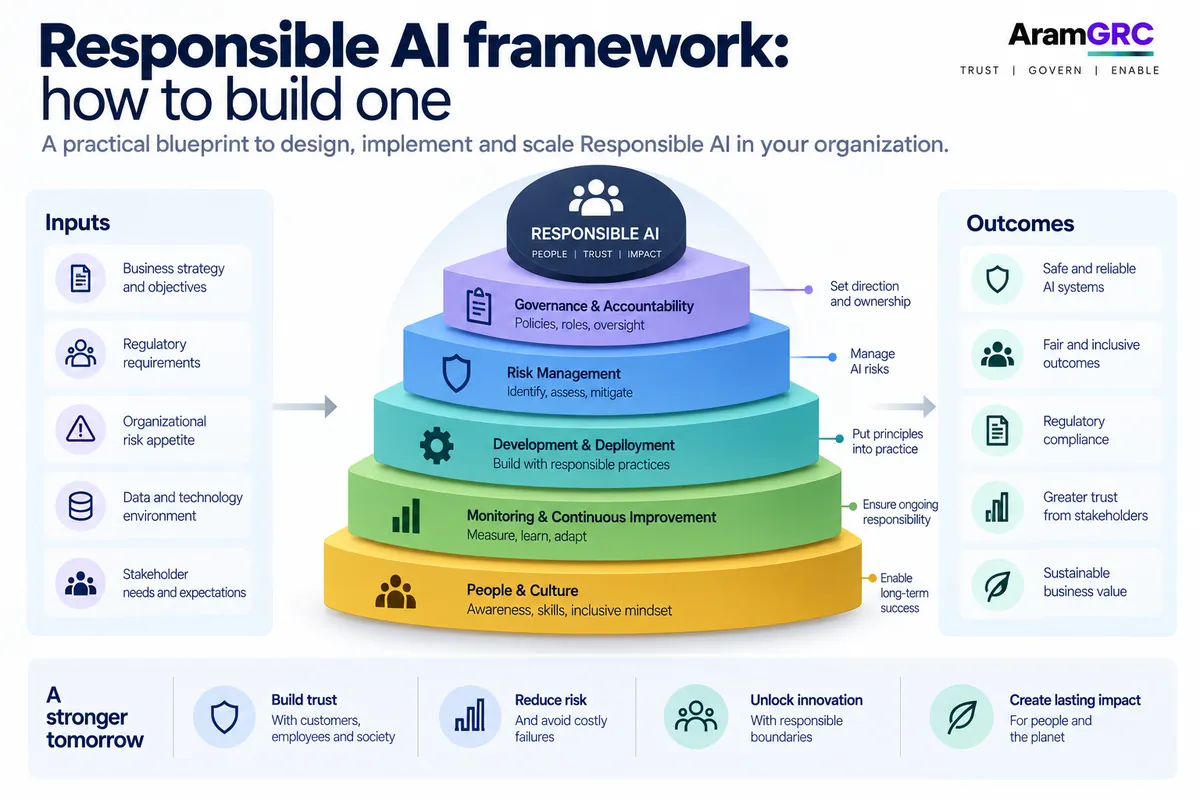
A responsible AI framework is what turns responsible-AI principles into repeatable practice. This guide explains the components and how it maps to recognised standards. Part of our guide to Responsible AI.
AramGRC Team·Responsible AI·September 11, 2026·8 min read
What is a responsible AI framework?
A responsible AI framework is a structured operating model that turns responsible-AI principles into policies, roles, assessments, controls and evidence — so an organisation applies them consistently across every AI system, rather than case by case.
The components of a responsible AI framework
Principles and policy — your stated commitments and what's allowed.
AI inventory and risk tiering — every system, classified by risk.
A risk and impact assessment gate — before any system goes live.
Controls for each principle — bias testing (fairness), documentation (transparency), data governance (privacy), evaluation (safety), human-in-the-loop (oversight).
Monitoring — for drift, performance and emerging harm in production.
Roles and accountability — a RACI so each system has an owner.
Evidence — documentation you can show auditors, regulators and buyers.
Recognised frameworks to build on
Adopt a recognised structure rather than starting from scratch: the NIST AI Risk Management Framework (Govern, Map, Measure, Manage), ISO/IEC 42001 (the certifiable AI management system standard), and the OECD AI Principles, with the EU AI Act as the binding legal layer. See ISO 42001 certification and the EU AI Act.
How to build your responsible AI framework
Adopt your principles and a base standard (ISO 42001 or the NIST AI RMF).
Inventory and risk-tier your AI systems.
Translate each principle into requirements and controls.
Add a pre-deployment assessment gate and production monitoring.
Assign accountability, keep evidence, and map to the regulations you face.
Responsible AI framework vs AI governance framework
In practice these are the same system viewed through different lenses — a responsible AI framework emphasises the values, an AI governance framework emphasises the operating model. Build one system that does both.
How AramGRC helps
AramGRC designs and stands up your responsible AI framework — principles, policy, controls and RACI — mapped to ISO/IEC 42001, the NIST AI RMF and the EU AI Act.
Frequently asked questions
What is a responsible AI framework?+
A structured operating model that turns responsible-AI principles into policies, roles, assessments, controls and evidence, applied consistently across every AI system.
What should a responsible AI framework include?+
Principles and policy, an AI inventory with risk tiering, a risk and impact assessment gate, controls for each principle, monitoring, accountability, and an evidence trail.
What responsible AI frameworks exist?+
The NIST AI RMF, ISO/IEC 42001, and the OECD AI Principles are the main references, with the EU AI Act as the binding legal layer.
How do you build a responsible AI framework?+
Adopt your principles and a base standard, inventory and risk-tier your AI, translate principles into controls, add an assessment gate and monitoring, assign accountability, and map to the regulations you face.