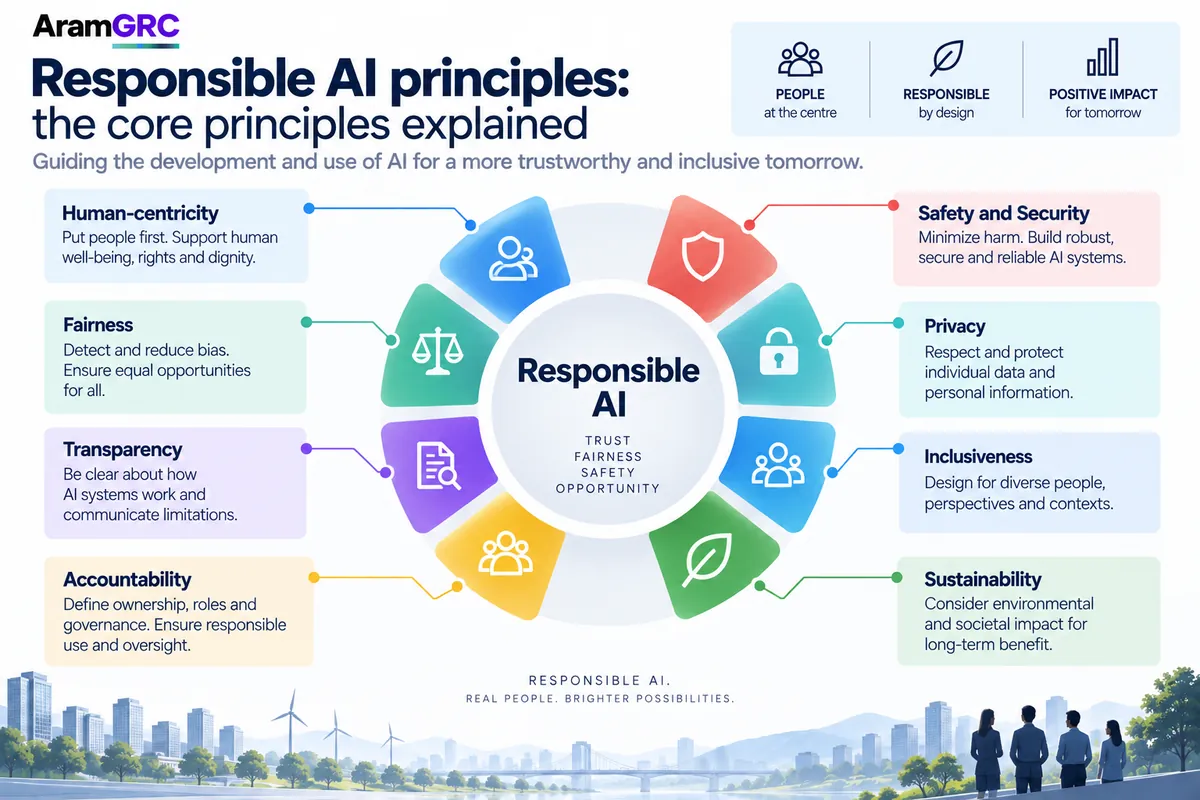
Responsible AI principles: the core principles explained
Responsible AI rests on a set of principles that recur across every major framework. This guide explains each one and what it means in practice — because principles only matter when they change what teams actually do. Part of our guide to Responsible AI.
AramGRC Team·Responsible AI·September 11, 2026·8 min read
Where responsible AI principles come from
You don't have to invent responsible-AI principles — the world's frameworks have largely converged. The OECD AI Principles, the NIST AI Risk Management Framework, the EU AI Act, UNESCO's recommendation, and the principles published by major technology companies all describe a very similar set. India's MeitY guidelines and RBI's FREE-AI framework use the same ideas, expressed as seven ‘sutras’.
The core responsible AI principles
Fairness — AI treats individuals and groups equitably and doesn't discriminate. In practice: bias and fairness testing across affected groups.
Transparency and explainability — how a system works and why it decided something can be explained appropriately. In practice: model documentation and user-facing disclosure.
Accountability — a named human or function owns each system's outcomes. In practice: a RACI and an escalation path.
Privacy and security — personal data is protected and used lawfully; systems resist misuse. In practice: data governance and security testing.
Safety and reliability — systems perform as intended and fail safely. In practice: evaluation, robustness testing and monitoring.
Human oversight — people can review, contest and override AI decisions. In practice: a human-in-the-loop for high-stakes decisions.
Inclusiveness — AI is designed to work for the diversity of people it serves. In practice: representative data and diverse review.
How the principles map to controls
Each principle points to a concrete control: fairness to bias testing, transparency to documentation, safety to evaluation and red-teaming, privacy to data governance, oversight to a human-in-the-loop. Naming the principle is the first step; the control is how you honour it. Turn them into a system with a responsible AI framework.
Principles versus practice
A principle on a poster changes nothing. Responsible AI works only when the principles become requirements, assessments, tests and evidence — which is the job of AI governance and a working implementation.
The principles in regulation
These principles are increasingly encoded in law: the EU AI Act requires fairness, transparency and human oversight for high-risk AI; India's MeitY guidelines and RBI FREE-AI express them as guiding sutras; and ISO/IEC 42001 provides a management system to uphold them.
How AramGRC helps
AramGRC benchmarks your organisation against these responsible-AI principles and gives you a scorecard and roadmap — see responsible AI maturity.
Frequently asked questions
What are the principles of responsible AI?+
Fairness, transparency and explainability, accountability, privacy and security, safety and reliability, human oversight, and inclusiveness.
How many responsible AI principles are there?+
It varies by framework, but they converge on around seven core principles; India's MeitY and RBI express them as seven 'sutras'.
What is fairness in AI?+
The principle that an AI system treats individuals and groups equitably and doesn't discriminate — verified through bias and fairness testing across affected groups.
How do you apply responsible AI principles?+
Translate each principle into a concrete control — fairness to bias testing, transparency to documentation, safety to evaluation, oversight to human-in-the-loop — and enforce them through governance.