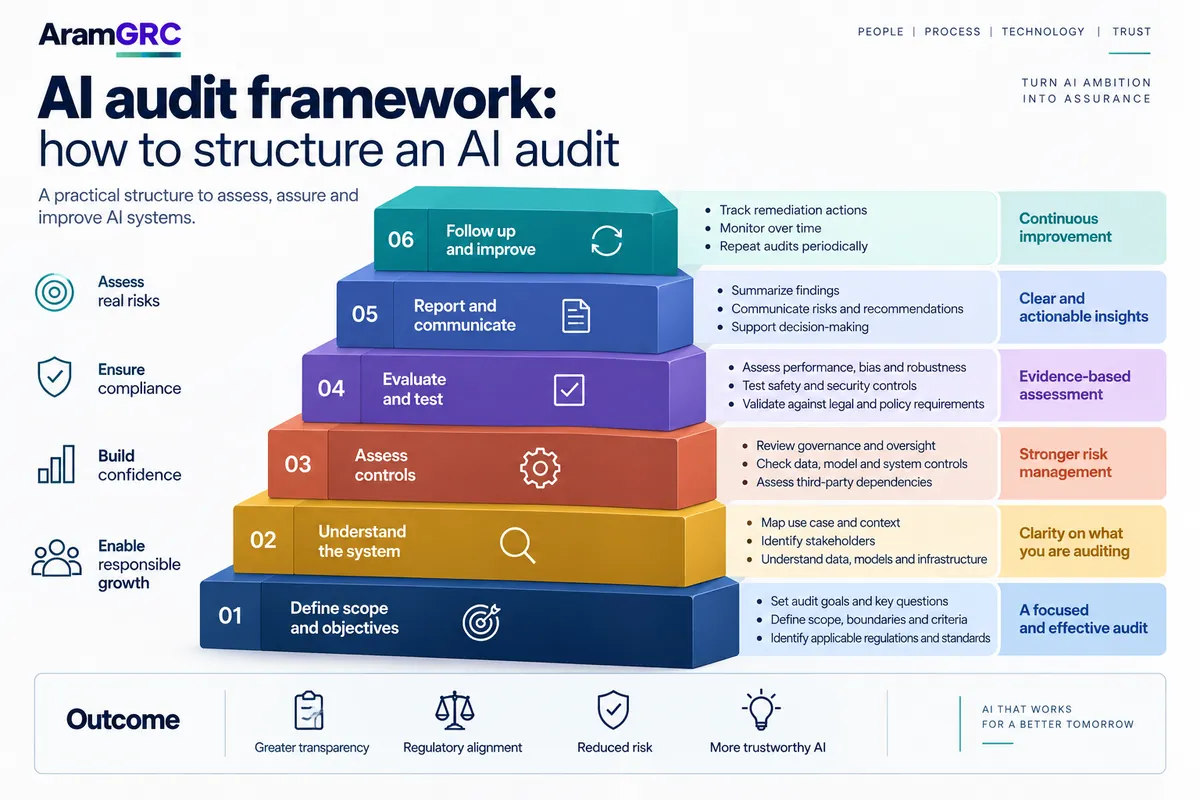
An AI audit framework is what turns an audit from a subjective review into a repeatable, defensible examination. This guide explains what a framework contains, the standards to map it to, and how to build one. Part of our guide to the AI audit.
AramGRC Team·AI Audit & Assurance·September 11, 2026·8 min read
What is an AI audit framework?
An AI audit framework is a structured set of criteria and methods for auditing an AI system against a standard. It defines what you assess, how you gather evidence, how you test, and how you rate and report findings — so two auditors reach the same conclusion and every audit produces comparable results.
The components of an AI audit framework
Scope and standard — what's audited and the benchmark (ISO/IEC 42001, EU AI Act, NIST AI RMF, or internal policy).
A control set / criteria — the specific things you check, derived from the standard.
Evidence requirements — what proof each criterion needs.
A severity and rating scheme — how gaps are scored and prioritised.
Reporting format — findings, evidence, remediation and, where warranted, attestation.
Standards to map your framework to
Rather than invent criteria, derive them from a recognised standard: ISO/IEC 42001's clauses and Annex A controls, the EU AI Act's high-risk requirements, or the NIST AI RMF's functions. Mapping to these makes your audit results portable and credible — see ISO 42001 certification and the EU AI Act.
How to build your AI audit framework
Choose your base standard and derive the control set.
Define the evidence each control requires.
Set your testing methods for bias, robustness and performance.
Build a severity/rating scheme and a report template.
Pilot it on one system, then standardise across your portfolio.
Why a framework beats ad-hoc audits
Ad-hoc audits depend on who runs them; a framework makes results consistent, defensible and comparable across systems — which is what auditors, regulators and buyers expect.
How AramGRC helps
AramGRC audits your AI against a framework mapped to ISO/IEC 42001, the EU AI Act and the NIST AI RMF — so the findings hold up with regulators and enterprise buyers.
Frequently asked questions
What is an AI audit framework?+
A structured set of criteria and methods for auditing an AI system against a standard — defining what you assess, the evidence required, the testing methods, and how findings are rated and reported.
What standard do you audit AI against?+
Commonly ISO/IEC 42001, the EU AI Act's high-risk requirements, or the NIST AI RMF — the framework derives its criteria from whichever applies.
How do you build an AI audit framework?+
Choose a base standard, derive the control set, define evidence requirements and testing methods, build a severity and reporting scheme, then pilot and standardise it.
Does ISO 42001 cover AI audits?+
Yes — ISO/IEC 42001 requires internal audits of the AI management system, and its clauses and Annex A controls are a common basis for structuring an AI audit.