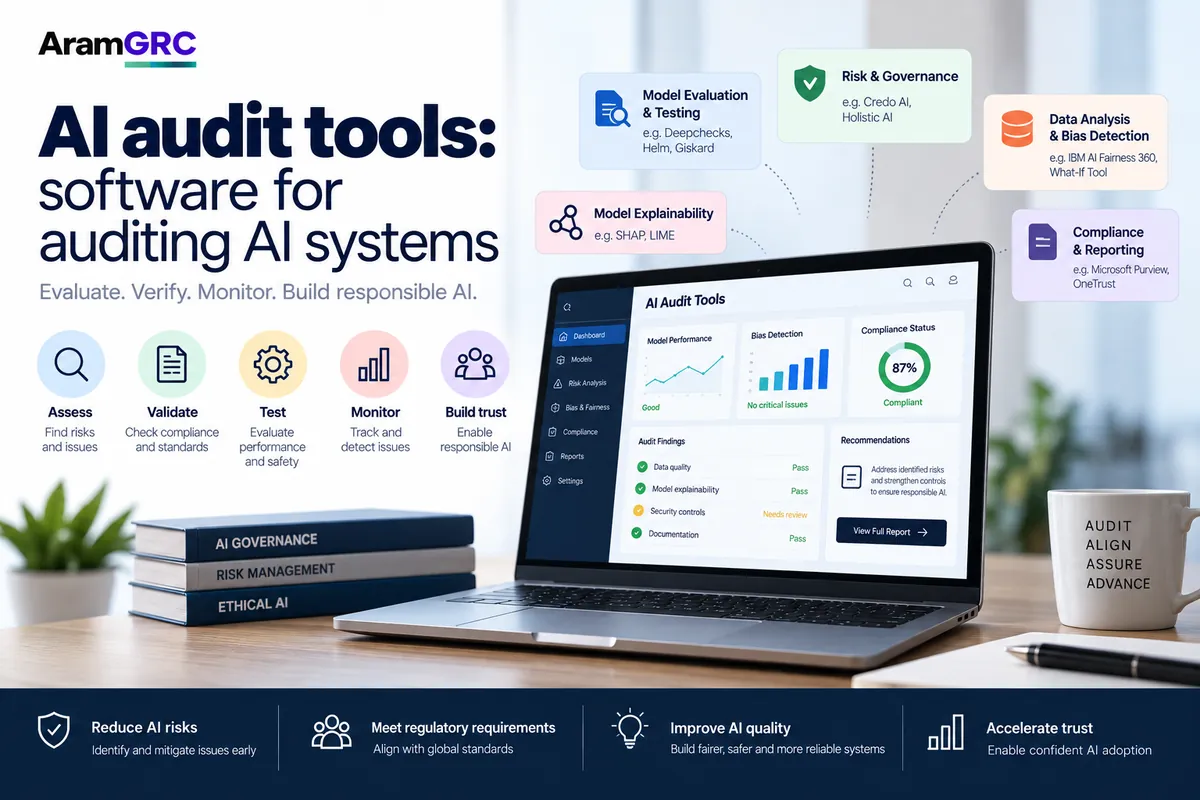
Auditing AI at scale needs tooling — for bias testing, robustness, explainability, monitoring and evidence. This guide explains the categories of AI audit tools, how to choose them, and where they fit alongside an auditor's judgement. Part of our guide to the AI audit.
AramGRC Team·AI Audit & Assurance·September 11, 2026·8 min read
What AI audit tools do
AI audit tools help an auditor gather evidence and run tests consistently — automating parts of the examination (bias tests, robustness probes, drift monitoring) and organising the evidence into something reportable. They make audits repeatable and scalable, but they don't make the judgement calls.
The categories of AI audit tools
Bias and fairness testing — toolkits that measure outcomes across protected and proxy attributes (for example, open-source libraries like Fairlearn and AIF360).
Robustness and adversarial testing — tools that probe models for failures and attacks (for example, Garak and PyRIT for LLMs).
Explainability — tools that surface why a model produced a result.
Model monitoring — drift, performance and bias monitoring for systems in production.
Governance and evidence platforms — AI governance/GRC platforms that hold the inventory, assessments and audit-ready evidence.
How to choose AI audit tools
Evaluate on: coverage (which dimensions they test), how well they map to the standard you audit against, whether they produce exportable, audit-ready evidence, and how they integrate with your MLOps and governance stack. Favour tools that strengthen an evidence trail, not just a dashboard.
Tools organise; they don't replace judgement
A tool can flag a fairness gap; it can't decide whether it's acceptable in context, or whether a control is adequate. Credible audits pair tooling with an experienced AI auditor.
Auditing AI vs AI for auditing
A note on terminology: “AI audit tools” usually means tools to audit AI systems, which is this guide's focus. It can also mean AI used by auditors to automate traditional financial or internal audit work — a different topic. If you're a financial or internal auditor exploring AI, that's the second sense; if you need to assess an AI system's safety and compliance, that's this one.
How AramGRC helps
AramGRC combines audit tooling with expert judgement to independently assess AI systems — and can advise on the tools that fit your governance stack.
Frequently asked questions
What tools are used to audit AI?+
Bias and fairness testing toolkits (e.g. Fairlearn, AIF360), robustness and adversarial testing tools (e.g. Garak, PyRIT), explainability tools, model-monitoring tools, and AI governance/evidence platforms.
Is there AI audit software?+
Yes — AI governance and GRC platforms and specialist testing tools automate parts of an AI audit and hold the evidence, though they don't replace an auditor's judgement.
Can you use AI to audit?+
Two senses: tools that use AI to help audit AI systems, and AI used by financial or internal auditors to automate traditional audit work. This guide is about auditing AI systems.
What should AI audit tools do?+
Test the right dimensions (bias, robustness, explainability), map to the standard you audit against, and produce exportable, audit-ready evidence that integrates with your stack.