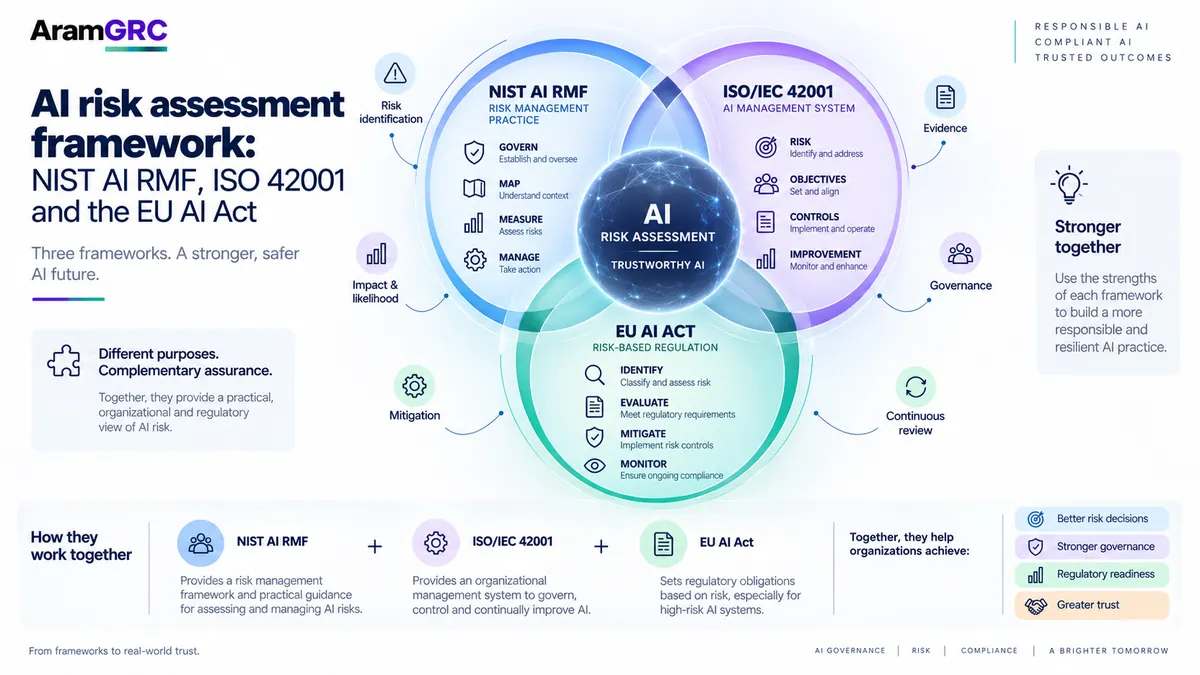
AI risk assessment framework: NIST AI RMF, ISO 42001 and the EU AI Act
An AI risk assessment framework is what makes your assessments consistent, defensible and mapped to the standards you're judged against. This guide explains what a framework contains and how it aligns with the NIST AI RMF, ISO 42001 and the EU AI Act. Part of our guide to the AI risk assessment.
AramGRC Team·AI Risk & Assurance·September 11, 2026·8 min read
What is an AI risk assessment framework?
An AI risk assessment framework is the structured method behind your assessments — a risk taxonomy, a scoring method, a library of controls, decision thresholds and a review cadence — so every assessment is run the same way and produces comparable, auditable results.
The main frameworks to build on
NIST AI Risk Management Framework — organised around four functions: Govern, Map, Measure and Manage. A widely used, voluntary backbone for AI risk.
ISO/IEC 42001 — the AI management system standard, which requires AI risk and impact assessments and provides Annex A controls to treat risk. See ISO 42001 certification.
EU AI Act — requires a risk-management system across the lifecycle for high-risk AI. See the EU AI Act.
The components of your framework
A risk taxonomy — the dimensions and categories of AI risk you assess against.
A scoring method — consistent likelihood and impact scales.
A controls library — standard mitigations mapped to common risks.
Decision thresholds — what score triggers conditions, escalation or a stop.
A review cadence — when systems are re-assessed.
How to build your AI risk assessment framework
Adopt a base framework (the NIST AI RMF or ISO 42001) rather than starting from scratch.
Define your risk taxonomy and scoring scale.
Build a controls library and decision thresholds.
Create the template and cadence, then pilot on one system and standardise.
Mapping to multiple regimes at once
Because the NIST AI RMF, ISO 42001 and the EU AI Act overlap heavily, one framework can satisfy all three — assess once and map the evidence to each. Govern once, evidence everywhere.
How AramGRC helps
AramGRC builds your AI risk assessment framework and maps it to the NIST AI RMF, ISO/IEC 42001 and the EU AI Act — so your assessments are consistent and hold up with regulators and buyers.
Frequently asked questions
What is an AI risk assessment framework?+
The structured method behind AI risk assessments — a risk taxonomy, scoring method, controls library, decision thresholds and review cadence — that makes assessments consistent and auditable.
What is the NIST AI RMF?+
The NIST AI Risk Management Framework, a voluntary US framework organised around four functions — Govern, Map, Measure, Manage — widely used as a backbone for AI risk assessment.
Does ISO 42001 require a risk assessment?+
Yes — ISO/IEC 42001 requires AI risk assessment and AI impact assessment as part of its management system, with Annex A controls to treat the risks.
How do you build an AI risk assessment framework?+
Adopt a base framework (NIST AI RMF or ISO 42001), define your risk taxonomy and scoring, build a controls library and thresholds, create a template and cadence, then pilot and standardise.