A client once asked us for “an AI audit,” and in the kickoff call it became obvious that four people in the room meant four different things. Legal wanted a compliance check against regulation. The data science lead pictured a model performance and bias review. Security assumed we’d be attacking the system. The CEO just wanted a report they could show a customer. They weren’t confused — “AI audit” genuinely covers all of those, and if you don’t say which one you mean, you’ll buy the wrong thing.
I’m Anand, one of the co-founders of AramGRC. So let me untangle it: what an AI audit actually is, the main types, what a good one covers, and — the part that separates a real audit from a rubber stamp — what a strong AI audit report should contain.
What is an AI audit?
An AI audit is a structured, independent examination of an AI system to check whether it does what it claims and meets defined expectations — for compliance, fairness, safety, performance or all of the above — with documented evidence to back the conclusions. Unlike a one-off test, an audit is systematic: a defined scope, a methodology, evidence, findings, and a report someone outside the team can rely on.
Key takeaway
“AI audit” is an umbrella term. The first question in any audit is: an audit against what — a regulation, a standard, fairness, or security?
The main types of AI audit
Different questions call for different audits. These are the ones teams actually ask for:
| Type of AI audit | Core question | Checked against |
|---|
| Governance / compliance audit | Do our AI governance and controls meet the bar? | ISO/IEC 42001, EU AI Act, NIST AI RMF |
| Bias & fairness audit | Does the system treat people fairly? | Fairness metrics, anti-discrimination law (e.g. NYC Local Law 144) |
| Model / technical audit | Is the model accurate, robust and well-built? | Performance, data quality, robustness benchmarks |
| Security / red-team audit | Can the AI be attacked or manipulated? | Adversarial testing, OWASP LLM Top 10 |
| Regulatory conformity audit | Does it satisfy a specific law’s requirements? | The regulation’s own conformity criteria |
Most serious “AI audits” are really a combination — for example a governance audit with a bias assessment and a red-team component behind it.
What’s in scope: what a good audit covers
A thorough AI audit looks beyond the model to the whole system:
- The AI system itself — its purpose, model, inputs and outputs.
- The data — sources, quality, representativeness, and governance of training and test data.
- The controls — human oversight, logging, access, incident processes.
- The governance — policies, roles, risk and impact assessments, lifecycle management.
- The evidence — documentation that proves the above actually happens, not just that it’s written down.
Scope is where audits quietly succeed or fail: a “model-only” audit that ignores the data pipeline and the humans around it gives false comfort.
The AI audit process
A credible audit follows a clear path: agree the scope and criteria; gather evidence (documentation, logs, data, configurations); test the system (technical checks, bias probes, and — where relevant — red teaming); analyse and rate findings by severity; write the report; support remediation; and re-test to confirm fixes. The word that matters throughout is independent — the auditor should have no stake in the result.
What a good AI audit report looks like
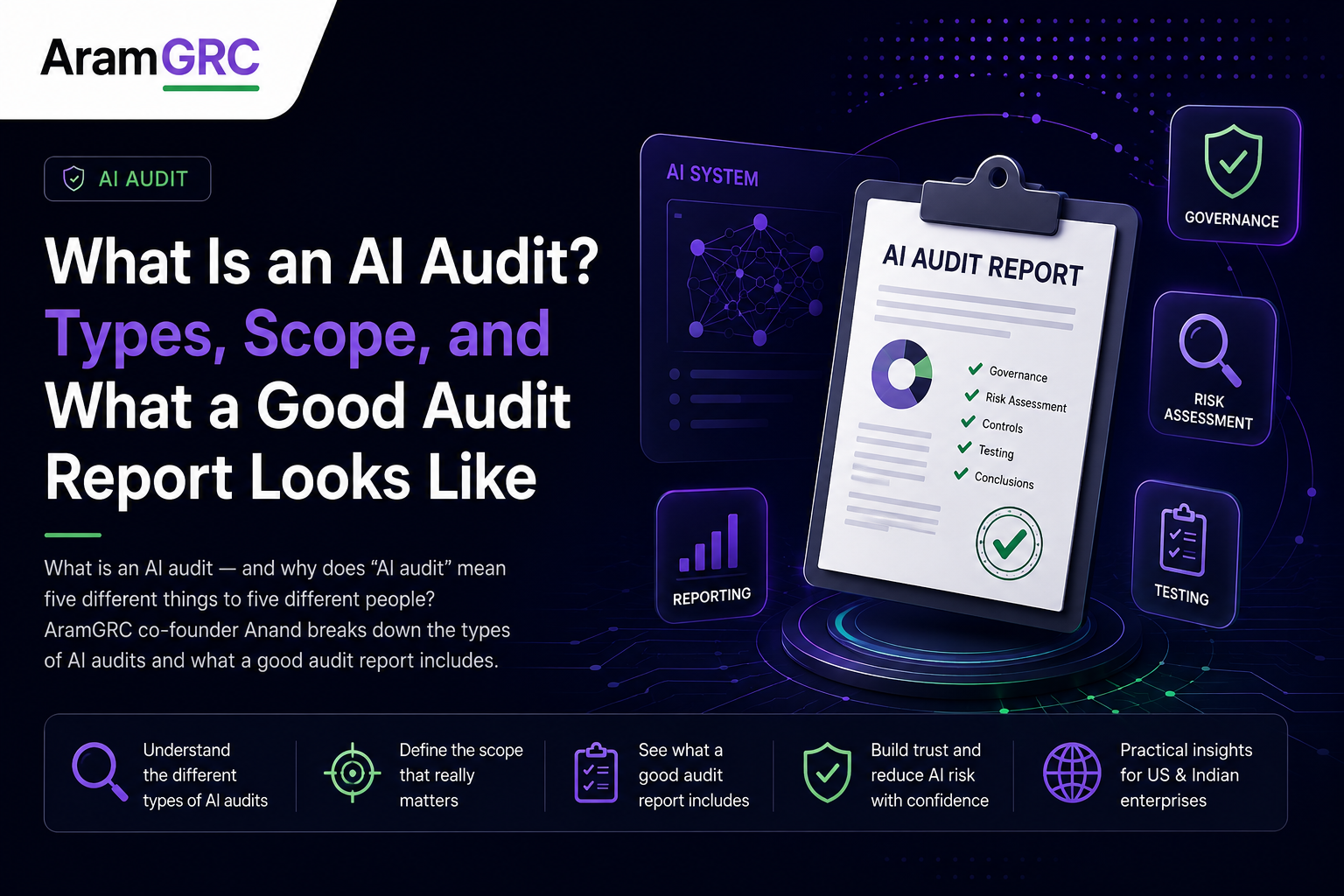
This is the deliverable that separates a real audit from a certificate, and it’s what you should judge any provider on. A strong AI audit report includes:
- Executive summary — the headline conclusions and risks in plain English, readable by a leader or a customer.
- Scope and criteria — exactly what was audited, and against which standard, regulation or metric.
- Methodology — how it was done, mapped to references (ISO/IEC 42001, NIST AI RMF, OWASP LLM Top 10, relevant law).
- Findings — each with a severity rating, a clear description, the evidence behind it, and the business or regulatory impact.
- Risk summary — a simple view of where the risk concentrates.
- Remediation — specific, prioritised recommendations, not “improve governance.”
- Retest results — what was fixed and verified.
- Statement of independence and limitations — who audited, and what the audit did and didn’t cover.
Key takeaway
If an “audit report” is a score and a logo with no findings, evidence or scope, it isn’t an audit — it’s a badge. Insist on findings and evidence.
Tools and checklists help — but they aren’t the audit
There are useful AI audit tools and checklists now, and a good audit checklist is a great way to prepare. But running a tool or filling a checklist is the input to an audit, not the audit itself. The value is in the judgement — interpreting evidence, weighing severity, and reaching an independent, defensible conclusion.
Internal vs independent audits
Internal audits are valuable for catching issues early, and every AI team should do them. But an internal audit shares the team’s blind spots and carries little weight with an external buyer or regulator. When the audit needs to prove something to someone outside your organisation, it needs to be independent. That’s the whole point of third-party assurance.
How we help at AramGRC
We run independent AI audits and assessments for AI product companies in India and the US — governance audits against ISO/IEC 42001 and the EU AI Act, bias and fairness reviews, and security/red-team audits — delivered as a report your engineers, customers and regulators can actually rely on, with remediation guidance and a retest. Tell us the question you’re being asked, and we’ll scope the right audit to answer it.
Need an AI audit — but not sure which kind?
Tell us what you’re being asked to prove, and we’ll scope the right audit — governance, bias, or security — and deliver a report you can act on. For AI companies in India and the US.
Talk to the AramGRC team
Frequently asked questions
What is an AI audit?
An AI audit is a structured, independent examination of an AI system to check whether it does what it claims and meets defined expectations — for compliance, fairness, safety or performance — with documented evidence behind the conclusions.
What are the main types of AI audit?
The common types are governance/compliance audits (against ISO 42001, the EU AI Act or NIST AI RMF), bias and fairness audits, model/technical audits, security or red-team audits, and regulatory conformity audits. Many real engagements combine several.
What does an AI audit include or cover?
A good AI audit covers the AI system, its data (sources, quality, governance), the controls around it (human oversight, logging, incident processes), the governance and documentation, and the evidence that these actually operate — not just the model in isolation.
What should an AI audit report include?
An executive summary, scope and criteria, methodology mapped to standards, findings rated by severity with evidence and impact, a risk summary, prioritised remediation, retest results, and a statement of independence and limitations.
Who performs AI audits?
Internal teams can run AI audits for early detection, but audits meant to prove something to customers or regulators should be performed by an independent third party with no stake in the outcome. Governance certifications like ISO 42001 must be audited by an accredited certification body.
Are AI audit tools and checklists enough?
They help you prepare and cover ground, but they are inputs, not the audit. The value of an audit is independent judgement — interpreting evidence, rating severity, and reaching a defensible conclusion — which no tool or checklist does on its own.
About the author
Anand — Co-founder, AramGRC. AramGRC is an independent AI assurance partner. We help AI product companies in India and the US prove their systems are safe, fair and trustworthy through AI audits, red teaming and assurance reporting aligned to ISO/IEC 42001, the EU AI Act and NIST AI RMF.