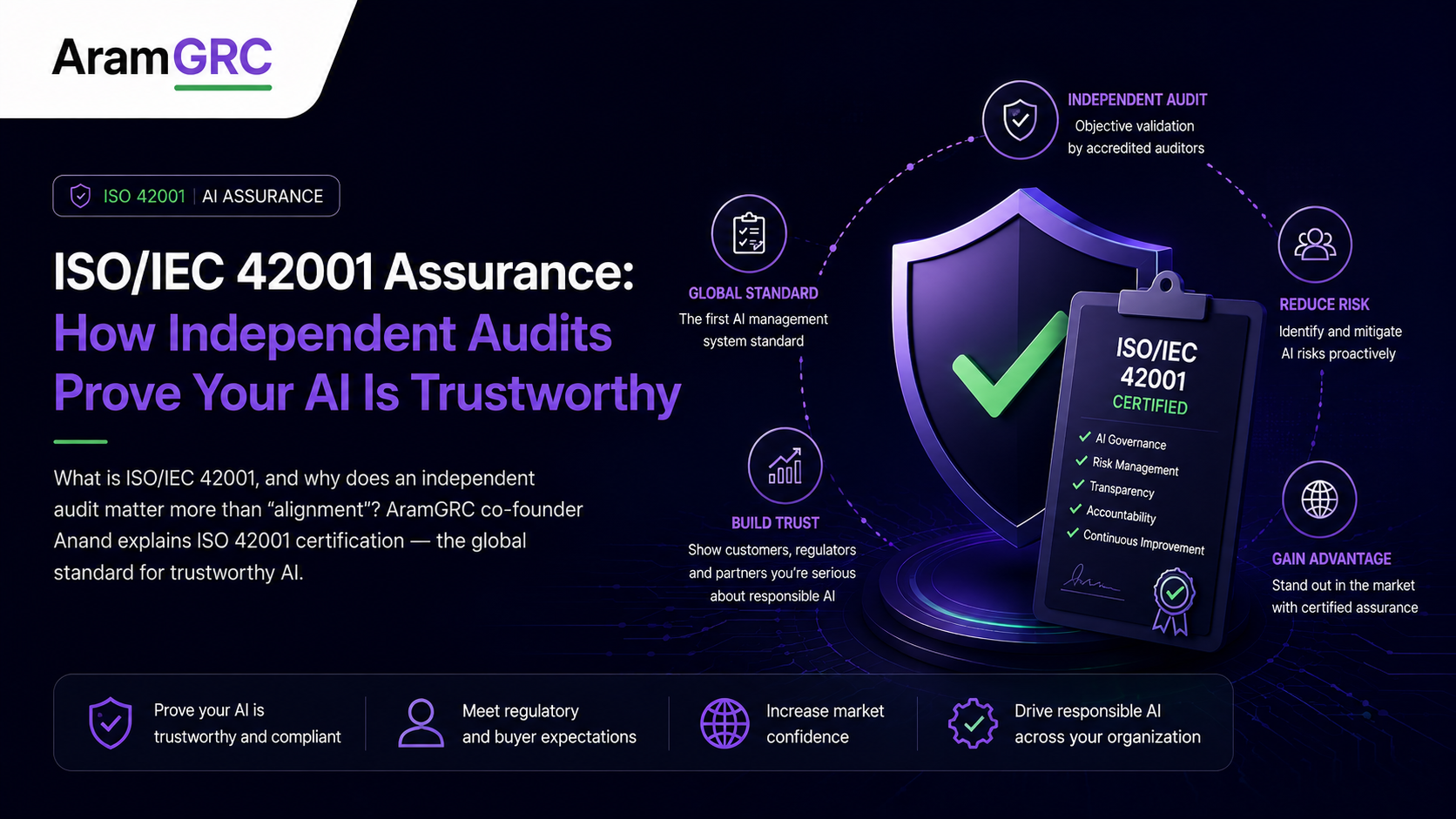
A company once told a prospect they were “ISO 42001 aligned.” The prospect’s procurement lead asked one quiet question: “Aligned, or certified?” There was an awkward pause, and the deal stalled while everyone worked out what the difference was. It’s a difference worth understanding before you’re the one in that meeting — because “we follow the standard” and “an independent body audited us against the standard” are not remotely the same promise.
I’m Anand, one of the co-founders of AramGRC. ISO/IEC 42001 is quickly becoming the way organisations prove they govern AI responsibly. But the value isn’t in the document — it’s in the independent audit behind the certificate. Here’s what ISO 42001 is, how the audit works, and why third-party certification is what actually makes your “trustworthy AI” claim believable.
What is ISO/IEC 42001?
ISO/IEC 42001 is the international standard for an AI management system (AIMS) — a structured way of governing how your organisation develops, deploys and oversees AI. Published in late 2023, it does for AI governance roughly what ISO 27001 did for information security: it defines the policies, roles, risk processes and controls a responsible organisation should have, and it can be independently certified. It’s not about one model passing one test; it’s about proving your whole organisation manages AI in a disciplined, repeatable way.
Key takeaway
ISO 42001 certifies how your organisation governs AI — not whether a single model is “safe.” It’s the management system, audited.
“Aligned” vs “certified”: the trust gap
This is the distinction that stalled the deal above.
| “ISO 42001 aligned” | ISO 42001 certified |
|---|
| Who says so | You do | An accredited, independent certification body |
| Evidence | Your own claim | A two-stage audit and a certificate |
| How much a buyer trusts it | Low — it’s a self-declaration | High — it’s independently verified |
| Travels to customers/regulators | Not really | Yes — that’s the point |
“Aligned” is a fine place to start and an honest way to describe early work. But only an independent audit turns it into something a customer’s risk committee or a regulator will actually accept. Independence is what converts effort into assurance.
How ISO 42001 certification actually works
Certification is done by an accredited third-party certification body, not by you. The journey usually looks like this:
- Gap assessment. Compare your current practice against the standard and find what’s missing.
- Build the AIMS. Put the policies, roles, risk processes and controls in place, and run them long enough to generate real records.
- Internal audit and management review. Check yourself before the external auditor does.
- Stage 1 audit. The certification body reviews your documentation and readiness.
- Stage 2 audit. They audit your AIMS in practice — is it actually implemented and working?
- Certificate. If you pass, you’re certified, typically for a three-year cycle.
- Surveillance audits. Annual checks that you’re maintaining the system, with recertification at the end of the cycle.
The important word throughout is independent: the body auditing you has no stake in the outcome, and — under ISO/IEC 42006, which governs bodies that certify AI management systems — is itself accredited to do this work. That chain of accreditation is what gives the certificate its weight.
What the auditors actually check
ISO 42001 follows the familiar management-system structure, plus AI-specific controls. In practice auditors look at:
- Context and leadership — do you understand your AI’s impact, and does leadership own AI governance?
- Planning and risk — do you identify and manage AI risks, including AI impact assessments?
- Support and operation — roles, competence, data governance, and controls across the AI lifecycle.
- Performance evaluation and improvement — monitoring, internal audits, corrective action.
- Annex A controls — the AI-specific control set: AI policy, roles and responsibilities, impact assessment, data for AI systems, lifecycle management, transparency and information to users.
They’re not looking for perfection; they’re looking for a real, working system with evidence behind it.
Why independent certification matters more every month
Two forces are pushing ISO 42001 from “nice to have” to “expected.” First, procurement: enterprise buyers increasingly ask AI vendors for independent proof of AI governance, and a certificate answers the question in one line. Second, regulation: ISO 42001 maps closely to the governance expectations of the EU AI Act and the NIST AI RMF, so a certified AIMS is strong, reusable evidence toward those regimes — even though certification to 42001 is not itself an EU AI Act conformity assessment.
ISO 42001 and technical assurance: you need both
Here’s a nuance I stress with every team: ISO 42001 proves you govern AI well at the organisational level. It does not, by itself, prove that a specific model won’t be jailbroken or leak data. The strongest assurance story combines the two — a certified management system for governance, plus independent technical testing (red teaming, robustness and security) as evidence that your controls actually hold up in the real world. The audit shows the system exists; the red team shows it works.
Getting started
- Run a gap assessment against ISO 42001 to see where you stand.
- Prioritise the missing controls — usually AI inventory, risk/impact assessment, data governance and lifecycle documentation.
- Operate the system for a while so you have real records before the audit.
- Choose an accredited certification body for the formal audit.
- Pair it with independent technical testing so your assurance covers both governance and behaviour.
How we help at AramGRC
We help AI companies in India and the US get ISO 42001 audit-ready: gap assessment, building the AIMS, and producing the risk, impact-assessment and technical-testing evidence auditors expect. To be clear, we’re not the certification body — the formal certificate must come from an accredited one — but we get you to the point where that audit passes, and we add the independent red-teaming evidence that makes your “trustworthy AI” claim stand up.
Aiming for ISO 42001 — or just want to prove your AI is trustworthy?
We’ll run a gap assessment, get you audit-ready, and add the independent testing evidence buyers and regulators expect. For AI companies in India and the US.
Talk to the AramGRC team
Frequently asked questions
What is ISO/IEC 42001?
ISO/IEC 42001 is the international standard for an AI management system (AIMS) — a structured framework of policies, roles, risk processes and controls for governing how an organisation develops, deploys and oversees AI. It can be independently certified by an accredited body.
What’s the difference between being “ISO 42001 aligned” and certified?
“Aligned” is a self-declaration that you follow the standard. “Certified” means an accredited, independent certification body has audited you against it and issued a certificate. Only certification carries real weight with customers and regulators.
How does ISO 42001 certification work?
You run a gap assessment, build and operate the AIMS, and complete internal audits, then an accredited certification body performs a Stage 1 (documentation) and Stage 2 (implementation) audit. If you pass you’re certified, typically for three years, with annual surveillance audits.
Who can certify ISO 42001?
Only an accredited third-party certification body can issue an ISO 42001 certificate — you cannot certify yourself. Under ISO/IEC 42006, those bodies are themselves accredited to audit AI management systems, which is what gives the certificate its credibility.
Is ISO 42001 mandatory?
No — ISO 42001 is a voluntary standard. But it is increasingly expected by enterprise buyers, and it maps closely to the governance expectations of the EU AI Act and NIST AI RMF, so a certified AIMS is strong, reusable evidence toward those regimes.
Does ISO 42001 cover the EU AI Act?
ISO 42001 aligns closely with the EU AI Act’s governance and risk-management expectations and provides strong supporting evidence, but certification to ISO 42001 is not the same as an EU AI Act conformity assessment. They complement each other rather than replace one another.
About the author
Anand — Co-founder, AramGRC. AramGRC is an independent AI assurance partner. We help AI product companies in India and the US get ISO/IEC 42001 audit-ready and prepare for the EU AI Act and NIST AI RMF, backed by independent AI red teaming and assurance reporting.