The first time I red-teamed a client’s AI, it took me about nine minutes to make their “safe” customer-support assistant draft a phishing email and hand over an internal discount code it was never supposed to reveal. Nobody on their team had been careless — they’d tested it. They just hadn’t tested it the way a real attacker, or an unlucky real user, actually would.
I’m Sakthi, one of the co-founders of AramGRC, and a big part of what I do is AI red teaming: we try to break AI systems on purpose, before someone with worse intentions does, and then we write the report that tells you exactly what we found and how to fix it. Across a lot of these engagements I’ve learned that “red teaming” means very different things to different people. So this is the complete, practical guide I wish I’d had — what AI red teaming actually is, how it works step by step, the tools we use, and what a real report should contain.
What is AI red teaming?
AI red teaming is the practice of deliberately attacking an AI system — with adversarial prompts, manipulation, and creative misuse — to discover how it can be made to behave unsafely, unfairly, or insecurely, before it reaches production or customers. Instead of checking whether the system works on a good day, you find out how it breaks on a bad one.
The term comes from security, where a “red team” plays the attacker and a “blue team” defends. Applied to AI, red teaming goes beyond the model itself to the whole system around it — the prompts, the retrieved documents, the tools and APIs it can call, and the humans in the loop.
Key takeaway
In one line: evaluations measure how good your AI is on average; red teaming measures how badly it can fail when someone is trying to make it.
How AI red teaming is different from a normal security test
People often assume a penetration test covers this. It doesn’t — they answer different questions.
| Approach | What it looks for |
|---|
| Penetration testing | Weaknesses in infrastructure, networks and code (known vulnerabilities, misconfigurations). |
| Model evaluations / benchmarks | Average-case quality: accuracy, helpfulness, standard fairness metrics. |
| Guardrail / tool scanning | Whether a known list of attacks is blocked by filters. |
| AI red teaming | Worst-case, adversarial behaviour of the whole AI system — including attacks nobody has scripted yet. |
You need the others too. But only red teaming asks, creatively and adversarially, “what is the worst a motivated person could make this do?”
Why AI red teaming matters now
Two forces are making this non-optional. First, regulation: the EU AI Act expects robustness and testing for high-risk systems, and the GPAI Code of Practice explicitly expects adversarial testing and red teaming of general-purpose models. Second, procurement: enterprise buyers — banks, insurers, health systems, governments — increasingly ask AI vendors “has this been independently red-teamed, and can we see the report?” before they sign. And as AI becomes agentic — calling tools, moving money, touching production — the blast radius of a single manipulated prompt keeps growing.
How AI red teaming works: the process
A real engagement is structured, not just “poke the chatbot.” Here’s how we run it.
1. Scope and rules of engagement
Agree what’s in scope (which model, app, data, tools), what’s off-limits, and how we handle anything sensitive we find. Define what “bad” means for this specific system.
2. Threat modeling
Who would attack this, and what’s the worst realistic outcome? A hiring model’s nightmare is discrimination; a support bot’s is data leakage; an agent’s is unauthorized actions. The threat model decides where we push hardest.
3. Attack execution — the categories we test
This is the heart of it. We work through, and combine, attack classes such as:
- Prompt injection — direct (“ignore your instructions…”) and indirect (malicious instructions hidden in a web page or document the AI reads).
- Jailbreaks — role-play, obfuscation and framing tricks that bypass safety rules.
- Sensitive-data and PII leakage — getting the system to reveal data about other users, or data it shouldn’t hold.
- System-prompt and training-data extraction — pulling out the hidden instructions or memorized data behind the model.
- Bias and fairness failures — probing for discriminatory behaviour with realistic, context-specific inputs.
- Harmful or unsafe content generation — coaxing outputs the system is meant to refuse.
- Tool and agent abuse (excessive agency) — talking an agent into calling an API, sending an email, or taking an action it shouldn’t.
- RAG and data-source poisoning — planting content that hijacks what the AI retrieves and says.
- Resource abuse (“denial of wallet”) — forcing expensive or looping behaviour.
- High-stakes hallucination — pushing confident, wrong answers where they cause real harm.
4. Chaining and escalation
The serious findings are rarely a single prompt. They come from chaining: a low-severity quirk plus a data source plus a tool call becomes a real exploit. This is the part no automated scanner does for you.
5. Triage and severity
Every finding gets a severity (critical / high / medium / low) based on how easy it is to trigger and how bad the impact is — with the business and regulatory context, not just a generic score.
6. Report and retest
We write it up (see below), you remediate, and we re-test to confirm the fixes actually hold.
Manual red teaming vs automated tools
There’s a strong toolkit now, and any serious team should use it: Garak (open-source LLM vulnerability scanner), Microsoft PyRIT (Python Risk Identification Toolkit), promptfoo (LLM eval and red-teaming), Giskard (bias and robustness testing), IBM’s Adversarial Robustness Toolbox (ART) and Microsoft Counterfit for ML models, runtime guardrails like Llama Guard, NeMo Guardrails and Lakera, and the OWASP Top 10 for LLM Applications as a reference checklist.
But — and I say this as someone who runs these tools every week — passing them is not the finish line. Tools test generic, known attacks on the model in isolation. They don’t know your context, they don’t test the workflow around the model, they don’t chain findings into a real exploit, and they go stale as new attacks appear. They find the known 80%; expert, adversarial humans find the dangerous 20%. And a green dashboard from your own tools isn’t independent evidence a buyer or regulator will accept.
Key takeaway
Use the tools to cover ground fast — then bring in people to find the attacks the tools have never heard of.
What an AI red teaming report includes
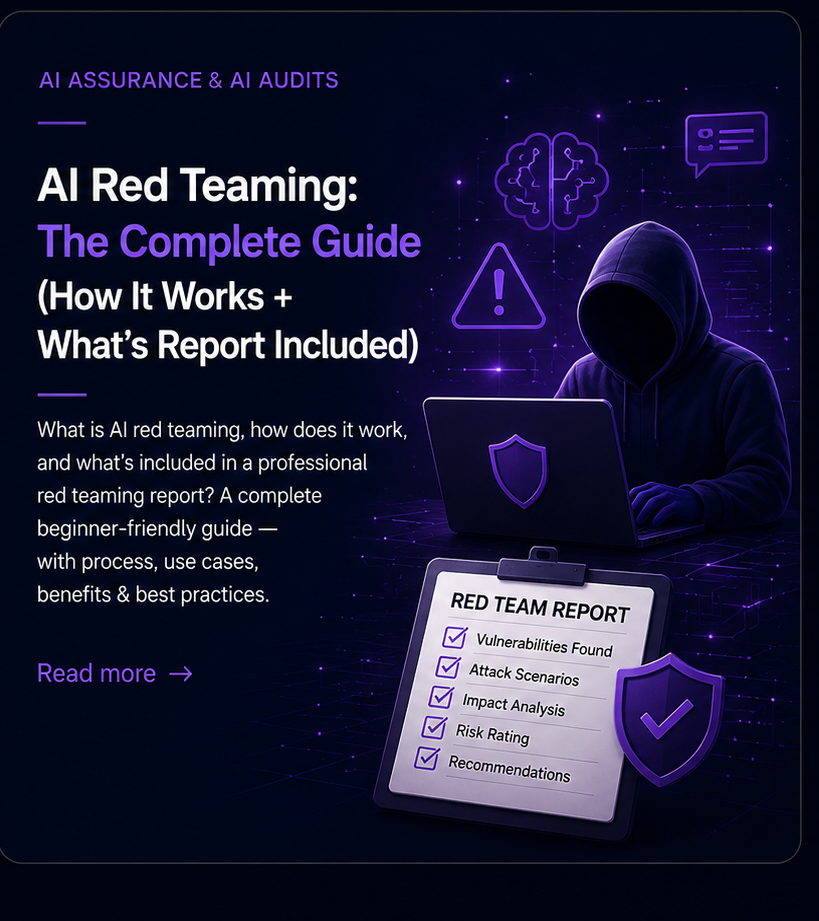
This is the deliverable that actually matters, and it’s where cheap “red teaming” falls apart. A report you can hand to your engineers, your customers and a regulator should contain:
- Executive summary — the headline risks in plain English, readable by a non-technical leader or buyer.
- Scope and rules of engagement — exactly what was and wasn’t tested.
- Methodology and standards — how we tested, mapped to references like the OWASP LLM Top 10, NIST AI RMF, MITRE ATLAS and relevant EU AI Act obligations.
- Threat model — the attackers and worst-case outcomes considered.
- Findings — each with a severity rating, the attack category, a clear description, step-by-step reproduction, evidence (transcripts/screenshots), and the business and regulatory impact.
- Risk summary — a simple heat map so leadership can see the shape of the risk at a glance.
- Remediation — prioritized, specific fixes, not “add more guardrails.”
- Retest results — what was fixed and verified after remediation.
- Statement of independence and limitations — who tested, and what the test did and didn’t cover.
Key takeaway
If a “report” is just a score and a logo, it isn’t a red-team report — it’s a certificate. Insist on reproduction steps and evidence.
A couple of things I’ve actually seen
An internal knowledge assistant looked airtight — until we uploaded a document into the system it was allowed to read, with instructions hidden inside it. The assistant dutifully followed the hidden instructions and summarized another team’s confidential file. Nobody typed anything malicious into the chat box; the attack rode in through the data.
Another time, a helpful “agent” that could look up orders could be talked, over a few polite messages, into calling an internal endpoint it was never meant to expose to customers. Individually, each step looked fine. Chained together, it was a real incident waiting to happen.
When should you red team your AI?
You almost certainly should when any of these is true:
- You’re about to launch a customer-facing or high-stakes AI feature.
- You’re selling AI into enterprises or regulated industries and buyers are asking hard questions.
- Your AI makes or influences decisions about people — hiring, credit, claims, eligibility, safety.
- You fall under the EU AI Act’s high-risk or GPAI obligations.
- You’ve made a major change — new model, new prompt, new tools, new data source.
- It’s been a while. Models drift and new attacks appear constantly; red teaming isn’t one-and-done.
How we approach AI red teaming at AramGRC
We run independent, expert-led AI red teaming for AI product companies in India and the US — combining the best open-source and commercial tooling with human adversarial testing, mapped to the standards your buyers and regulators care about (ISO/IEC 42001, the EU AI Act, NIST AI RMF, OWASP LLM Top 10). You get more than a pass/fail: you get a report that shows exactly what breaks, why it matters, and how to fix it — the kind of independent evidence that unblocks enterprise deals.
If you’re shipping AI that real people or real money depend on, it’s worth having someone try to break it on your terms — before someone else does it on theirs.
Want your AI red-teamed before your customers test it for you?
We’ll adversarially test your AI system and deliver a report your engineers, customers and regulators can trust — for AI companies in India and the US.
Talk to the AramGRC team
Frequently asked questions
What is AI red teaming?
AI red teaming is deliberately attacking an AI system with adversarial prompts, manipulation and misuse to find how it can behave unsafely, unfairly or insecurely — before it reaches production or customers. It tests the whole system (prompts, data, tools, humans), not just the model.
How is AI red teaming different from penetration testing?
Penetration testing looks for weaknesses in infrastructure and code. AI red teaming targets the adversarial behaviour of the AI system itself — jailbreaks, prompt injection, data leakage, biased or harmful outputs, and tool/agent abuse — including novel attacks that aren’t on any checklist.
What tools are used for AI red teaming?
Common tools include Garak, Microsoft PyRIT, promptfoo, Giskard, IBM’s Adversarial Robustness Toolbox and Microsoft Counterfit, plus runtime guardrails like Llama Guard, NeMo Guardrails and Lakera, with the OWASP Top 10 for LLM Applications as a reference. They are best used alongside expert manual testing, not as a replacement.
What does an AI red teaming report include?
A good report includes an executive summary, scope and methodology (mapped to standards), a threat model, findings rated by severity with reproduction steps and evidence, business and regulatory impact, prioritized remediation, retest results, and a statement of independence.
How often should you red team AI?
At minimum before launching a high-stakes or customer-facing AI feature, and again after any major change to the model, prompts, tools or data. Because models and attack techniques drift, periodic re-testing is strongly recommended rather than a one-off.
Is AI red teaming required by the EU AI Act?
The EU AI Act requires robustness and testing for high-risk AI systems, and the GPAI Code of Practice expects adversarial testing and red teaming of general-purpose models. Even where it isn’t strictly mandated, enterprise buyers increasingly require an independent red-team report before purchasing.
About the author
Sakthi — Co-founder, AramGRC. AramGRC is an independent AI assurance partner. We help AI product companies in India and the US prove their systems are safe and trustworthy through AI red teaming and assurance reporting aligned to ISO/IEC 42001, the EU AI Act and NIST AI RMF.