I once reviewed a “red team report” a startup had proudly paid for. It was three pages: a logo, a green “PASS,” and a bar chart. A month later their biggest prospect’s security team asked two questions — “what exactly did they test, and can we see the findings?” — and the whole thing fell apart. The report couldn’t answer either. The startup had bought a certificate, not a red team, and it cost them the deal.
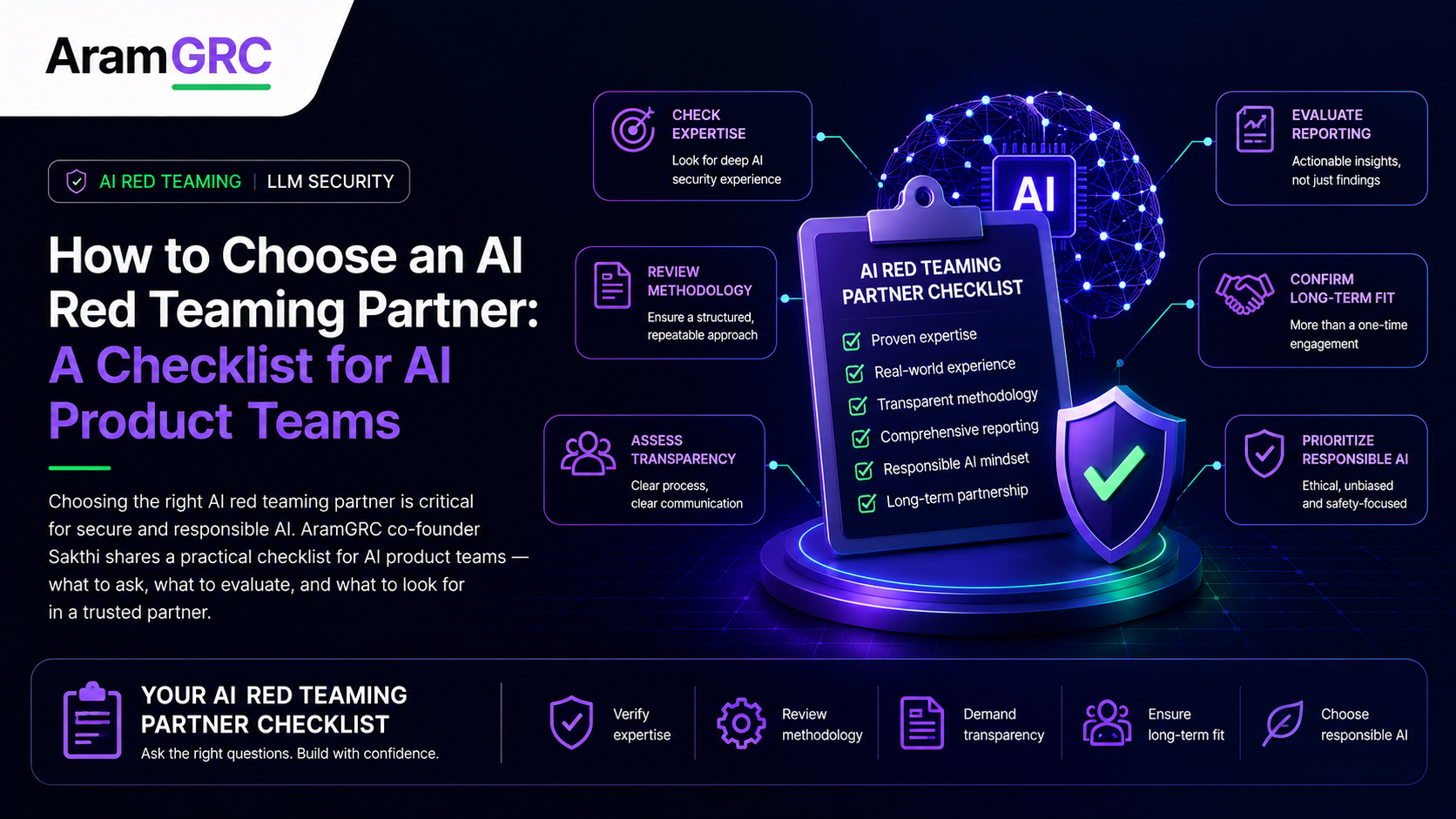
I’m Sakthi, one of the co-founders of AramGRC, and I spend a lot of my time on the other side of that table — either doing the red teaming, or helping enterprises judge whether a vendor’s report is worth trusting. Choosing the wrong AI red teaming partner is worse than doing nothing, because it gives you false confidence right when you can least afford it. So here’s the practical checklist I give AI product teams when they ask, “how do we pick the right one?”
First, why the partner you choose actually matters
A weak red team hands you a clean-looking result that hides real risk. You ship, you tell customers you’ve been “tested,” and the gap surfaces later — in a breach, a biased decision, or a procurement review you fail. A strong partner does the opposite: they find the ugly stuff now, on your terms, and give you something you can actually act on and show to buyers and regulators. The difference between the two is almost never the price. It’s the method.
Key takeaway
A cheap automated scan that says “PASS” is not assurance. If anything, a false all-clear is more dangerous than no test at all.
The checklist: what to look for in an AI red teaming partner
1. Do they do expert, manual testing — not just automated scans?
Automated tools (Garak, PyRIT, promptfoo and the like) are a great starting point, but they only test known, generic attacks. The serious findings come from humans thinking adversarially and chaining issues together. Ask: “What percentage of the work is manual, expert testing versus running a scanner?” If the answer is “we run a tool and export the results,” keep looking.
2. Do they test the whole system, not just the model?
Most real-world AI incidents live in the system around the model — the retrieved documents (RAG), the tools and APIs the AI can call, the agent workflows, the human process. Ask whether they test indirect prompt injection through your data sources, tool/agent abuse, and multi-step attacks — not just single prompts against the raw model.
3. Is their methodology mapped to recognised standards?
A credible partner maps their testing to references your buyers and regulators know: the OWASP Top 10 for LLM Applications, NIST AI RMF, MITRE ATLAS, and relevant EU AI Act obligations. This is what turns “we poked at it” into defensible, comparable evidence.
4. Are they genuinely independent?
The whole value of third-party red teaming is independence. If the same firm built your AI, or has a stake in the outcome, the report carries less weight. Ask directly: “Is your report written so we can hand it to an enterprise customer or a regulator?” Independence is the product.
5. What does their report actually contain?
Ask to see a sample (redacted) report before you sign. A good one has: an executive summary in plain English, scope and methodology, a threat model, findings each with a severity rating, reproduction steps and evidence, business and regulatory impact, prioritized remediation, and retest results. If the sample is a score and a logo with no reproduction steps, that tells you everything.
6. Do they have relevant experience?
AI red teaming a hiring model, a healthcare RAG assistant, and an autonomous agent are different jobs. Ask for references and case studies close to your domain, your model type, and your stack. “We’ve tested LLMs” is not the same as “we’ve tested a customer-facing agent that calls internal APIs.”
7. Do they cover your specific risks?
Your worst-case isn’t everyone’s. A lending model’s is discrimination; a support bot’s is data leakage; an agent’s is unauthorized actions. Make sure their scope explicitly includes bias and fairness, sensitive-data leakage, and — if relevant — agentic/tool abuse and your regulatory context (EU AI Act, DPDP, sector rules).
8. Is remediation and retesting included?
Findings are only half the job. A good partner helps you understand and prioritise fixes, and re-tests afterwards to confirm the fix actually holds. Ask whether retest is included or a costly add-on.
9. How do they handle your data and their findings?
You’re handing an outside team access to a sensitive system and, potentially, giving them a map of your weaknesses. Ask about NDAs, secure testing environments, how findings are stored and shared, and responsible-disclosure practices. A serious partner has clear answers.
10. Is the scope and price clear?
Fixed, well-defined scope beats open-ended “we’ll poke around.” Understand what’s included (systems, attack categories, retest, report), how long it takes, and what a follow-up costs. Vague scope is where both under-testing and surprise bills hide.
Red flags — walk away if you see these
- The deliverable is a “certificate” or a pass/fail score with no reproduction steps or evidence.
- It’s purely an automated scan with no human testing.
- They won’t share their methodology or a sample report.
- They only test the model in isolation, ignoring RAG, tools and agents.
- No independence, or no retest after remediation.
- They can’t give references in anything like your domain.
Five questions to ask on the very first call
- “Walk me through your methodology — what’s manual versus automated?”
- “Can I see a redacted sample report?”
- “How do you test our RAG sources, tools and agent actions, not just the model?”
- “Which standards do you map findings to?”
- “Is remediation guidance and a retest included?”
The quality of these answers will tell you more than any sales deck.
Should you just do it in-house?
In-house red teaming is genuinely useful, and I encourage every team to build the muscle. But it has two limits: your own team shares the blind spots of the people who built the system, and an internal sign-off carries little weight with an external buyer or regulator. The strongest approach is both — continuous internal testing, plus periodic independent red teaming for the depth and the credibility that only an outside party can provide.
How we approach it at AramGRC
We run independent, expert-led AI red teaming for AI product companies in India and the US: manual adversarial testing across the whole system, mapped to OWASP LLM Top 10, NIST AI RMF and the EU AI Act, with a report your engineers, customers and regulators can actually rely on — plus remediation guidance and a retest. If you’re evaluating partners, hold us to every item on this checklist.
Evaluating AI red teaming partners?
Put us to the test against this checklist. We’ll scope an independent AI red teaming engagement and show you a sample report — for AI companies in India and the US.
Talk to the AramGRC team
Frequently asked questions
What does an AI red teaming partner do?
An AI red teaming partner independently attacks your AI system — with adversarial prompts, manipulation and misuse — to find how it can behave unsafely, unfairly or insecurely, then delivers a report with findings, severity, evidence and remediation you can act on and show to buyers and regulators.
How do I choose an AI red teaming vendor?
Prioritise expert manual testing (not just automated scans), whole-system coverage (RAG, tools, agents), a methodology mapped to standards like the OWASP LLM Top 10 and NIST AI RMF, genuine independence, a substantive report with reproduction steps, relevant references, and included remediation and retesting.
How much does AI red teaming cost?
It varies with scope — the number of systems, the attack categories, and whether retesting is included. Beware quotes that are cheap because they are only an automated scan; ask for a fixed, well-defined scope and a sample report so you can compare like for like.
Is automated AI red teaming enough?
No. Automated tools cover known, generic attacks quickly, but they miss context-specific and chained attacks, don’t test the workflow around the model, and go stale. Expert manual testing on top of the tools is what finds the dangerous issues.
Can we red team our AI in-house instead?
In-house testing is valuable, but it shares your team’s blind spots and carries little weight with external buyers or regulators. The best approach is continuous internal testing plus periodic independent, third-party red teaming.
What should an AI red teaming report include?
An executive summary, scope and methodology mapped to standards, a threat model, findings rated by severity with reproduction steps and evidence, business and regulatory impact, prioritized remediation, retest results, and a statement of independence.
About the author
Sakthi — Co-founder, AramGRC. AramGRC is an independent AI assurance partner. We help AI product companies in India and the US prove their systems are safe and trustworthy through AI red teaming and assurance reporting aligned to ISO/IEC 42001, the EU AI Act and NIST AI RMF.