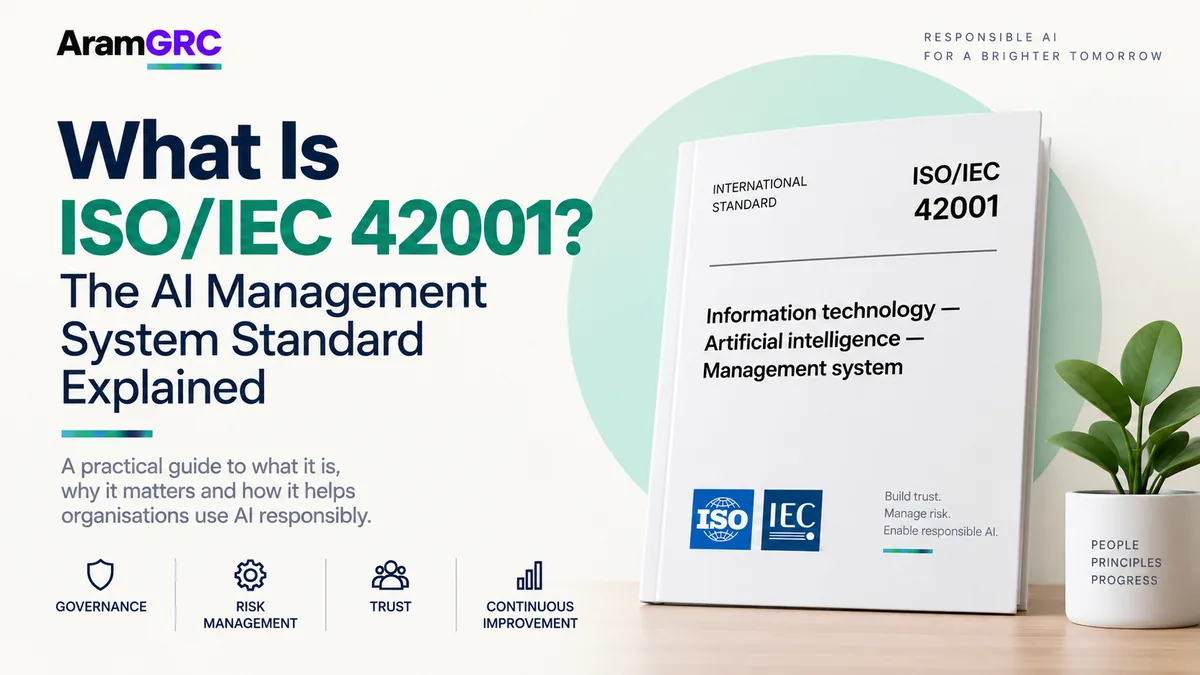
What Is ISO/IEC 42001? The AI Management System Standard Explained
A plain-language answer to the question every AI-governance conversation now starts with.
By Sakthi Thangavelu, CEO, AramGRC·September 2026 · AI Governance Insights·September 18, 2026·9 min read
ISO/IEC 42001 is the international standard for an AI management system (AIMS) — a structured, auditable way for an organization to govern the artificial intelligence it develops, provides, or uses. Published by ISO and IEC in December 2023, it is the first AI standard an organization can be formally certified against, and it applies to any organization of any size in any sector.
What does ISO 42001 actually cover?
It covers the management system, not the model. Rather than dictating how a specific algorithm must be built, ISO 42001 requires you to have a repeatable process for identifying AI risks and impacts, assigning accountability, applying controls across the AI lifecycle, monitoring performance, and improving over time. It is built on the same Plan-Do-Check-Act logic as other ISO management standards, which is what makes it certifiable and auditable.
What does “management system” mean here?
A management system is the set of policies, roles, processes, and records an organization uses to consistently achieve an objective — in this case, trustworthy AI. The point is repeatability: instead of every team inventing its own approach to AI risk, the whole organization runs one defined process. That is the difference between a responsible-AI statement and a responsible-AI capability, a distinction we unpack in from principles to proof.
Who does ISO 42001 apply to?
The standard explicitly recognizes different roles in the AI value chain — you might develop AI, provide it to others, or use third-party AI — and it scales to each. A startup deploying a single customer-facing model and a bank running hundreds of use cases both implement the same framework at proportionate depth. If your organization makes decisions with AI, sells software with AI in it, or depends on foundation models from a vendor, you are in scope.
What ISO 42001 is not
It is not a certification of individual AI systems, and it does not certify that any given model is unbiased or safe. It certifies that your management system for AI meets a recognized standard. It is also not the same as personal certification: organizations are certified, while people earn professional credentials to build and audit those systems.
ISO 42001 in five points
The first certifiable international standard for AI management systems.
Published December 2023 by ISO/IEC JTC 1/SC 42.
Built on the Plan-Do-Check-Act cycle and ISO's Harmonized Structure.
Requirements in Clauses 4–10, plus 38 Annex A controls.
Applies to developers, providers, and users of AI, at any scale.
Why does ISO 42001 matter?
Because it converts trust into evidence. A certificate from an accredited body lets a customer, regulator, or investor rely on an independent assessment instead of taking your governance claims on faith. As AI-specific regulation arrives — the EU AI Act, India's AI governance guidelines — a certified AIMS is the operating backbone that makes demonstrating compliance far cheaper than assembling it per regulator. For the full picture of how the standard is built and certified, start with our complete ISO 42001 guide.
Frequently asked questions
What is ISO 42001 in simple terms?+
It is a checklist-and-process standard for governing AI responsibly. It tells an organization what a good AI governance system must include and lets an independent auditor confirm the system is really working.
What does ISO 42001 stand for?+
ISO/IEC 42001 is the standard's number, not an acronym. Its full title is "Information technology — Artificial intelligence — Management system." ISO is the International Organization for Standardization and IEC is the International Electrotechnical Commission.
When was ISO 42001 published?+
ISO/IEC 42001:2023 was published on 18 December 2023 and is the first edition of the standard.
Is ISO 42001 for AI developers or AI users?+
Both. The standard defines requirements for organizations that develop, provide, or use AI systems, and scales to each role.