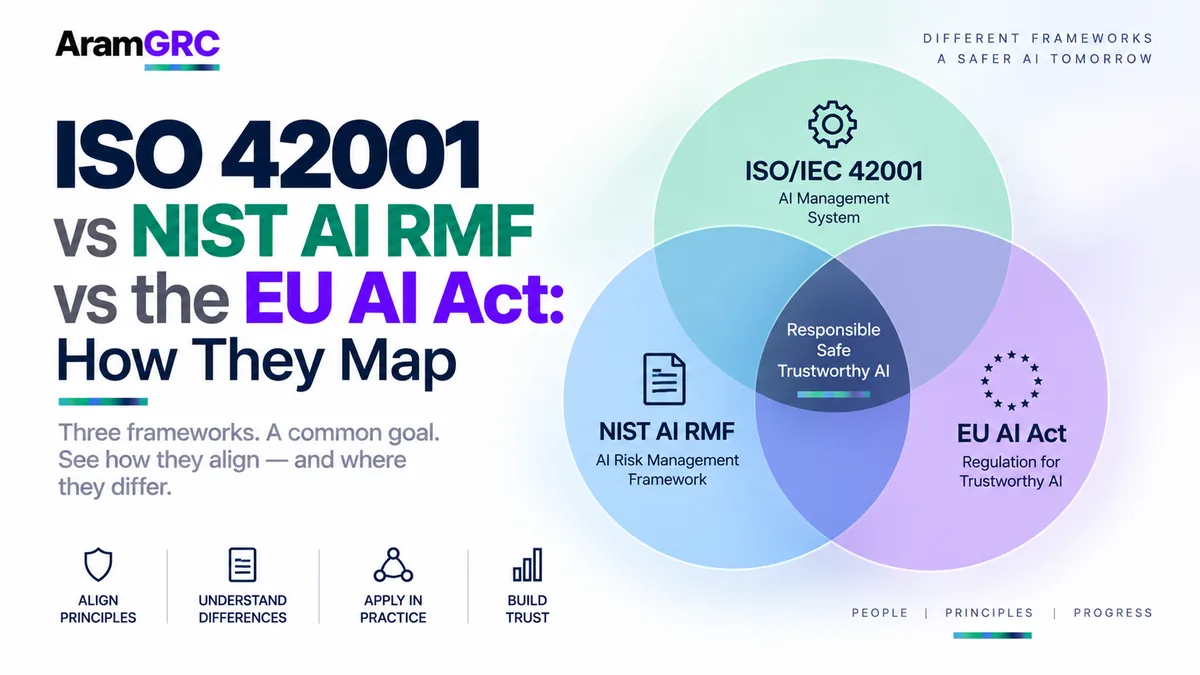
ISO 42001 vs NIST AI RMF vs the EU AI Act: How They Map
A standard, a voluntary framework, and a law — how the three fit together, and why one ISO 42001 system helps you meet all of them.
By Sakthi Thangavelu, CEO, AramGRC·September 2026 · AI Governance Insights·September 18, 2026·10 min read
The three names get used interchangeably, but they are different kinds of thing. ISO/IEC 42001 is a certifiable international standard, the NIST AI RMF is a voluntary framework, and the EU AI Act is binding law. Understanding which is which is the key to not doing the same governance work three times — because a well-built ISO 42001 management system is the operational backbone that helps you demonstrate all three.
Three different kinds of instrument
It helps to be precise about what each one actually is, because it determines what “compliance” even means for it.
Dimension
ISO/IEC 42001
NIST AI RMF
EU AI Act
Type
Certifiable management-system standard
Voluntary risk-management framework
Binding regulation (law)
Geography
International
United States (and beyond, voluntarily)
European Union (extraterritorial reach)
Can you be certified?
Yes, by an accredited body
No formal certification
Conformity assessment for high-risk systems
Structure
Clauses 4–10 + Annex A controls
Govern, Map, Measure, Manage functions
Risk tiers: unacceptable, high, limited, minimal
Enforcement
Market/procurement-driven
None (voluntary)
Fines up to the higher of set caps or a % of global turnover
What the NIST AI RMF is
The NIST AI Risk Management Framework is a voluntary US framework organized around four functions — Govern, Map, Measure, and Manage. It is influential, practical, and widely adopted, but there is no certificate and no legal obligation attached to it. Its functions map closely onto ISO 42001's clauses and controls, which is why organizations commonly satisfy both with one control set and a crosswalk rather than two programs.
What the EU AI Act is
The EU AI Act is the world's first comprehensive AI law. It classifies AI systems by risk — from prohibited “unacceptable-risk” uses, through tightly regulated “high-risk” systems, to limited- and minimal-risk categories — and places obligations on providers and deployers accordingly, especially for high-risk systems. Non-compliance carries substantial fines. Its reach is extraterritorial: it can apply to organizations outside the EU whose AI outputs are used there.
Where ISO 42001 fits between them
ISO 42001 is not the EU AI Act's official harmonized standard, and holding a certificate does not equal legal conformity with the Act. What it does do is give you the organizational, risk-management, and quality-management machinery the Act expects — the AI policy, the risk and impact assessments, the human oversight, the documentation trail — so that demonstrating readiness becomes far cheaper. Think of ISO 42001 as the operating system, and the EU AI Act and NIST AI RMF as two sets of requirements you run on top of it.
How to use one system for all three
Build the ISO 42001 AIMS first, because it is the most structured and the only certifiable one. Then map its controls outward: to the NIST Govern/Map/Measure/ Manage functions with a published crosswalk, and to the EU AI Act's high-risk obligations for the specific systems in scope. Evidence produced once — an impact assessment, a risk sign-off, a monitoring log — then serves all three. This is the same “one control set, many obligations” logic that makes ISO 42001 so efficient for Indian regulation too.
A useful mental model: NIST AI RMF tells you how to think about AI risk, ISO 42001 tells you how to run a system that manages it, and the EU AI Act tells you what you are legally required to achieve for certain systems. They are complementary, not competing — and ISO 42001 is the layer that connects the other two to daily operations.
Frequently asked questions
Is ISO 42001 the same as the NIST AI RMF?+
No. ISO 42001 is a certifiable management-system standard; the NIST AI RMF is a voluntary framework with no certification. Their structures align closely, so organizations often use one control set to satisfy both.
Does ISO 42001 certification mean I comply with the EU AI Act?+
Not by itself. ISO 42001 is not the Act's official harmonized standard, and certification is not legal conformity. But an ISO 42001 AIMS provides much of the governance and risk-management evidence the Act expects, making compliance far easier to demonstrate.
Which should I implement first — ISO 42001, NIST AI RMF, or EU AI Act readiness?+
Start with ISO 42001. It is the most structured and the only certifiable one, and its controls can then be mapped outward to the NIST functions and the EU AI Act's high-risk obligations.
Is the NIST AI RMF mandatory?+
No. The NIST AI RMF is voluntary and carries no legal obligation or certification, though it is widely adopted as good practice, especially in the United States.