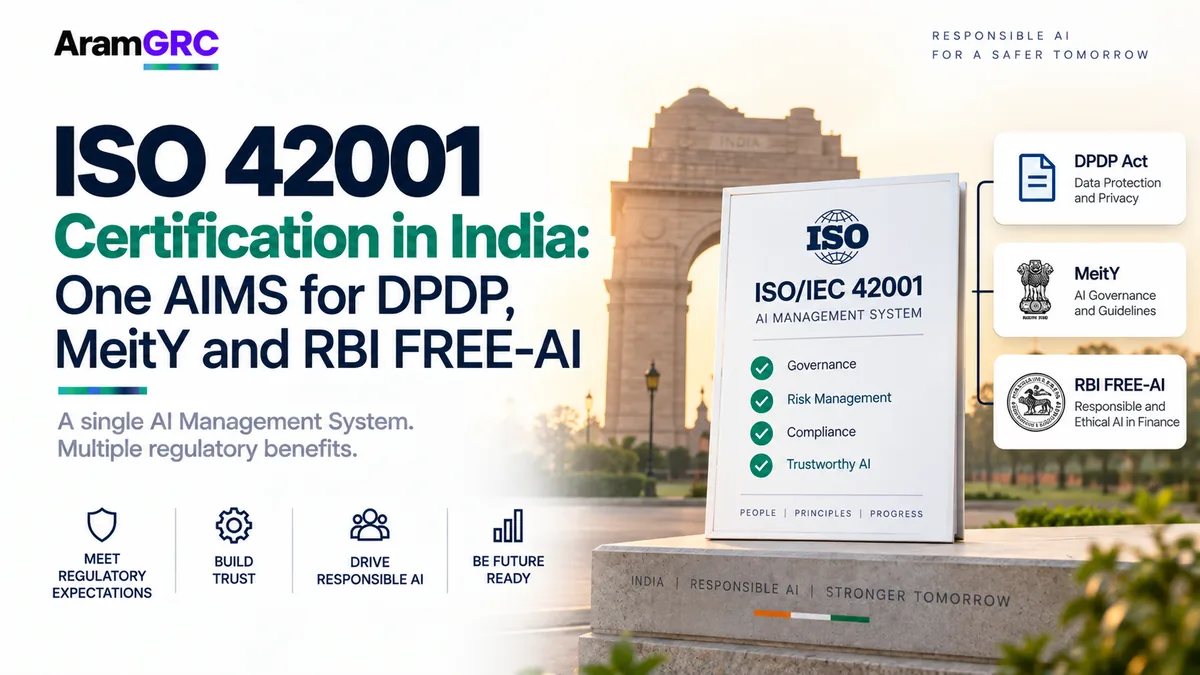
ISO 42001 Certification in India: One AIMS for DPDP, MeitY and RBI FREE-AI
Why a single ISO 42001 management system is the most efficient way for Indian organizations to meet three overlapping AI expectations at once.
By Sakthi Thangavelu, CEO, AramGRC·September 2026 · AI Governance Insights·September 18, 2026·10 min read
For Indian organizations, ISO 42001 has become more than an international credential — it is the most efficient way to satisfy three overlapping AI expectations with one implementation: the DPDP Act, MeitY's AI Governance Guidelines, and, for financial firms, the RBI's FREE-AI framework. Build the AI management system once, and the same controls, evidence, and accountability answer all three.
Three threads converged on Indian AI in late 2025
Within a few months, the regulatory picture for AI in India sharpened dramatically. The Digital Personal Data Protection Rules were notified, MeitY published national AI governance guidelines, and the RBI's expert committee delivered a framework for AI in finance. Individually manageable; together, a lot to track. ISO 42001 is the connective layer that lets you respond to all three as one program rather than three parallel projects.
The DPDP Act and DPDP Rules 2025
The Digital Personal Data Protection Act was passed in 2023, and the DPDP Rules were notified on 14 November 2025, operationalizing it with phased timelines that extend well into 2026–2027. For any AI system that processes personal data of people in India, four obligations matter most: clear consent and notice before processing; purpose limitation (you cannot quietly repurpose data to retrain a model); data-principal rights to access, correction, and erasure; and, for Significant Data Fiduciaries, mandatory Data Protection Impact Assessments and independent audits. Penalties reach up to ₹250 crore per instance, which is what moves this from legal's inbox to the board's agenda.
MeitY's India AI Governance Guidelines
On 5 November 2025, MeitY released the India AI Governance Guidelines — a voluntary, principles-based framework built around seven “sutras”: trust as the foundation, people first, innovation over restraint, fairness and equity, accountability, understandable by design, and safety, resilience and sustainability. They are advisory rather than binding, but they set the expectations that procurement teams, sector regulators, and courts will increasingly reference. Crucially, their structure — risk-based, accountability-driven, with grievance redress — mirrors the logic of ISO 42001 almost point for point.
The RBI FREE-AI framework
For regulated financial entities, the Reserve Bank of India's FREE-AI framework — the Framework for Responsible and Ethical Enablement of AI — is the one to watch. Delivered by an RBI committee on 13 August 2025, it sets out sutras, sub-frameworks, pillars, and 26 recommendations covering board-approved AI policies, incident reporting, bias testing, audit trails, and AI-specific assurance. It is a set of recommendations rather than binding regulation today, but banks and NBFCs are already building toward it — and an ISO 42001 AIMS supplies most of the governance scaffolding it expects.
How one ISO 42001 AIMS maps to all three
The reason a single management system works is that these frameworks share the same foundations: risk assessment, human oversight, documentation and auditability, and fairness. Evidence gathered once satisfies several obligations at once.
Annex A controls on oversight, escalation and override
Fairness & equity
Annex A.5 AI system impact assessment (also supports DPDP DPIAs)
Safety & resilience
Clause 8 operational controls across the AI lifecycle
AI policy & incident reporting (RBI FREE-AI)
Clause 5.2 AI policy + Clause 9 performance evaluation
DPDP documentation trail
Clause 7.5 documented information + Annex A impact assessments
Indian advisory practice suggests a well-scoped ISO 42001 AIMS covers the large majority of the work for MeitY alignment and RBI FREE-AI readiness, with jurisdiction-specific items added on top rather than duplicated. For the underlying regulatory detail, see our guide to AI governance in India.
What Indian organizations should do first
Start by scoping the AIMS around the AI systems that carry the most regulatory and reputational exposure — typically anything processing personal data or driving customer-facing decisions. Run a gap assessment that maps each control to DPDP, MeitY, and (if relevant) RBI expectations simultaneously, so you build one control set, not three. Then follow the standard certification path. Our certification cost guide covers what to budget in India, and the how-to-get-certified walkthrough covers the process.
The DPDP Rules are binding, the MeitY guidelines are voluntary, and RBI FREE-AI is currently a set of recommendations — but all three point the same direction: demonstrable, documented, auditable AI governance. Building an ISO 42001 AIMS now positions you for whichever hardens into enforcement first.
Frequently asked questions
Is ISO 42001 certification recognized in India?+
Yes. ISO 42001 is an international standard, and certificates issued by accredited bodies are recognized in India and globally. It is increasingly referenced in Indian enterprise procurement and aligns closely with MeitY's AI governance guidelines.
Does ISO 42001 make me DPDP Act compliant?+
Not automatically. ISO 42001 is an AI management-system standard, not a data-protection law. But its data-governance and impact-assessment controls can be built to satisfy DPDP obligations such as consent, purpose limitation, and impact assessments at the same time.
How does ISO 42001 relate to the RBI FREE-AI framework?+
RBI FREE-AI sets AI governance expectations for financial entities — board-approved AI policies, bias testing, audit trails, assurance. An ISO 42001 AIMS provides most of that governance scaffolding, so financial firms can use it as the backbone for FREE-AI readiness.
How much does ISO 42001 certification cost in India?+
It depends on scope, headcount, and the number of AI systems and sites in scope. Indian organizations often benefit from lower auditor-day rates; see our ISO 42001 certification cost guide for the four cost components to budget.