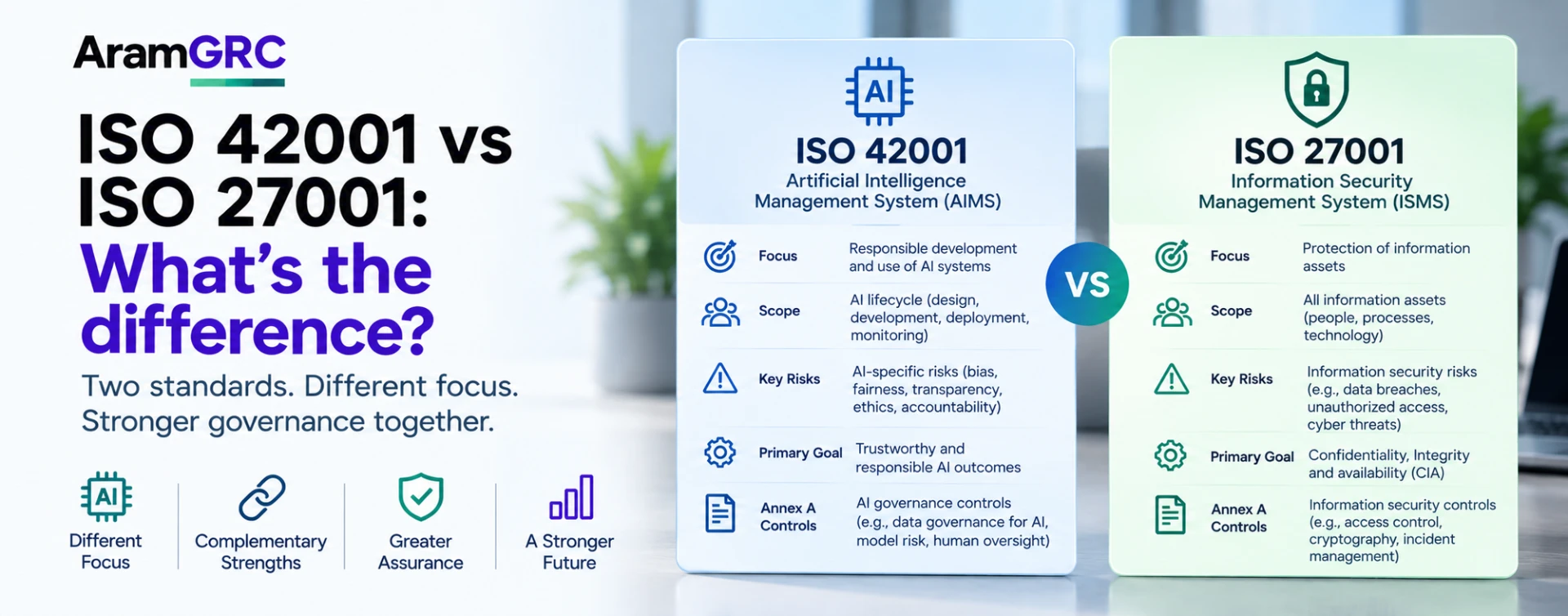
ISO 42001 and ISO 27001 are often confused — both are ISO management-system standards, but they govern different things. This guide explains the difference, where they overlap, and whether you need both, plus how ISO 42001 compares to the NIST AI RMF. Part of our guide to ISO 42001 certification.
AramGRC Team·ISO 42001 & Assurance·September 10, 2026·7 min read
What each standard covers
ISO/IEC 27001 is the standard for an Information Security Management System (ISMS) — protecting the confidentiality, integrity and availability of information. ISO/IEC 42001 is the standard for an AI Management System (AIMS) — governing the responsible development and use of AI, including risks security standards don't address, like bias, explainability, transparency and societal impact.
ISO 42001 vs ISO 27001: the key differences
ISO 27001ISO 42001
FocusISO 27001: Information security.ISO 42001: Responsible AI.
Core riskISO 27001: Data breaches and confidentiality.ISO 42001: Bias, opacity, unsafe or harmful AI outcomes.
Scope objectISO 27001: Information assets.ISO 42001: AI systems across their lifecycle.
Unique requirementISO 27001: Information-security controls.ISO 42001: AI impact assessment and AI-specific Annex A controls.
SharedISO 27001: Both use the same high-level management-system structure, so they integrate.
Where they overlap
Both are management-system standards with the same backbone — leadership, risk, controls, audit, improvement — and both care about data. If you hold ISO 27001, you already run the machinery ISO 42001 needs; you extend it to AI rather than build a second system from scratch, which is why 27001-certified organisations reach 42001 faster.
Do you need both?
If you handle sensitive information, ISO 27001 remains essential; if you build or deploy AI, ISO 42001 adds the AI-specific governance 27001 doesn't cover. Many organisations pursue both and run them as one integrated management system.
What about the NIST AI RMF?
The NIST AI Risk Management Framework is a voluntary US framework (Govern, Map, Measure, Manage), not a certifiable standard. ISO 42001 is certifiable; the NIST AI RMF is a flexible reference. Many organisations use the NIST AI RMF operationally and certify to ISO 42001 for the credential — the two map together well. See our overview of the AI governance framework.
How AramGRC helps
AramGRC helps you extend an existing ISO 27001 system to ISO 42001, or build the AI management system from scratch, and map it to the NIST AI RMF and the EU AI Act at the same time.
Frequently asked questions
What is the difference between ISO 42001 and ISO 27001?+
ISO 27001 manages information security; ISO 42001 manages responsible AI, including bias, transparency and oversight. They share the same management-system structure and complement each other.
Do I need both ISO 42001 and ISO 27001?+
If you handle sensitive data, ISO 27001 stays essential; if you build or deploy AI, ISO 42001 adds AI-specific governance. Many organisations hold both as one integrated system.
Can ISO 27001 help with ISO 42001?+
Yes — an existing ISO 27001 management system provides most of the structure ISO 42001 needs, which shortens the path to certification.
Is ISO 42001 the same as the NIST AI RMF?+
No — ISO 42001 is a certifiable standard; the NIST AI RMF is a voluntary framework. They map together well, and many organisations use both.