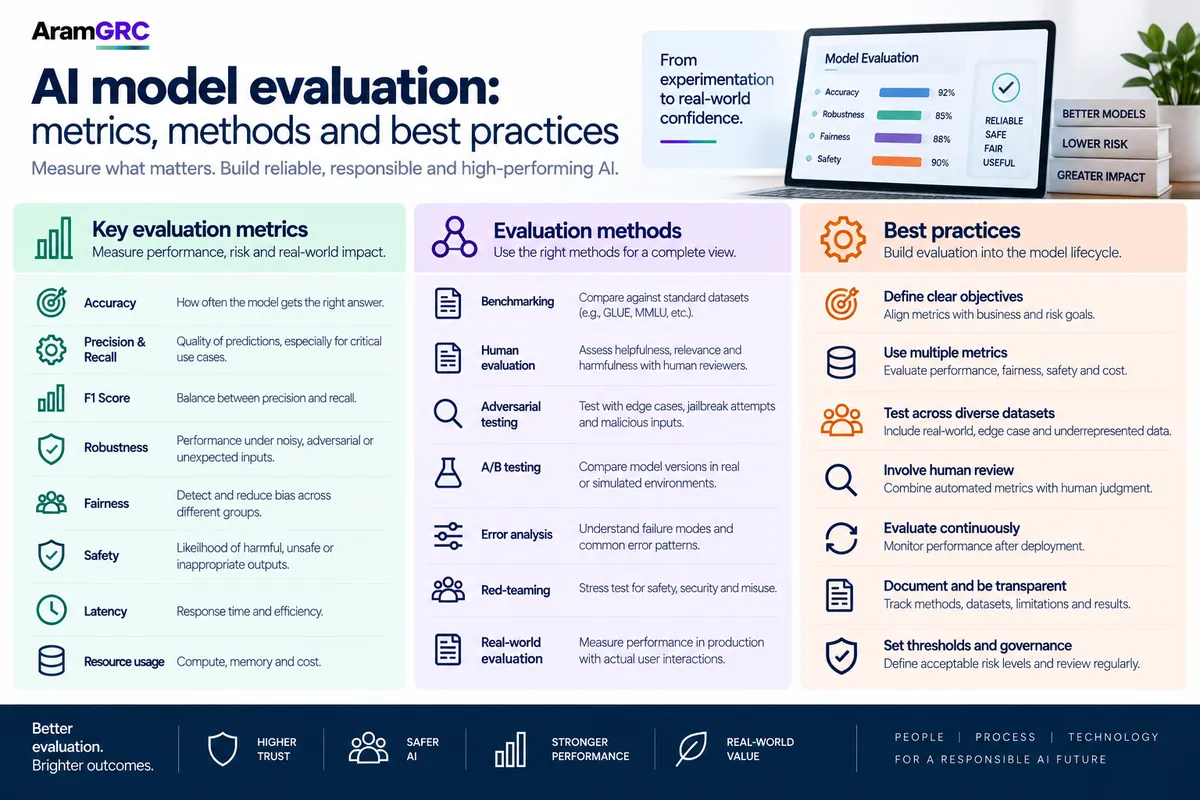
AI model evaluation: metrics, methods and best practices
AI model evaluation measures whether a system does its job well. This guide covers the metrics, the methods, and the important limit — evaluation tells you a model is good, not that it's safe. Part of our guide to AI testing.
AramGRC Team·AI Testing & Assurance·September 11, 2026·8 min read
What is AI model evaluation?
AI model evaluation is the process of measuring how well an AI system performs its intended task, using defined metrics and representative test data. It answers “is this model accurate and useful enough to ship?” — a different question from “is it safe, fair and robust?”, which is what red-teaming and bias testing address.
Why evaluation matters — and its limits
Evaluation is the baseline of any AI testing programme: without it you don't know if a model works. But it has a blind spot — a model can score highly on a benchmark and still be biased, brittle under attack, or wrong in ways the test set never covered. Evaluation proves capability; it doesn't prove trustworthiness. That's why it sits alongside red-teaming and bias testing.
AI model evaluation metrics
The right metrics depend on the task:
Classification — accuracy, precision, recall, F1 score, and the confusion matrix.
Regression — mean absolute error (MAE) and root-mean-square error (RMSE).
Ranking and retrieval — precision@k, recall@k, and mean reciprocal rank.
LLMs and generative AI — quality, relevance, groundedness/faithfulness, and human or LLM-as-judge evaluation, since there's no single correct output.
AI model evaluation methods
Common methods include benchmarking against standard datasets, testing on a held-out set the model never saw in training, human evaluation for subjective quality, and — increasingly for LLMs — using another model as an automated judge. The strongest programmes combine automated metrics with human review.
Evaluation vs red-teaming
Evaluation measures how well a system performs on its intended task; red-teaming measures how badly it can be made to fail when someone attacks it. You need both — one tells you it's good, the other tells you it's safe.
Best practices
Use representative test data that reflects real-world inputs, not just clean examples.
Choose metrics appropriate to the task and the stakes — accuracy alone can hide serious errors.
Avoid data leakage — never evaluate on data the model trained on.
Re-evaluate on every material change to the model, data or use.
How AramGRC helps
AramGRC evaluates AI and LLM systems against task-appropriate metrics and independent test sets, as part of a release-gating assessment.
Frequently asked questions
What is AI model evaluation?+
Measuring how well an AI system performs its intended task, using defined metrics and representative test data — it proves capability, not safety.
What metrics are used to evaluate an AI model?+
It depends on the task: accuracy, precision, recall and F1 for classification; MAE/RMSE for regression; precision@k for ranking; and quality, relevance and groundedness (with human or LLM-as-judge evaluation) for generative AI.
How do you evaluate an LLM?+
With a mix of automated metrics (quality, relevance, groundedness), benchmark datasets, and human or LLM-as-judge evaluation, since there's no single correct output.
Is evaluation the same as AI testing?+
No — evaluation is one part of AI testing that measures performance. Full testing also includes red-teaming, security, bias and drift testing.