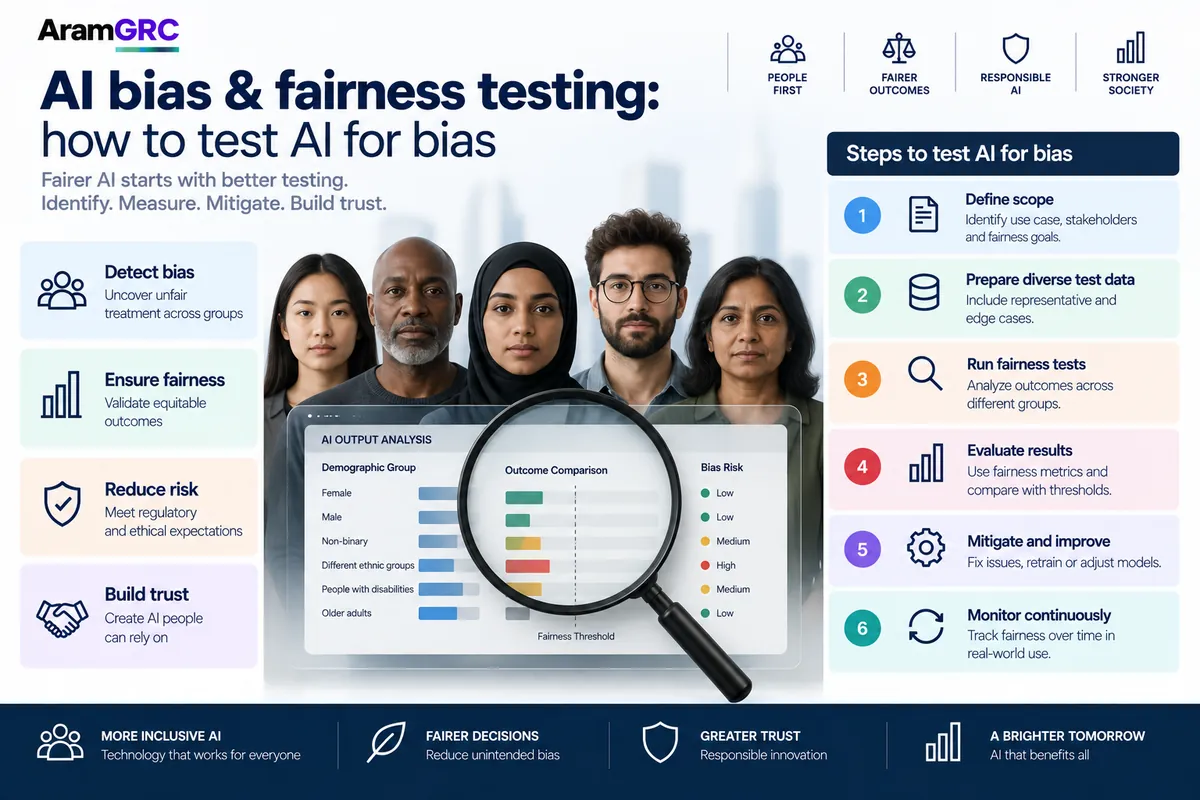
AI bias & fairness testing: how to test AI for bias
AI bias is the risk that's invisible in the code and only shows in the outcomes — which is why it has to be tested for, not assumed away. This guide explains how to test an AI system for bias, the fairness metrics, and how to mitigate it. Part of our guide to AI testing.
AramGRC Team·AI Testing & Assurance·September 11, 2026·8 min read
What is AI bias testing?
AI bias testing is the process of measuring whether an AI system produces equitable outcomes across the groups it affects, and identifying where it discriminates. Because bias lives in outcomes rather than in the code, the only way to find it is to measure results across groups — you can't read it off the model.
Where AI bias comes from
Bias usually enters through the data: unrepresentative training data, historical patterns the model learns and amplifies, and proxy variables that stand in for protected attributes (a postcode standing in for ethnicity, say). Feedback loops can then reinforce it over time. None of this requires anyone to intend to discriminate.
Fairness metrics
Fairness is measured with specific metrics, and they can conflict — so you choose the ones that fit the use:
Demographic parity — equal positive rates across groups.
Equal opportunity — equal true-positive rates across groups.
Equalised odds — equal true- and false-positive rates across groups.
Disparate impact — the ratio of favourable outcomes between groups (a common legal test).
How to test for bias
Identify the protected and proxy attributes relevant to the system.
Measure outcomes across those groups using appropriate fairness metrics.
Compare the results and flag disparities against a defined threshold.
Document the findings and decide on mitigation or acceptance, with an owner.
Tools for bias testing
Open-source toolkits like Fairlearn and AIF360 help measure and compare fairness metrics across groups, and integrate into an evaluation pipeline. Tools measure; a human still decides what's acceptable in context.
How to mitigate AI bias
Mitigation can happen at three stages: the data (rebalancing, removing proxies), the model (fairness constraints during training), and post-processing (adjusting outputs) — backed by human oversight for high-stakes decisions.
Bias testing and regulation
Fairness is a legal as well as an ethical requirement: the EU AI Act requires non-discrimination for high-risk systems, and India's DPDP and sector rules expect fair treatment. Documented bias testing is how you evidence it. See the EU AI Act.
How AramGRC helps
AramGRC runs independent bias and fairness testing across the groups your AI affects, with documented results you can show regulators and buyers.
Frequently asked questions
What is AI bias testing?+
Measuring whether an AI system produces equitable outcomes across the groups it affects, and identifying where it discriminates — done by measuring results across groups, since bias lives in outcomes not code.
How do you test AI for bias?+
Identify the protected and proxy attributes, measure outcomes across those groups with fairness metrics, compare against a threshold, and document findings and mitigation.
What are fairness metrics?+
Measures like demographic parity, equal opportunity, equalised odds and disparate impact that quantify whether outcomes are equitable across groups — they can conflict, so you pick the ones that fit the use.
How do you reduce AI bias?+
Mitigate at the data (rebalancing, removing proxies), the model (fairness constraints), or post-processing (adjusting outputs), backed by human oversight for high-stakes decisions.