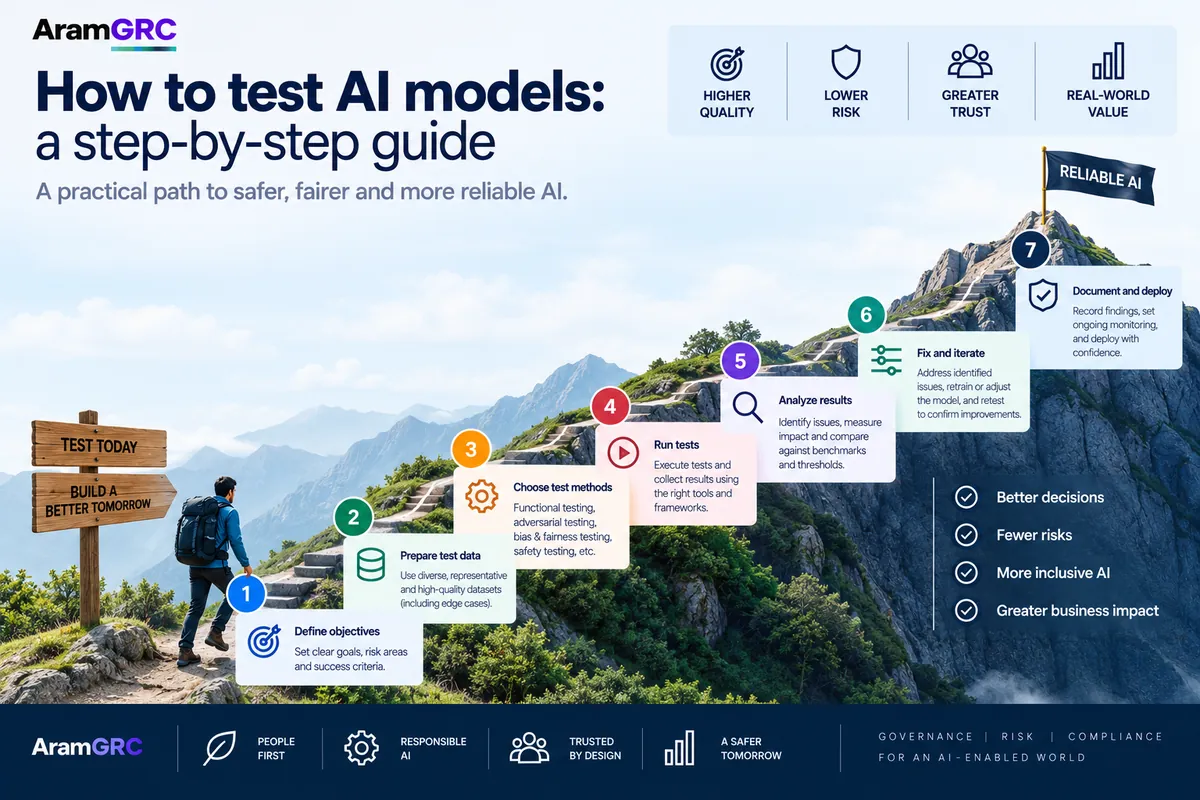
Testing an AI model well means more than checking accuracy — it means evaluating performance, fairness, security and robustness, then gating the release on the results. This guide walks the whole process. Part of our guide to AI testing.
AramGRC Team·AI Testing & Assurance·September 11, 2026·9 min read
Before you start
Define two things first: the model's intended use (what it should do, and the decisions it informs) and what ‘good’ looks like — the performance, fairness and safety thresholds it must meet. Testing without a target is just poking at the model.
The AI testing process
Define intended use, requirements and risk tier — higher-risk systems get deeper testing.
Build representative test data — reflecting real inputs, edge cases and the groups the system affects.
Run model evaluation — measure performance against task-appropriate metrics (see AI model evaluation).
Run adversarial and security testing — probe for jailbreaks, prompt injection and data leakage (see AI security & adversarial testing).
Test robustness — edge cases, noisy inputs and drift simulation.
Review and gate the release — make a documented go / conditional / no-go decision based on the results.
Monitor in production — testing continues after launch (see AI model monitoring).
Pre-deployment vs continuous testing
Pre-deployment testing is the release gate; continuous testing and monitoring keep the system safe as it drifts and as users find new inputs. Both are necessary — a launch-day pass is not a permanent guarantee.
Documenting the results
Record what you tested, how, and what you found — the evidence that a system was tested responsibly. This documentation is what an AI audit, the EU AI Act and ISO/IEC 42001 expect to see.
Common mistakes
The usual failures: testing only the happy path, skipping adversarial testing, using unrepresentative test data, testing once and never again, and having no threshold that can actually block a release.
How AramGRC helps
AramGRC runs end-to-end AI testing — evaluation, bias, security and robustness — and delivers a clear, evidence-backed release-gating decision.
Frequently asked questions
How do you test an AI model?+
Define intended use and thresholds, build representative test data, run evaluation, bias, adversarial/security and robustness testing, gate the release on the results, and monitor in production.
What tests should you run on an AI model?+
Model evaluation (performance), bias and fairness testing, adversarial and security testing, robustness testing, and continuous monitoring after launch.
How do you test an LLM?+
Combine evaluation (quality, relevance, groundedness), adversarial and red-team testing against the OWASP LLM Top 10, bias testing, and human review — before release and continuously after.
Do you need to test AI after deployment?+
Yes — models drift and users send new inputs, so continuous testing and monitoring are as important as pre-deployment testing.