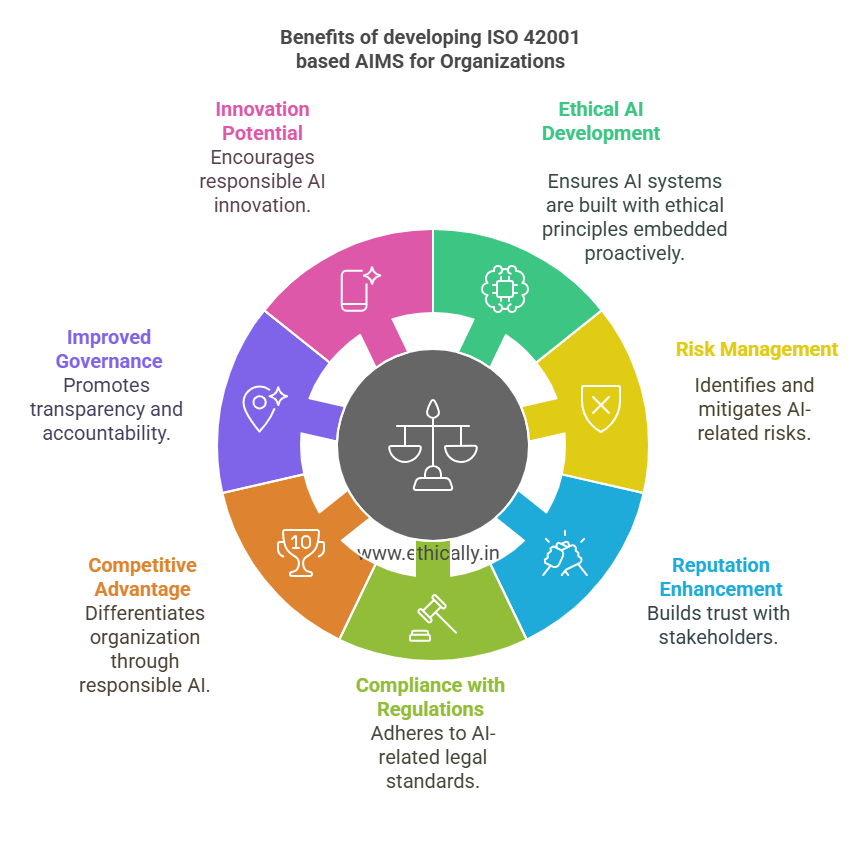
AI is moving from experimental projects to mission‑critical systems that affect customers, employees, and regulators. That shift makes robust governance essential. ISO 42001 — the emerging international standard for AI management systems — gives organisations a structured, auditable way to manage AI risk, compliance, and performance across the whole lifecycle.
Why ISO 42001 matters
- Common language: It creates a consistent framework for roles, responsibilities, policies, and controls so teams across engineering, legal, privacy, and business units can coordinate.
- Auditability: Designed for management systems, it supports internal and external audits and aligns with other ISO systems such as ISO 27001 and ISO 27701.
- Risk focus: The standard emphasises risk identification, assessment, mitigation, and continuous monitoring specific to AI harms (safety, bias, privacy, explainability).
- Scalability: It’s applicable for small deployments and enterprise‑scale AI portfolios because it focuses on processes rather than prescribing technical solutions.
Core components to implement
- Governance structure: Define accountable roles (AI management owner, risk leads, model stewards) and decision pathways for procurement, deployment, and decommissioning.
- Risk management process: Establish AI‑specific risk criteria, register, and treatment plans covering ethical, safety, legal, privacy, and security risks.
- Lifecycle controls: Implement requirements for data governance, model development, testing (including fairness and robustness tests), validation, deployment controls, and ongoing performance monitoring.
- Documentation and traceability: Maintain model cards, data lineage, versioning logs, test results, and change records to support transparency and audits.
- Incident and change management: Create workflows for detecting, reporting, investigating, and remediating AI incidents and for controlled model updates.
- Human oversight and training: Define human‑in‑the‑loop interventions, escalation rules, and mandatory training for stakeholders on risk awareness and control use.
- Metrics and continuous improvement: Use KPIs (e.g., drift rates, fairness metrics, incident frequency) and regular reviews to drive iterative improvement.
Practical implementation tips
- Start with alignment: Map existing ISO systems (ISO 27001/27701) to ISO 42001 requirements to reuse controls and reduce duplication.
- Prioritise by impact: Use a risk‑based approach to onboard systems — classify AI assets by potential harm and address high‑impact systems first.
- Build cross‑functional teams: Include product owners, ML engineers, privacy, legal, security, and operations in governance design and audits.
- Automate monitoring: Instrument models for telemetry that measures performance, drift, and downstream impacts to enable timely interventions.
- Document decisions, not just outputs: Capture why models were chosen and what mitigations were accepted; auditors look for rationale as well as technical artifacts.
Common pitfalls to avoid
- Treating ISO 42001 as a checkbox exercise rather than an operational change.
- Over‑centralising controls that slow innovation; balance governance with practical guardrails.
- Ignoring data governance: poor data lineage and consent tracking undermine the entire management system.
- Lacking measurable KPIs — governance without metrics is hard to prove and improve.
Take Away
ISO 42001 offers a pragmatic, auditable path to managing AI responsibly across organisations. For compliance professionals and practitioners, the value lies in turning governance from a set of ad‑hoc rules into repeatable processes that balance innovation with accountability. Start small, focus on high‑impact systems, and integrate with existing management systems to scale governance effectively.