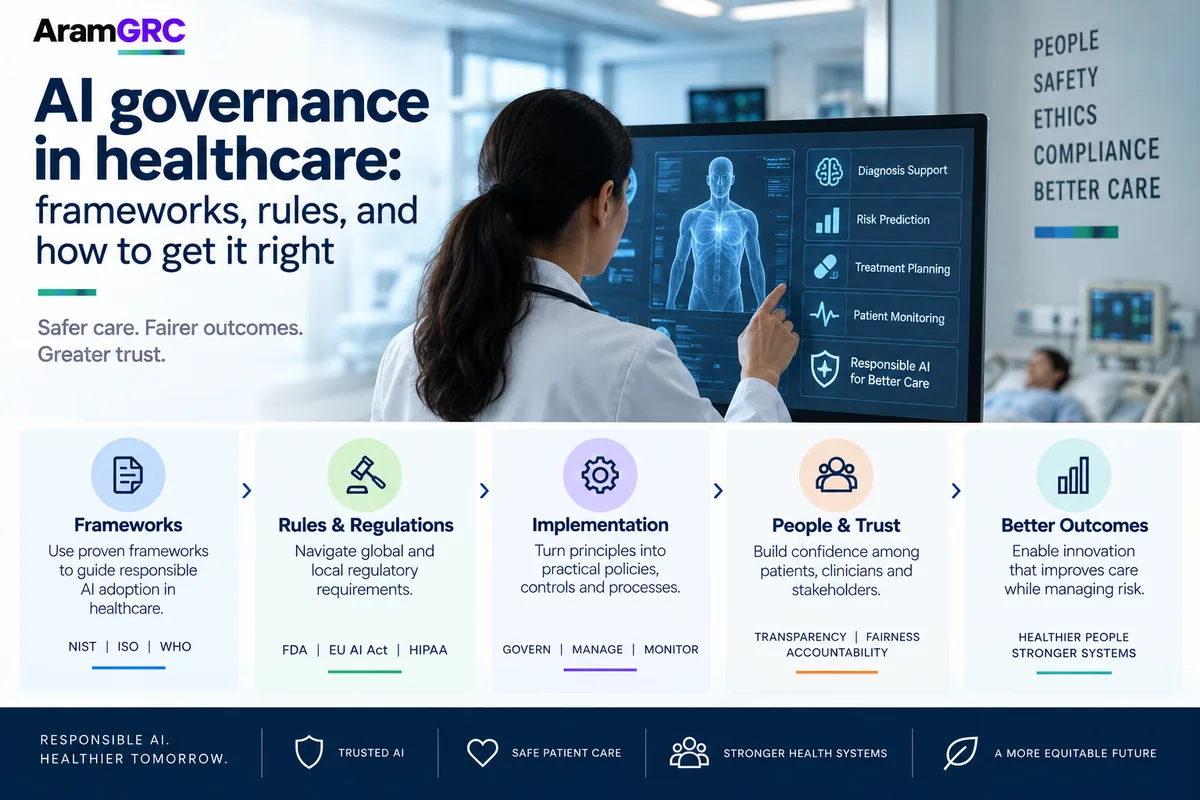
AI governance in healthcare: frameworks, rules, and how to get it right
In most industries, a badly governed AI system costs money or reputation. In healthcare, it can cost a life. That raises the bar: AI governance in healthcare has to protect patients, satisfy a thicket of regulators, and still let clinicians benefit from the technology. This guide covers why it matters, the rules that apply — globally and in India — a practical framework, real examples, and how to establish it in your organisation. Part of our guide to AI governance.
AramGRC Team·Responsible AI·September 13, 2026·12 min read
What is AI governance in healthcare?
AI governance in healthcare is the set of policies, roles, controls and review processes that make sure the AI a health organisation builds or buys is safe, effective, fair and lawful — from a diagnostic imaging model to an ambient scribe to a triage chatbot. It's the same discipline as general AI governance, tightened for a setting where the AI touches patient safety, clinical decisions and highly sensitive health data.
Why AI governance matters more in healthcare
The stakes and the scrutiny are both higher than almost anywhere else:
Patient safety — a wrong output can lead to a missed diagnosis, an unsafe dose or a delayed intervention.
Bias with real harm — a model trained on unrepresentative data can under-serve whole groups of patients; documented cases include risk-scoring and sepsis-prediction tools that performed worse for some populations.
Sensitive data — health data is among the most sensitive personal data there is, and mishandling it carries steep legal and trust costs.
Clinician trust and liability — clinicians need to understand and be able to override AI, and it must be clear who is accountable when AI is in the loop.
Heavy regulation — healthcare AI sits under medical-device rules, health-IT transparency rules, data-protection law and, increasingly, AI-specific law all at once.
The rules that apply to healthcare AI
There is no single “healthcare AI law.” Instead, several regimes overlap. The important ones:
WHO guidance — the World Health Organization's Ethics and Governance of Artificial Intelligence for Health sets six consensus principles, and its later guidance on large multi-modal models (LMMs) extends them to generative AI in health. It's the global ethical baseline.
US — FDA — has authorised more than 1,000 AI/ML-enabled medical devices and now expects a Predetermined Change Control Plan (PCCP) so a model can be updated safely after clearance.
US — ONC HTI-1 — the HTI-1 rule requires transparency for predictive decision support interventions (DSIs) in certified health IT — effectively a “nutrition label” of source attributes so clinicians can judge a model.
EU AI Act — classifies most AI used in medical devices and in clinical decision-making as high-risk, triggering risk management, data-quality, human-oversight and documentation duties. See the EU AI Act guide.
India — ICMR — the Indian Council of Medical Research's Ethical Guidelines for Application of AI in Biomedical Research and Healthcare (2023) set patient-centred principles for AI in Indian clinical settings.
India — DPDP & health data — the DPDP Act governs the personal (health) data these systems use, alongside ABDM's health-data rules and the Telemedicine Practice Guidelines. See AI governance in India.
A practical AI governance framework for healthcare
You don't need a healthcare-only framework — you need a general one (the NIST AI RMF or ISO/IEC 42001) tuned for clinical risk. Anchor it on the WHO principles and add the components that matter most in a health setting:
An inventory of every clinical and operational AI system, with its intended use and risk tier.
A pre-deployment review — clinical validation, bias/subgroup testing, and a human-oversight plan.
Model transparency — model cards / DSI source attributes so clinicians know what they’re using.
Ongoing monitoring — performance and drift tracking once the model is live on real patients.
Clear accountability — a named owner and a governance committee with clinical, data-protection and technical members.
Data governance — lawful basis, de-identification, minimisation and retention for the health data involved.
For the underlying structure, see our AI governance framework guide, which maps to ISO 42001 and the NIST AI RMF.
How to establish organisational AI governance in healthcare
A practical, staged path from nothing to a working programme:
Stand up a cross-functional AI governance committee — clinicians, IT, data protection, legal, and a patient-safety voice.
Build the inventory — you cannot govern AI you can’t see, including AI embedded in devices and vendor products.
Adopt a policy and a risk-tiering method so high-risk clinical AI gets the most scrutiny.
Put pre-deployment review and human-oversight requirements in place before the next system goes live.
Add post-deployment monitoring and an incident process.
Assess your maturity and improve on a cycle — many organisations use an AI governance maturity model to track progress from ad-hoc to optimised.
Much of healthcare AI governance is really data governance: what health data trains the model, whether there's a lawful basis and consent, how it's de-identified, and how an erasure request propagates. In India this means mapping to the DPDP Act and ABDM; elsewhere to HIPAA or the GDPR. The two disciplines are related but distinct — see AI governance vs data governance.
Examples of AI governance in healthcare
What governance actually looks like, system by system:
Diagnostic imaging model — clinical validation on representative data, subgroup accuracy testing, and a radiologist-in-the-loop before any finding reaches a patient.
Sepsis / deterioration prediction — external validation before trusting vendor claims, plus live monitoring, after well-known cases where a widely deployed model underperformed in practice.
Ambient clinical scribe (generative AI) — human review of the note, hallucination checks, and clear data-handling for the recorded consultation.
Triage or symptom chatbot — guardrails, escalation to a human, and honest limits on what it can advise.
Administrative AI (coding, scheduling, prior-auth) — lower clinical risk, but still bias and fairness checks where it affects access to care.
The ethics of AI in healthcare
Underneath the rules sit the WHO's six principles, and they are a good ethical checklist for any health AI: protect autonomy; promote human well-being and safety; ensure transparency and explainability; foster responsibility and accountability; ensure inclusiveness and equity; and promote AI that is responsive and sustainable. Equity is the one that catches teams out — a model that is accurate on average can still be unsafe for a subgroup. This connects to the broader practice of responsible AI.
Jobs, certifications and courses in healthcare AI governance
Demand for people who can do this is rising fast — health systems are hiring AI governance leads and creating committees, and professionals are pursuing credentials to fill the gap. If you're building a team or a career, our AI governance certification guide covers the courses and credentials, and AI governance roles & careers covers the roles and skills. For the tooling side, see AI governance platforms & tools.
How AramGRC helps
AramGRC helps healthcare organisations stand up AI governance that satisfies clinical, ethical and legal demands at once — mapping your AI to the WHO principles, ISO/IEC 42001, the NIST AI RMF, the EU AI Act, and India's ICMR guidelines and DPDP Act. We build the committee, the inventory, the review process and the evidence, so you can adopt AI in care with confidence instead of caution.
Frequently asked questions
What is AI governance in healthcare?+
The policies, roles, controls and review processes that ensure AI used in a health organisation is safe, effective, fair and lawful — covering clinical models, generative AI and the sensitive health data they use.
Why is AI governance important in healthcare?+
Because the stakes are higher: poorly governed healthcare AI can harm patients, entrench bias, mishandle sensitive data, and breach medical-device, health-IT and data-protection rules. Governance manages those risks so AI can be adopted safely.
What are the WHO principles for AI in health?+
Six: protect autonomy; promote human well-being and safety; ensure transparency and explainability; foster responsibility and accountability; ensure inclusiveness and equity; and promote AI that is responsive and sustainable.
Which regulations apply to AI in healthcare?+
Several overlap: WHO ethical guidance; the FDA's rules for AI/ML medical devices and the ONC HTI-1 transparency rule in the US; the EU AI Act (most clinical AI is high-risk); and in India, the ICMR ethical guidelines plus the DPDP Act and ABDM for health data.
How do you start AI governance in a hospital or health system?+
Form a cross-functional committee, build an inventory of all AI in use, adopt a policy and risk-tiering, require pre-deployment review and human oversight, add monitoring, and improve against a maturity model over time.
Is there a certification for AI governance in healthcare?+
There's no single mandatory certification, but general AI governance credentials (and ISO/IEC 42001 for organisations) apply well to healthcare. See our AI governance certification guide.