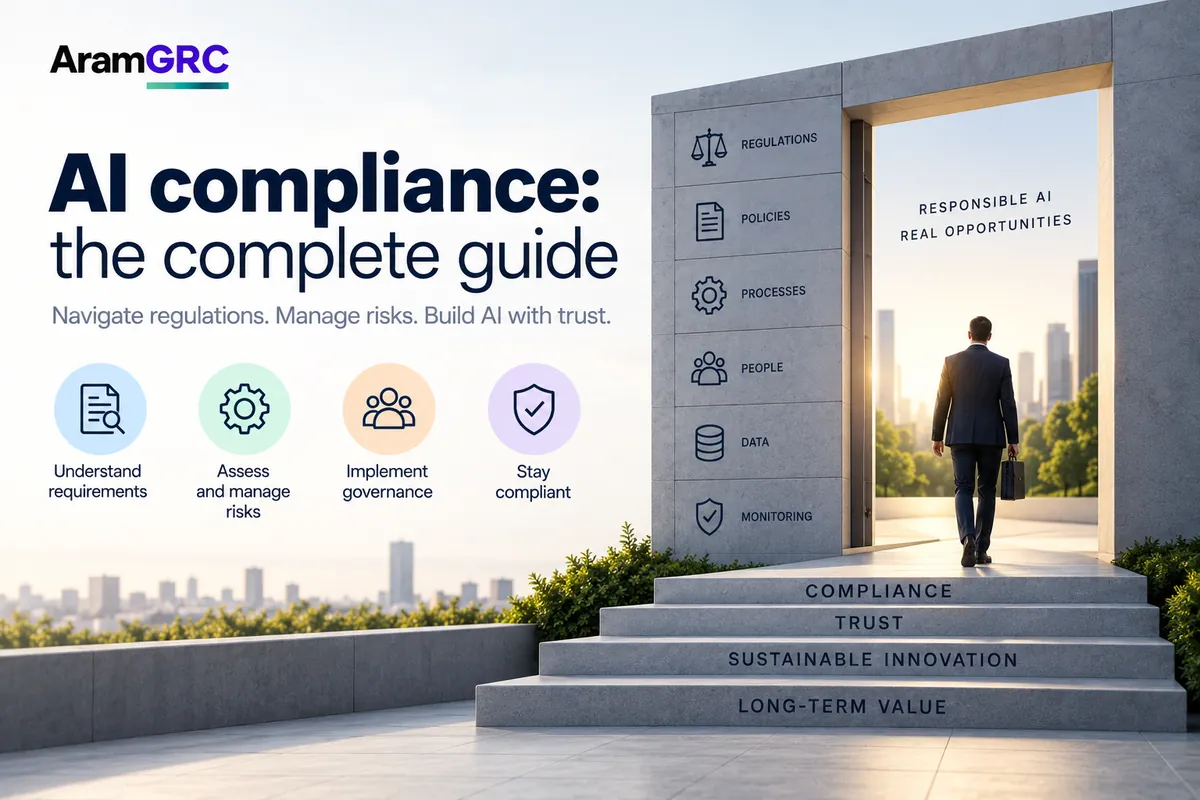
AI compliance means meeting the growing set of laws, regulations and standards that govern how AI is built and used. This guide explains what it covers, the key regulations and frameworks, and how to build an AI compliance program that satisfies several regimes at once. It's the broad companion to our guide to the EU AI Act and pairs with AI governance.
AramGRC Team·AI Compliance & Assurance·September 11, 2026·11 min read
What is AI compliance?
AI compliance is the practice of ensuring an organisation's AI systems meet the applicable legal, regulatory and standards requirements — from the EU AI Act and India's DPDP Act to ISO/IEC 42001 and sector rules. It covers knowing which obligations apply to each system, meeting them, and being able to prove it. As AI regulation multiplies, compliance is shifting from a legal afterthought to an operational discipline.
AI compliance vs AI governance
The two are closely linked. AI compliance is about meeting external rules; AI governance is the internal system — policies, roles, assessments and controls — that makes compliance happen consistently. Good AI governance is how you achieve AI compliance without reinventing the wheel for every new regulation.
The key AI regulations and frameworks
EU AI Act — the world's first comprehensive AI law, risk-based and extraterritorial. See our EU AI Act guide.
ISO/IEC 42001 — the certifiable international AI management system standard. See ISO 42001 certification.
NIST AI Risk Management Framework — a voluntary US framework (Govern, Map, Measure, Manage).
India: the DPDP Act, MeitY guidelines and RBI FREE-AI — India's data-protection and AI regime. See the DPDP Act and AI regulation in India.
US state laws and sector rules — e.g. Colorado's AI Act and sector regulators in finance, insurance and healthcare.
How to build an AI compliance program
Inventory your AI systems — you can't comply for what you can't see.
Map obligations — for each system, identify which regulations and standards apply.
Run a gap assessment — measure each system against those requirements.
Implement controls — risk and impact assessments, human oversight, transparency, security.
Build the evidence trail — documentation you can show regulators and buyers.
Monitor and update — compliance is continuous as systems and rules change.
AI compliance software and tools
A growing market of AI compliance and governance tools helps automate the inventory, assessments, control mapping and evidence. They're useful for scale — but software organises compliance, it doesn't make the judgement calls. The strongest programs pair tooling with expertise.
AI compliance certification
There are two kinds: organisational certification against ISO/IEC 42001 (independent proof your company governs AI), and professional credentials for individuals. See our guide to AI governance certification.
AI compliance for global companies
Organisations operating across regions face the EU AI Act, India's DPDP Act, US state laws and sector rules at once. The efficient answer is not one compliance project per regulation but one control framework — aligned to ISO/IEC 42001 and the NIST AI RMF — mapped to all of them. Govern once, evidence everywhere. Start with the EU AI Act compliance checklist.
Key takeaways
AI compliance is meeting the laws, regulations and standards that apply to your AI — and proving it.
The core regimes are the EU AI Act, ISO/IEC 42001, the NIST AI RMF, and India's DPDP Act and AI guidelines.
Build one control framework and map it to every regulation, rather than running parallel projects.
Software helps, but compliance still needs governance and expert judgement.
How AramGRC helps
AramGRC gives you a single AI compliance program mapped to the EU AI Act, ISO/IEC 42001, the NIST AI RMF and India's DPDP and sector rules — inventory, assessments, controls and audit-ready evidence, backed by expertise.
Frequently asked questions
What is AI compliance?+
Ensuring an organisation's AI systems meet the applicable laws, regulations and standards — the EU AI Act, ISO/IEC 42001, the NIST AI RMF, India's DPDP Act and sector rules — and being able to prove it.
What are the main AI regulations?+
The EU AI Act, ISO/IEC 42001 (a standard), the NIST AI RMF, India's DPDP Act and AI guidelines, and various US state laws and sector rules.
What is the difference between AI compliance and AI governance?+
AI compliance is meeting external rules; AI governance is the internal system of policies, roles and controls that makes compliance consistent and provable.
Is there AI compliance software?+
Yes — tools that automate AI inventory, risk and impact assessments, regulatory control mapping and evidence. They help at scale, but don't replace governance and expert judgement.
How do I make my AI compliant?+
Inventory your AI, map the obligations for each system, run a gap assessment, implement controls, keep an evidence trail, and monitor continuously — ideally on one control framework mapped to every regime you face.