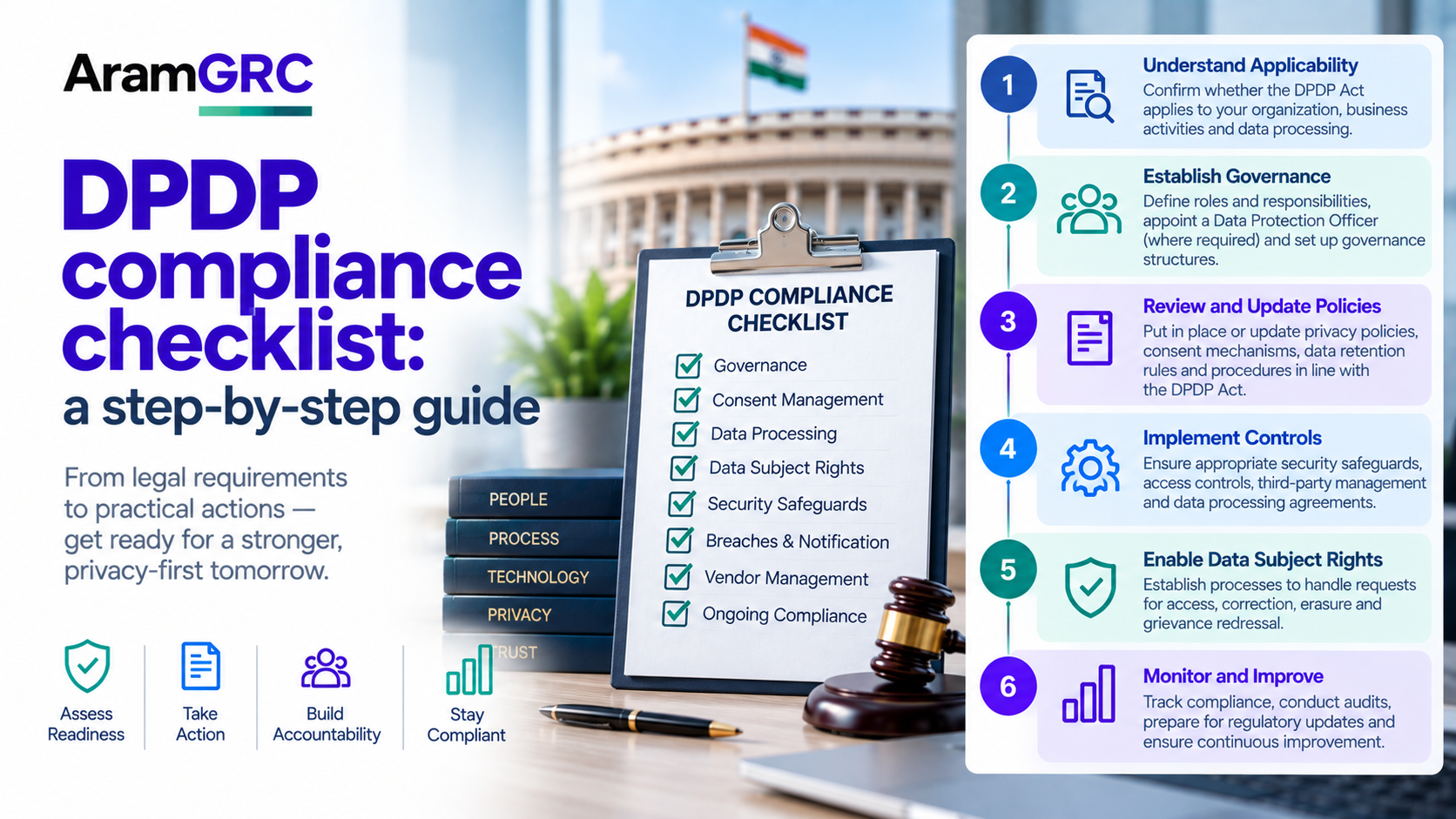
Becoming DPDP-compliant is a programme, not a policy update. This checklist walks the steps in the order you'd actually do them — from mapping your personal data to standing up consent, security and breach processes. Part of our guide to the DPDP Act.
AramGRC Team·Regulatory Readiness·September 10, 2026·9 min read
Before you start
Two things make DPDP compliance manageable: executive sponsorship (someone accountable, with budget) and a defined scope (which systems, data and business units are in play). A Data Fiduciary that treats this as a legal-only exercise will miss the operational work that actually creates compliance.
The DPDP compliance checklist
Map your personal data — build an inventory of every personal-data flow: what you collect, where it lives, which systems (including AI models) use it, and who you share it with.
Establish a lawful basis and rework consent — make consent clear, specific and withdrawable, and deploy an auditable consent-management mechanism across every touchpoint.
Update your privacy notices — clear, plain-language notices available in English and India's scheduled languages.
Set retention and deletion workflows — automated retention limits and a working process to honour erasure requests, including across backups and AI models.
Honour Data Principal rights — access, correction, erasure and a grievance-redress channel that actually reaches a person.
Implement reasonable security safeguards — encryption, access control, logging and monitoring appropriate to your risk.
Build breach detection and notification — the ability to detect a breach and notify the Board and affected individuals within the required timelines.
Handle children's data — verifiable parental consent, and no tracking or targeted advertising to children.
Appoint accountability — a grievance officer for everyone, and a Data Protection Officer in India if you're a Significant Data Fiduciary.
Keep auditable evidence — records of consent, decisions, controls and processing, because compliance you can't evidence is compliance the Board won't credit.
DPDP compliance for AI systems
AI adds steps most checklists miss: confirm every training dataset has a valid purpose and consent trail, quarantine data that doesn't, and design how a deletion request reaches a trained model. This is where DPDP and AI governance overlap.
From checklist to evidence
A checklist tells you what to do; the Board wants proof you did it. Turn each item into a documented artefact — your data map, consent records, retention policy, breach runbook and grievance log — so you can demonstrate compliance on demand.
How AramGRC helps
AramGRC runs a DPDP readiness assessment that maps your data across your AI and IT footprint, scores you against every obligation, and hands you a prioritised roadmap — so the checklist becomes a plan.
Frequently asked questions
What is DPDP compliance?+
The set of measures a Data Fiduciary implements to meet the DPDP Act — data mapping, consent and notices, retention and deletion, security, breach response, children's-data protection and accountability, all backed by evidence.
How do I become DPDP compliant?+
Map your personal data, fix consent and notices, set retention and deletion workflows, implement security, build breach notification, handle children's data, appoint a grievance officer (and a DPO if you're an SDF), and keep auditable records.
What is a Data Protection Officer under the DPDP Act?+
An India-based officer that Significant Data Fiduciaries must appoint to oversee data protection and act as the contact point for Data Principals and the Board.
Do small businesses need to comply with the DPDP Act?+
Yes — the Act applies regardless of size, though the government may relax certain obligations for startups and small entities by notification. The core duties around consent, security and rights still apply.