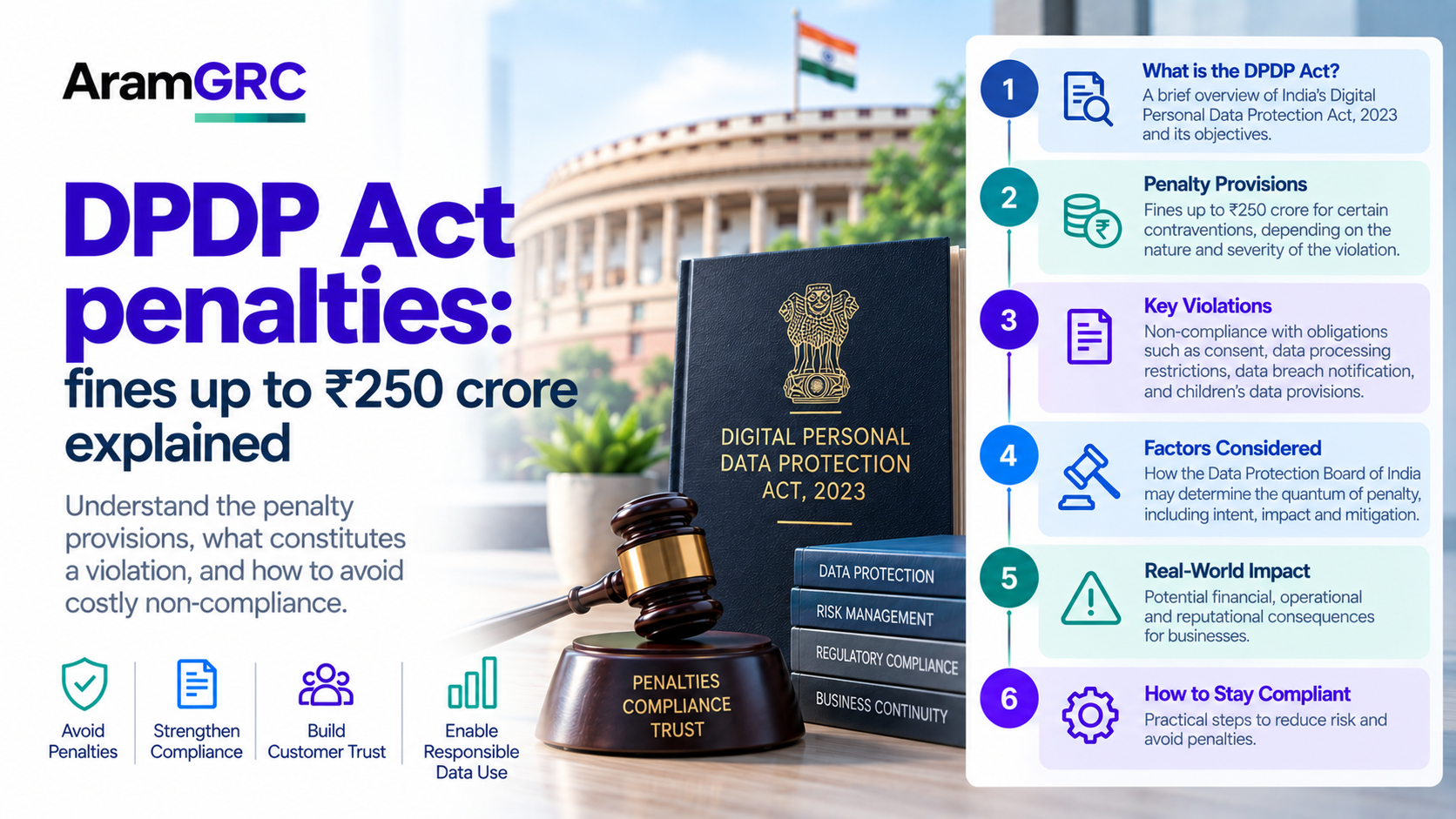
DPDP Act penalties: fines up to ₹250 crore explained
The DPDP Act carries some of the largest data-protection penalties in Asia — up to ₹250 crore per instance. This guide breaks down the full penalty schedule, who imposes the fines, how enforcement works, and how to reduce your exposure. Part of our guide to the DPDP Act.
AramGRC Team·Regulatory Readiness·September 10, 2026·8 min read
How DPDP Act penalties work
DPDP penalties are fixed-amount and assessed per instance of non-compliance — not linked to turnover like GDPR fines. They are imposed by the Data Protection Board of India after an inquiry, and a single incident can trigger more than one penalty category, which compounds the exposure.
The DPDP Act penalty schedule
The Act sets maximum penalties by type of violation:
Failure to take reasonable security safeguards to prevent a personal data breach — up to ₹250 crore.
Failure to notify a breach to the Board and affected Data Principals — up to ₹200 crore.
Non-compliance with children's-data obligations — up to ₹200 crore.
Breach of Significant Data Fiduciary obligations — up to ₹150 crore.
Non-compliance with the Data Protection Board's directions — up to ₹50 crore.
Breach of a Data Principal's duties — up to ₹10,000.
Who imposes penalties, and how
The Data Protection Board of India adjudicates. It can act on a complaint or on its own motion, conduct an inquiry, and impose a penalty from the schedule. Appeals go to the Telecom Disputes Settlement and Appellate Tribunal (TDSAT), with a further appeal to the Supreme Court on questions of law.
What the Board considers before fixing an amount
Penalties are maximums, not automatic. The Board weighs mitigating factors — the nature and gravity of the breach, whether you self-disclosed, the corrective action you took, your cooperation, and your prior compliance history. A prepared organisation with a breach runbook and evidence of good-faith compliance is treated very differently from one that ignored its obligations.
Why the real exposure is bigger than the headline
Two features make DPDP penalties sharper than the top-line number suggests: they're per instance, so a breach affecting many records can multiply, and a single failure can breach several categories at once (for example, a breach you failed to prevent and failed to notify). Add the reputational cost of a public Board order, and the case for getting ahead of compliance is clear.
How to reduce your penalty exposure
Implement genuine, documented security safeguards — the ₹250 crore category is the one to design out first.
Build and test a breach-notification runbook so you can meet the timelines.
Keep auditable evidence of consent, controls and decisions.
If a breach happens, self-disclose and act fast — cooperation and remediation are explicit mitigating factors.
How AramGRC helps
AramGRC helps you close the gaps that lead to the largest penalties — security safeguards, breach response and evidence — with a DPDP readiness assessment mapped to the specific obligations the Board enforces. See the compliance checklist.
Frequently asked questions
What are the penalties under the DPDP Act?+
Fixed-amount penalties assessed per instance, up to ₹250 crore for failing to prevent a data breach, ₹200 crore for breach-notification or children's-data failures, ₹150 crore for Significant Data Fiduciary breaches, ₹50 crore for ignoring Board directions, and ₹10,000 for Data Principal duty breaches.
What is the maximum fine under the DPDP Act?+
₹250 crore per instance, for failing to implement reasonable security safeguards to prevent a personal data breach.
Who imposes DPDP Act penalties?+
The Data Protection Board of India, after an inquiry. Appeals go to the TDSAT and then the Supreme Court on questions of law.
Are DPDP Act penalties based on turnover?+
No — unlike GDPR, DPDP penalties are fixed maximum amounts assessed per instance, not a percentage of turnover.
Can you appeal a DPDP penalty?+
Yes — to the Telecom Disputes Settlement and Appellate Tribunal (TDSAT), with a further appeal to the Supreme Court on questions of law.